Division of Pulmonary, Allergy, and Critical Care Medicine and the Department of Medicine, University of Pennsylvania Perelman School of Medicine, 3615 Civic Center Boulevard, Abramson Research Center, Office Suite 1016C, Philadelphia, PA 19104, USA.
Int J Mol Sci. 2016 Mar 1;17(3):322. doi: 10.3390/ijms17030322.
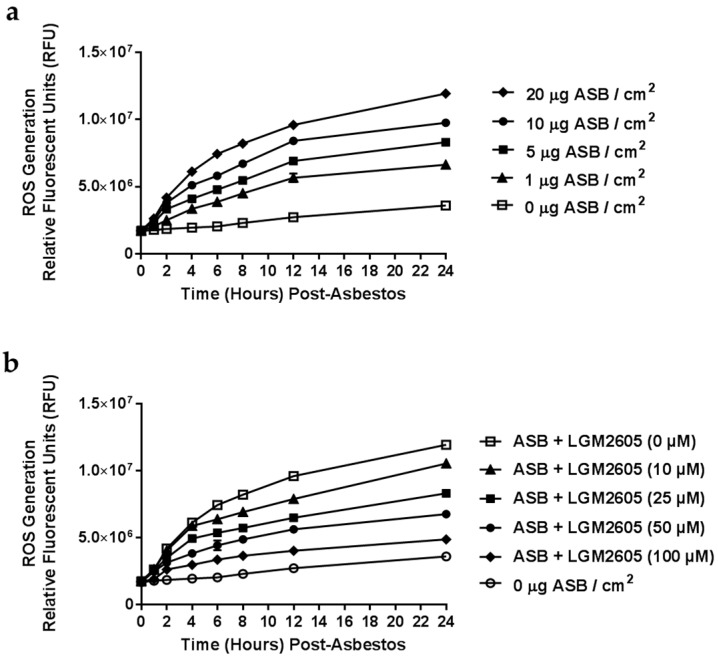
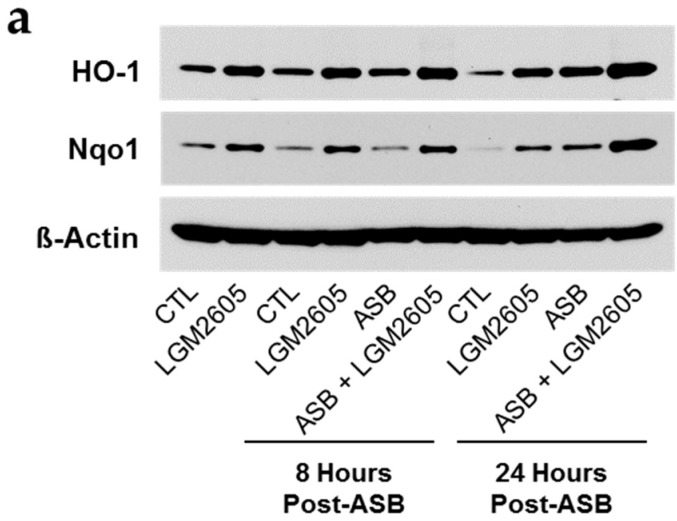
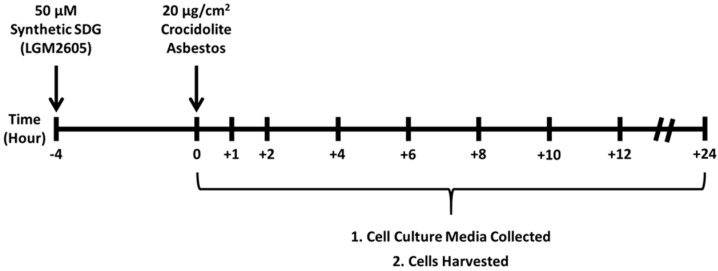
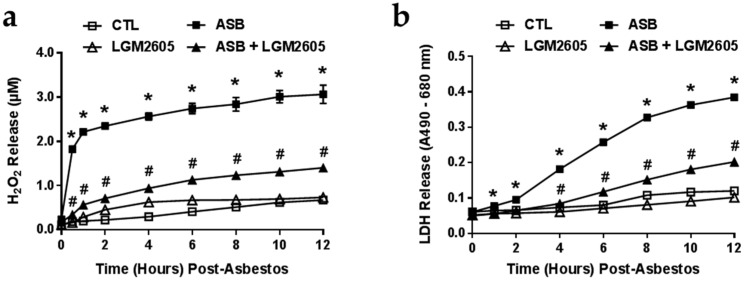
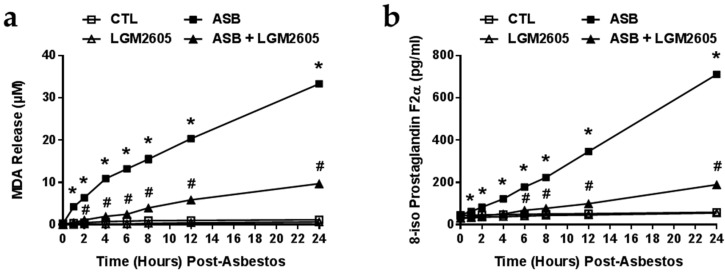
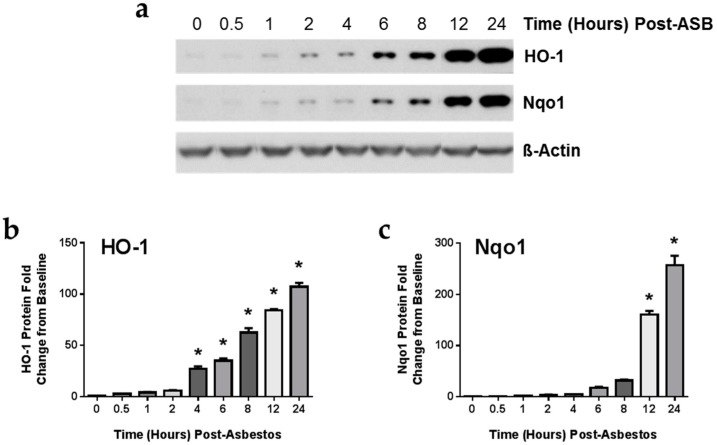
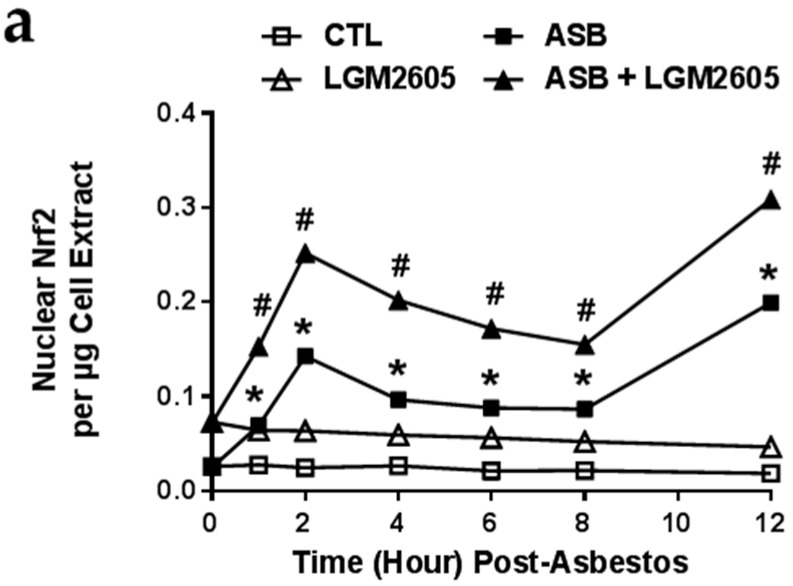
The interaction of asbestos fibers with macrophages generates harmful reactive oxygen species (ROS) and subsequent oxidative cell damage that are key processes linked to malignancy. Secoisolariciresinol diglucoside (SDG) is a non-toxic, flaxseed-derived pluripotent compound that has antioxidant properties and may thus function as a chemopreventive agent for asbestos-induced mesothelioma. We thus evaluated synthetic SDG (LGM2605) in asbestos-exposed, elicited murine peritoneal macrophages as an in vitro model of tissue phagocytic response to the presence of asbestos in the pleural space. Murine peritoneal macrophages (MFs) were exposed to crocidolite asbestos fibers (20 µg/cm²) and evaluated at various times post exposure for cytotoxicity, ROS generation, malondialdehyde (MDA), and levels of 8-iso Prostaglandin F2α (8-isoP). We then evaluated the ability of LGM2605 to mitigate asbestos-induced oxidative stress by administering LGM2605 (50 µM) 4-h prior to asbestos exposure. We observed a significant (p < 0.0001), time-dependent increase in asbestos-induced cytotoxicity, ROS generation, and the release of MDA and 8-iso Prostaglandin F2α, markers of lipid peroxidation, which increased linearly over time. LGM2605 treatment significantly (p < 0.0001) reduced asbestos-induced cytotoxicity and ROS generation, while decreasing levels of MDA and 8-isoP by 71%-88% and 41%-73%, respectively. Importantly, exposure to asbestos fibers induced cell protective defenses, such as cellular Nrf2 activation and the expression of phase II antioxidant enzymes, HO-1 and Nqo1 that were further enhanced by LGM2605 treatment. LGM2605 boosted antioxidant defenses, as well as reduced asbestos-induced ROS generation and markers of oxidative stress in murine peritoneal macrophages, supporting its possible use as a chemoprevention agent in the development of asbestos-induced malignant mesothelioma.
石棉纤维与巨噬细胞相互作用会产生有害的活性氧(ROS),随后发生氧化细胞损伤,这是与恶性肿瘤相关的关键过程。开环异落叶松脂醇二葡萄糖苷(SDG)是一种无毒的、源自亚麻籽的多功能化合物,具有抗氧化特性,因此可能作为石棉诱导的间皮瘤的化学预防剂。因此,我们在暴露于石棉的、诱发的小鼠腹腔巨噬细胞中评估了合成的 SDG(LGM2605),作为在胸膜腔内存在石棉时组织吞噬反应的体外模型。将小鼠腹腔巨噬细胞(MFs)暴露于青石棉纤维(20μg/cm²)中,并在暴露后不同时间点评估细胞毒性、ROS 生成、丙二醛(MDA)和 8-异前列腺素 F2α(8-isoP)的水平。然后,我们通过在暴露于石棉之前 4 小时给予 LGM2605(50μM)来评估 LGM2605 减轻石棉诱导的氧化应激的能力。我们观察到,石棉诱导的细胞毒性、ROS 生成以及 MDA 和 8-异前列腺素 F2α(脂质过氧化的标志物)的释放显著(p<0.0001),随时间呈时间依赖性增加,且呈线性增加。LGM2605 处理显著(p<0.0001)降低了石棉诱导的细胞毒性和 ROS 生成,同时使 MDA 和 8-isoP 的水平分别降低了 71%-88%和 41%-73%。重要的是,暴露于石棉纤维会诱导细胞保护防御机制,例如细胞 Nrf2 激活和 II 相抗氧化酶 HO-1 和 Nqo1 的表达,而 LGM2605 处理进一步增强了这些防御机制。LGM2605 增强了抗氧化防御能力,降低了石棉诱导的 ROS 生成和氧化应激标志物在小鼠腹腔巨噬细胞中的水平,支持其在预防石棉诱导的恶性间皮瘤发生中用作化学预防剂的可能性。