
体外诊断检测在医疗实践中的价值:一份现状报告。
The Value of In Vitro Diagnostic Testing in Medical Practice: A Status Report.
作者信息
Rohr Ulrich-Peter, Binder Carmen, Dieterle Thomas, Giusti Francesco, Messina Carlo Guiseppe Mario, Toerien Eduard, Moch Holger, Schäfer Hans Hendrik
机构信息
Roche Diagnostics, Sequencing Unit, Pleasanton, CA, 94588, United States of America.
Institute of Surgical Pathology, University Hospital Zurich, 8091, Zurich, Switzerland.
出版信息
PLoS One. 2016 Mar 4;11(3):e0149856. doi: 10.1371/journal.pone.0149856. eCollection 2016.
BACKGROUND
In vitro diagnostic (IVD) investigations are indispensable for routine patient management. Appropriate testing allows early-stage interventions, reducing late-stage healthcare expenditure (HCE).
AIM
To investigate HCE on IVDs in two developed markets and to assess the perceived value of IVDs on clinical decision-making. Physician-perceived HCE on IVD was evaluated, as well as desired features of new diagnostic markers.
METHODS
Past and current HCE on IVD was calculated for the US and Germany. A total of 79 US/German oncologists and cardiologists were interviewed to assess the number of cases where: physicians ask for IVDs; IVDs are used for initial diagnosis, treatment monitoring, or post-treatment; and decision-making is based on an IVD test result. A sample of 201 US and German oncologists and cardiologists was questioned regarding the proportion of HCE they believed to be attributable to IVD testing. After disclosing the actual IVD HCE, the physician's perception of the appropriateness of the amount was captured. Finally, the association between physician-rated impact of IVD on decision-making and perceived contribution of IVD expenditure on overall HCE was assessed.
RESULTS
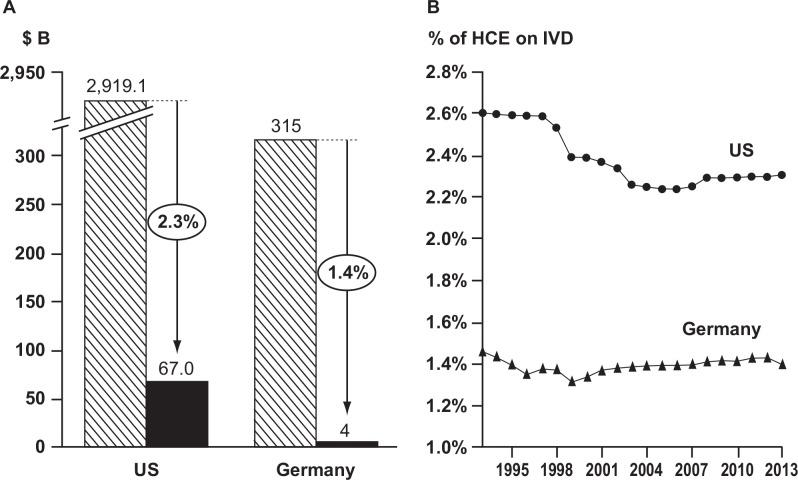
IVD costs account for 2.3% and 1.4% of total HCE in the US and Germany. Most physicians (81%) believed that the actual HCE on IVDs was >5%; 19% rated the spending correctly (0-4%, p<0.001). When informed of the actual amount, 64% of physicians rated this as appropriate (p<0.0001); 66% of decision-making was based on IVD. Significantly, more physicians asked for either additional clinical or combined clinical/health economic data than for the product (test/platform) alone (p<0.0001).
CONCLUSIONS
Our results indicate a poor awareness of actual HCE on IVD, but a high attributable value of diagnostic procedures for patient management. New markers should deliver actionable and medically relevant information, to guide decision-making and foster improved patient outcomes.
背景
体外诊断(IVD)检查对于患者的常规管理不可或缺。适当的检测有助于早期干预,减少后期医疗保健支出(HCE)。
目的
调查两个发达市场中IVD的医疗保健支出,并评估IVD在临床决策中的感知价值。评估了医生对IVD的医疗保健支出感知,以及新型诊断标志物的期望特征。
方法
计算了美国和德国过去及当前IVD的医疗保健支出。共采访了79位美国/德国肿瘤学家和心脏病学家,以评估以下情况的病例数:医生要求进行IVD检查;IVD用于初始诊断、治疗监测或治疗后;以及决策基于IVD检测结果。对201位美国和德国肿瘤学家及心脏病学家进行抽样询问,了解他们认为可归因于IVD检测的医疗保健支出比例。在披露实际的IVD医疗保健支出后,了解医生对该金额适当性的看法。最后,评估医生对IVD对决策影响的评分与IVD支出对总体医疗保健支出的感知贡献之间的关联。
结果
在美国和德国,IVD成本分别占总医疗保健支出的2.3%和1.4%。大多数医生(81%)认为IVD的实际医疗保健支出>5%;19%的医生对支出的评估正确(0-4%,p<0.001)。在得知实际金额后,64%的医生认为这是适当的(p<0.0001);66%的决策基于IVD。值得注意的是,要求提供额外临床数据或临床/卫生经济联合数据的医生明显多于仅要求提供产品(检测/平台)的医生(p<0.0001)。
结论
我们的结果表明,医生对IVD实际医疗保健支出的认识不足,但诊断程序对患者管理具有较高的归因价值。新型标志物应提供可操作且与医学相关的信息,以指导决策并促进改善患者预后。


 Zotero 插件