Hosaka Akihiro, Kato Masaaki, Motoki Manabu, Sugai Hiroko, Okubo Nobukazu
From the Department of Surgery, Tokyo Metropolitan Tama Medical Center, Tokyo (AH), and Department of Cardiovascular Surgery, Morinomiya Hospital, Osaka (MK, MM, HS, NO), Japan.
Medicine (Baltimore). 2016 Mar;95(9):e2863. doi: 10.1097/MD.0000000000002863.
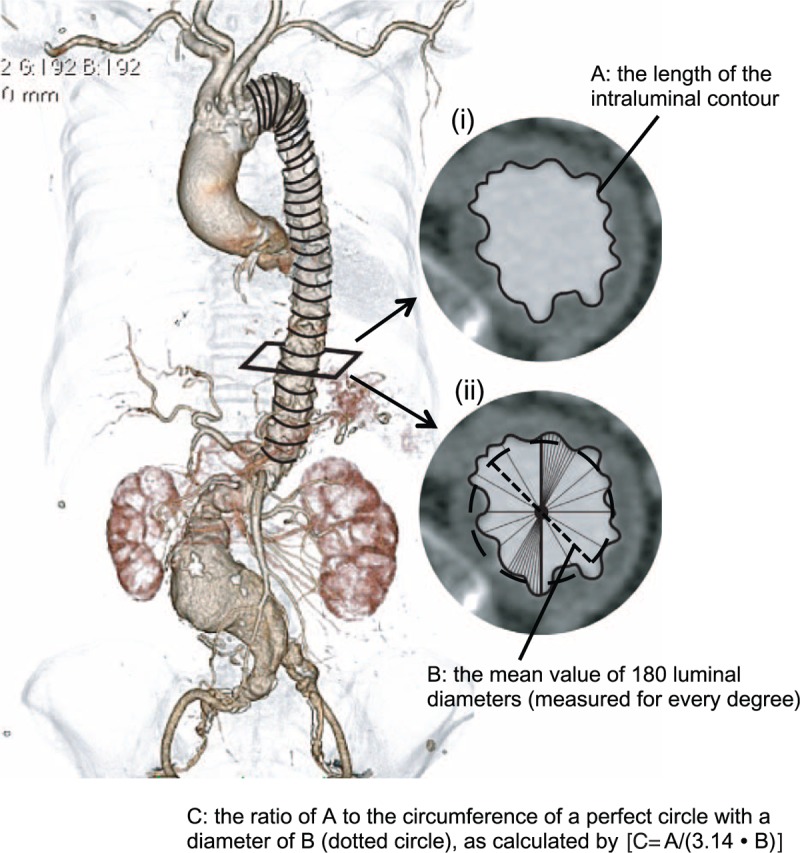
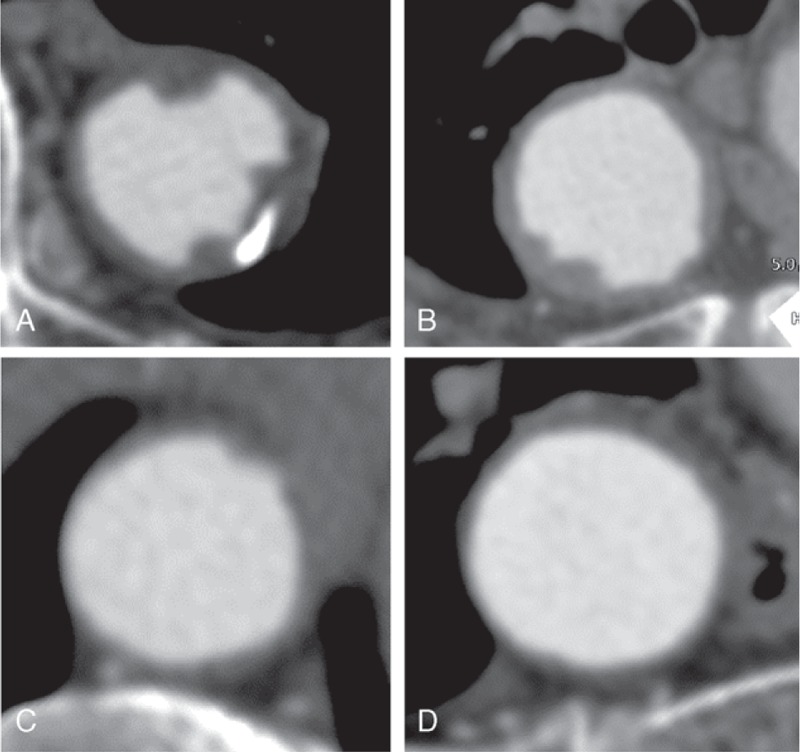
Atheromatous degeneration of the aorta is considered to be a risk factor for postoperative embolic complications after endovascular treatment, and is associated with a high incidence of vascular events in the long term. We devised a method to quantify the shagginess of the aorta using contrast-enhanced computed tomography (CT) images. This study examined the method's validity and prognostic usefulness in patients undergoing elective endovascular abdominal aortic aneurysm repair (EVAR). We retrospectively investigated 427 patients who underwent elective EVAR between 2007 and 2013. Preoperative contrast-enhanced CT images with a slice thickness of 1 mm were analyzed using a workstation, and the degree of aortic luminal irregularity from the level of the left subclavian artery ostium to that of the celiac artery ostium was quantified by computing a shagginess score. We compared the computed scores with subjective visual assessments of aortic shagginess. Subsequently, we evaluated the relationship between the computed scores and postoperative prognosis. The shagginess scores were significantly correlated with the visual assessments of the aortic lumen, which were performed by 5 experienced vascular surgeons (rho ranged from 0.564-0.654, all P < 0.001). Multiple logistic regression analysis demonstrated that the shagginess score was independently associated with the development of renal impairment within a month after EVAR (odds ratio, 2.78; 95% confidence interval [CI], 1.83-4.22, P < 0.001). The shagginess score was significantly higher in patients who suffered postoperative intestinal and peripheral ischemic complications, as compared with those who did not (P < 0.001). The mean postoperative follow-up period was 1207 ± 641 days. Cox proportional hazards regression showed that the shagginess score was a significant independent predictor of all-cause and cardiovascular mortality (hazard ratio [HR], 1.37; 95% CI, 1.09-1.72, P = 0.007, and HR, 1.51; 95% CI, 1.04-2.18, P = 0.030, respectively). The results suggest that the shagginess score provides a quantitative reflection of aortic luminal irregularity. It may serve as a useful predictive factor for postoperative renal function deterioration, embolic complications, and long-term mortality after elective EVAR.
主动脉粥样硬化变性被认为是血管内治疗术后栓塞并发症的一个危险因素,并且与长期血管事件的高发生率相关。我们设计了一种利用对比增强计算机断层扫描(CT)图像来量化主动脉表面粗糙程度的方法。本研究检验了该方法在接受择期血管内腹主动脉瘤修复术(EVAR)患者中的有效性及预后预测价值。我们回顾性调查了2007年至2013年间接受择期EVAR的427例患者。使用工作站分析术前层厚为1毫米的对比增强CT图像,并通过计算表面粗糙程度评分来量化从左锁骨下动脉开口水平至腹腔干动脉开口水平的主动脉管腔不规则程度。我们将计算得到的评分与对主动脉表面粗糙程度的主观视觉评估进行比较。随后,我们评估了计算得到的评分与术后预后之间的关系。表面粗糙程度评分与由5名经验丰富的血管外科医生进行的主动脉管腔视觉评估显著相关(rho范围为0.564 - 0.654,所有P < 0.001)。多因素逻辑回归分析表明,表面粗糙程度评分与EVAR术后1个月内肾功能损害的发生独立相关(比值比,2.78;95%置信区间[CI],1.83 - 4.22,P < 0.001)。与未发生术后肠道及外周缺血并发症的患者相比,发生这些并发症的患者表面粗糙程度评分显著更高(P < 0.001)。术后平均随访期为1207 ± 641天。Cox比例风险回归显示,表面粗糙程度评分是全因死亡率和心血管死亡率的显著独立预测因素(风险比[HR],1.37;95% CI,1.09 - 1.72,P = 0.007,以及HR,1.51;95% CI,1.04 - 2.18,P = 0.030)。结果表明,表面粗糙程度评分可定量反映主动脉管腔不规则程度。它可能是择期EVAR术后肾功能恶化、栓塞并发症及长期死亡率的一个有用预测因素。