Galindo-Izquierdo María, Rodriguez-Almaraz Esther, Pego-Reigosa José M, López-Longo Francisco J, Calvo-Alén Jaime, Olivé Alejandro, Fernández-Nebro Antonio, Martinez-Taboada Víctor, Vela-Casasempere Paloma, Freire Mercedes, Narváez Francisco J, Rosas José, Ibáñez-Barceló Mónica, Uriarte Esther, Tomero Eva, Zea Antonio, Horcada Loreto, Torrente Vicenç, Castellvi Iván, Calvet Joan, Menor-Almagro Raúl, Zamorano María A Aguirre, Raya Enrique, Díez-Álvarez Elvira, Vázquez-Rodríguez Tomás, García de la Peña Paloma, Movasat Atusa, Andreu José L, Richi Patricia, Marras Carlos, Montilla-Morales Carlos, Hernández-Cruz Blanca, Marenco de la Fuente José L, Gantes María, Úcar Eduardo, Alegre-Sancho Juan J, Manero Javier, Ibáñez-Ruán Jesús, Rodríguez-Gómez Manuel, Quevedo Víctor, Hernández-Beriaín José, Silva-Fernández Lucía, Alonso Fernando, Pérez Sabina, Rúa-Figueroa Iñigo
From the Rheumatology Department, Hospital 12 Octubre, Madrid (MG-I, ER-A); Rheumatology (JMP-R), University Hospital Complex, Instituto de Investigación Biomédica, Vigo, Spain; Rheumatology Department (FJL-L), Gregorio Marañón University Hospital, Madrid; Rheumatology Department (JC-A), Sierrallana Hospital, Torrelavega; Rheumatology Department (AO), Germans Trías i Pujol University Hospital, Badalona; Rheumatology Department (AF-N), Hospital Regional Universitario de Málaga, Málaga; Rheumatology Department (VM-T), Marques de Valdecilla Hospital, Santander; Rheumatology Department (PV-C), Hospital General de Alicante, Alicante; Rheumatology Department (MF), Hospital Universitario Juan Canalejo, Coruña; Rheumatology Department (FJN), Hospital Universitario de Bellvitge, Barcelona; Rheumatology Department (JR), Hospital Marina Baixa, Villajoyosa; Rheumatology Department (MI-B), Hospital Son Llatzer, Palma de Mallorca; Rheumatology Department (EU), Hospital de Donosti, San Sebastián; Rheumatology Department (ET), Hospital Universitario de La Princesa; Rheumatology Department (AZ), Hospital Universitario Ramón y Cajal, Madrid; Rheumatology Department (LH), Complejo Hospitalario de Navarra, Pamplona; Rheumatology Department (VT), Hospital Moisés Broggi; Rheumatology Department (IC), Hospital de la Santa Creu i Sant Pau, Barcelona; Rheumatology Department (JC), Hospital Parc Taulí. Sabadell; Rheumatology Department (RM-A), Hospital de Jerez, Jerez de la Frontera; Rheumatology Department (MAAZ), IMIBIC-Reina Sofia Hospital, Cordoba; Rheumatology Department (ER), University Hospital San Cecilio, Granada; Rheumatology Department (ED-Á), Leon Hospital, Leon; Rheumatology Department (TV-R), Hospital Lucus Augusti, Lugo; Rheumatology Department (PGDlP), Hospital Norte Sanchinarro, Madrid; Rheumatology Department (AM), Hospital Universitario Príncipe de Asturias, Alcalá de Henares; Rheumatology Department (JLA), Hospital Puerta de Hierro, Majadahonda, Madrid; Rheumatology Department (PR), Hospital Infanta Sofía, San Sebastián de los Reyes, Madrid; Rheumatology Department (CM), Hospital Virgen de la Arrixaca, Murcia, Spain; Rheumatology Department (CM-M), Hospital Clínico Universitario de Salamanca, Salamanca; Rheumatology Department (BH-C), University Hospital Virgen Macarena; Rheumatology Department (JLMDlF), Hospital de Valme, Sevilla; Rheumatology Department (MG), Hospital Universitario de Canarias, Tenerife; Rheumatology Department (EÚ), Hospital de Basurto, Bilbao; Rheumatology Department (JJA-S), Hospital Universitario Dr Peset, Valencia; Rheumatology Department (JM), Hospital Miguel Servet Zaragoza; Rheumatology Department (JI-R), Clínica POVISA, Vigo; Rheumatology Department (MR-G), Complejo Hospitalario Universitario de Ourense, Ourense; Rheumatology Department (VQ), Hospital de Monforte, Lugo; Rheumatology Department (JH-B), Hospital Insular de Gran Canaria, Las Palmas de Gran Canaria; Rheumatology Department (LSF), Hospital Universitario de Guadalajara, Guadalajara; Statistical Department (FA, SP), Research Unit, Spanish Society of Rheumatology (SER), Madrid; and Rheumatology Department (IR-F), Doctor Negrín University Hospital, Gran Canaria, Spain.
Medicine (Baltimore). 2016 Mar;95(9):e2891. doi: 10.1097/MD.0000000000002891.
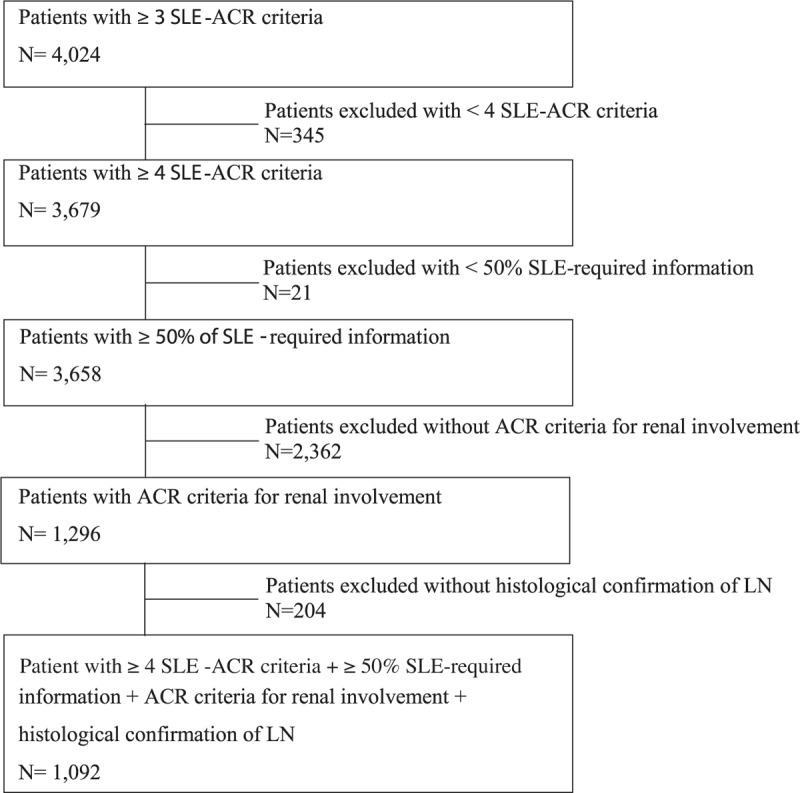
The aim of the study was to profile those patients included in the RELESSER registry with histologically proven renal involvement in order to better understand the current state of lupus nephritis (LN) in Spain. RELESSER-TRANS is a multicenter cross-sectional registry with an analytical component. Information was collected from the medical records of patients with systemic lupus erythematosus who were followed at participating rheumatology units. A total of 359 variables including demographic data, clinical manifestations, disease activity, severity, comorbidities, LN outcome, treatments, and mortality were recorded. Only patients with a histological confirmation of LN were included. We performed a descriptive analysis, chi-square or Student's t tests according to the type of variable and its relationship with LN. Odds ratio and confidence intervals were calculated by using simple logistic regression. LN was histologically confirmed in 1092/3575 patients (30.5%). Most patients were female (85.7%), Caucasian (90.2%), and the mean age at LN diagnosis was 28.4 ± 12.7 years. The risk for LN development was higher in men (M/F:47.85/30.91%, P < 0.001), in younger individuals (P < 0.001), and in Hispanics (P = 0.03). Complete response to treatment was achieved in 68.3% of patients; 10.35% developed ESRD, which required a kidney transplant in 45% of such cases. The older the patient, the greater was the likelihood of complete response (P < 0.001). Recurrences were associated with persistent lupus activity at the time of the last visit (P < 0.001) and with ESRD (P < 0.001). Thrombotic microangiopathy was a risk factor for ESRD (P = 0.04), as for the necessity of dialysis (P = 0.01) or renal transplantation (P = 0.03). LN itself was a poor prognostic risk factor of mortality (OR 2.4 [1.81-3.22], P < 0.001). Patients receiving antimalarials had a significantly lower risk of developing LN (P < 0.001) and ESRD (P < 0.001), and responded better to specific treatments for LN (P = 0.014). More than two-thirds of the patients with LN from a wide European cohort achieved a complete response to treatment. The presence of positive anti-Sm antibodies was associated with a higher frequency of LN and a decreased rate of complete response to treatment. The use of antimalarials reduced both the risk of developing renal disease and its severity, and contributed to attaining a complete renal response.
该研究的目的是对RELESSER注册中心中组织学确诊有肾脏受累的患者进行分析,以便更好地了解西班牙狼疮性肾炎(LN)的现状。RELESSER-TRANS是一个具有分析成分的多中心横断面注册研究。从参与研究的风湿病科所随访的系统性红斑狼疮患者的病历中收集信息。共记录了359个变量,包括人口统计学数据、临床表现、疾病活动度、严重程度、合并症、LN结局、治疗情况和死亡率。仅纳入组织学确诊为LN的患者。我们根据变量类型及其与LN的关系进行了描述性分析、卡方检验或Student t检验。采用简单逻辑回归计算比值比和置信区间。1092/3575例患者(30.5%)经组织学确诊为LN。大多数患者为女性(85.7%)、白种人(90.2%),LN诊断时的平均年龄为28.4±12.7岁。男性发生LN的风险更高(男/女:47.85%/30.91%,P<0.001),年轻人中风险更高(P<0.001),西班牙裔中风险更高(P=0.03)。68.3%的患者治疗后完全缓解;10.35%发展为终末期肾病(ESRD),其中45%的此类病例需要进行肾移植。患者年龄越大,完全缓解的可能性越大(P<0.001)。复发与最后一次就诊时狼疮活动持续存在相关(P<0.001),也与ESRD相关(P<0.001)。血栓性微血管病是ESRD的危险因素(P=0.04),也是透析必要性(P=0.01)或肾移植必要性(P=0.03)的危险因素。LN本身是死亡率的不良预后危险因素(比值比2.4[1.81 - 3.22],P<0.001)。接受抗疟药治疗的患者发生LN(P<0.001)和ESRD的风险显著降低(P<0.001),对LN特异性治疗的反应更好(P=0.014)。来自广泛欧洲队列的超过三分之二的LN患者治疗后完全缓解。抗Sm抗体阳性与LN发生率较高及治疗后完全缓解率降低相关。使用抗疟药可降低发生肾脏疾病的风险及其严重程度,并有助于实现完全肾脏缓解。