Azhari Shirzad, Azimi Parisa, Shahzadi Sohrab, Mohammadi Hassan Reza, Khayat Kashani Hamid Reza
Department of Neurosurgery, Shahid Beheshti University of Medical Sciences, Tehran, Iran.
Asian Spine J. 2016 Feb;10(1):136-42. doi: 10.4184/asj.2016.10.1.136. Epub 2016 Feb 16.
Cross-sectional.
To develop a strategy to determine a sound method for decision-making based on postoperative clinical outcome satisfaction.
The ideal management of thoracolumbar and lumbar burst fractures (TLBF) without neurological compromise remains controversial.
This was a prospective study. Patients with thoracolumbar injury severity and classification score (TLICS) <4 were treated nonoperatively, with bed rest and bracing until the pain decreased sufficiently to allow mobilization. Surgery was undertaken in patients with intractable pain despite an appropriate nonoperative treatment (surgery group). The Oswestry disability index (ODI) measure was observed at baseline and at the last follow-up. Clinically success was defined at least a 30% improvement from the baseline ODI scores in both the conservative and surgery groups. All case records were assessed for gender, age, residual canal and angulations at the site of the fracture in order to determine which patients benefited from surgery or conservative treatment and which did not.
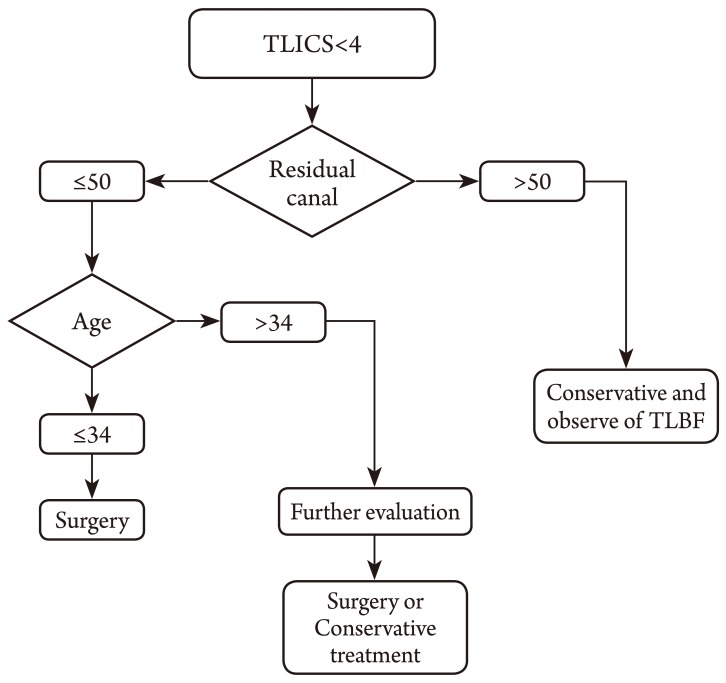
In all 113 patients with T11-L5, TLBFs were treated. The patients' mean age was 49.2 years. Patients successfully completed either nonoperative (n=99) or surgical (n=14) treatment based on ODI. Clinical examinations revealed that all of the patients had intact neurology. The mean follow-up period was 29.5 months. There was a significant difference between the two groups based on age and residual canal. The mean ODI score significantly improved for both groups (p <0.01). According to the findings, a decision matrix was proposed.
The findings confirm that TLICS <4, age, and residual canal can be used to guide the treatment of TLBF in conservative decision-making.
横断面研究。
制定一种基于术后临床结果满意度来确定合理决策方法的策略。
对于无神经损伤的胸腰椎爆裂骨折(TLBF)的理想治疗方法仍存在争议。
这是一项前瞻性研究。胸腰椎损伤严重程度和分类评分(TLICS)<4的患者接受非手术治疗,卧床休息并佩戴支具,直至疼痛充分减轻以允许活动。尽管进行了适当的非手术治疗但仍有顽固性疼痛的患者接受手术治疗(手术组)。在基线和最后一次随访时观察奥斯威斯利功能障碍指数(ODI)测量值。保守治疗组和手术治疗组的临床成功定义为ODI评分较基线至少提高30%。评估所有病例记录的性别、年龄、骨折部位的残余椎管和角度,以确定哪些患者从手术或保守治疗中获益,哪些患者没有获益。
共治疗了113例T11-L5的TLBF患者。患者的平均年龄为49.2岁。患者根据ODI成功完成了非手术治疗(n=99)或手术治疗(n=14)。临床检查显示所有患者神经功能均正常。平均随访期为29.5个月。两组在年龄和残余椎管方面存在显著差异。两组的平均ODI评分均显著改善(p<0.01)。根据研究结果,提出了一个决策矩阵。
研究结果证实,TLICS<4、年龄和残余椎管可用于指导胸腰椎爆裂骨折保守治疗的决策。