Dubinsky Marla C, Rosh Joel, Faubion William A, Kierkus Jaroslaw, Ruemmele Frank, Hyams Jeffrey S, Eichner Samantha, Li Yao, Huang Bidan, Mostafa Nael M, Lazar Andreas, Thakkar Roopal B
*Pediatric Gastroenterology and Hepatology, Icahn School of Medicine at Mount Sinai, New York, New York; †Division of Gastroenterology and Nutrition, Goryeb Children's Hospital/Atlantic Health, Morristown, New Jersey; ‡Gastroentrology and Hepatology, Mayo Clinic, Rochester, Minnesota; §Department of Gastroenterology, Hepatology and Feeding Disorders, Children's Memorial Health Institute, Warsaw, Poland; ‖Faculté de Médecine, Universite Paris Descartes, Sorbonne Paris-Cite and Department of Paediatric Gastroenterology, APHP Hopital Necker-Enfants Malades, Paris, France; ¶Digestive Diseases, Hepatology and Nutrition, Connecticut Children's Medical Center, Hartford, Connecticut; **US Medical Affairs, AbbVie Inc., North Chicago, Illinois; ††Data and Statistical Sciences, AbbVie Inc., North Chicago, Illinois; ‡‡Clinical Pharmacology & Pharmacometrics, AbbVie Inc., North Chicago, Illinois; §§AbbVie Deutschland GmbH & Co. KG, Ludwigshafen, Germany; and ‖‖Global Regulatory Affairs, AbbVie Inc., North Chicago, Illinois.
Inflamm Bowel Dis. 2016 Apr;22(4):886-93. doi: 10.1097/MIB.0000000000000715.
The efficacy of adalimumab in inducing and maintaining remission in children with moderately to severely active Crohn's disease was shown in the IMAgINE 1 trial (NCT00409682). As per protocol, nonresponders or patients experiencing flare(s) on every other week (EOW) maintenance dosing could escalate to weekly dosing; we aimed to determine the therapeutic benefits of weekly dose escalation in this subpopulation.
Week 52 remission and response rates were assessed in patients who escalated to weekly dosing from their previous EOW schedule, which was according to randomized treatment dose (higher dose [HD] adalimumab [≥40 kg, 40 mg EOW; <40 kg, 20 mg EOW] or lower dose [LD; ≥40 kg, 20 mg EOW; <40 kg, 10 mg EOW]). Adverse events were reported for patients remaining on EOW dosing and patients receiving weekly dosing.
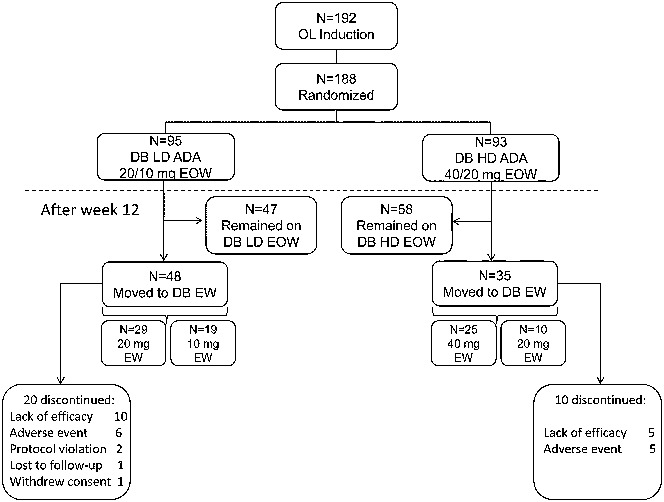
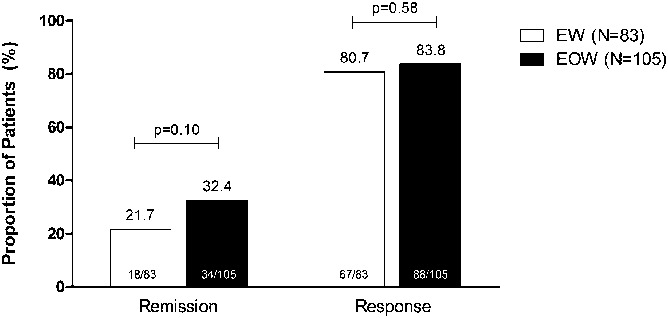
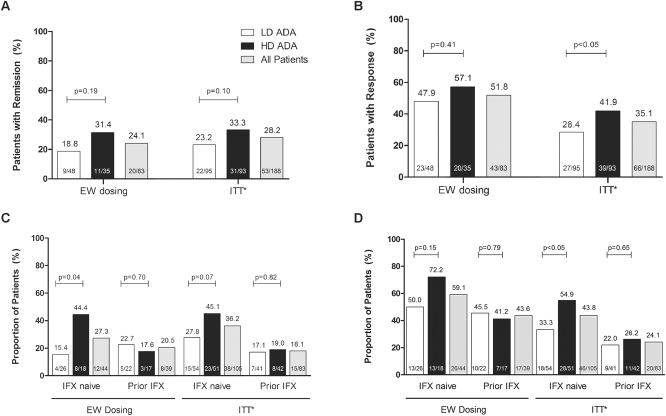
Escalation to weekly dosing occurred in 48/95 (50.5%) patients randomized to LD and 35/93 (37.6%) patients randomized to HD adalimumab (P = 0.076). Week 52 remission and response rates were 18.8% and 47.9% for patients receiving LD adalimumab weekly and 31.4% and 57.1% for patients receiving HD adalimumab weekly, respectively (LD versus HD, P = 0.19 for remission; P = 0.41 for response). Adverse event rates were similar for patients receiving EOW and weekly adalimumab.
Weekly adalimumab dosing was clinically beneficial for children with Crohn's disease who experienced nonresponse or flare on EOW dosing. No increased safety risks were observed with weekly dosing.
在IMAgINE 1试验(NCT00409682)中已证实阿达木单抗在诱导和维持中度至重度活动性克罗恩病儿童缓解方面的疗效。根据方案,无反应者或在每两周一次(EOW)维持给药时出现病情复发的患者可升级为每周给药;我们旨在确定在这一亚组人群中每周剂量升级的治疗益处。
对从之前的EOW给药方案升级为每周给药的患者进行第52周缓解率和反应率评估,之前的EOW给药方案是根据随机治疗剂量(高剂量[HD]阿达木单抗[≥40 kg,EOW 40 mg;<40 kg,EOW 20 mg]或低剂量[LD;≥40 kg,EOW 20 mg;<40 kg,EOW 10 mg])。报告了继续接受EOW给药的患者和接受每周给药的患者的不良事件。
随机分配至LD的95例患者中有48例(50.5%)升级为每周给药,随机分配至HD阿达木单抗的93例患者中有35例(37.6%)升级为每周给药(P = 0.076)。接受LD阿达木单抗每周给药的患者第52周缓解率和反应率分别为18.8%和47.9%,接受HD阿达木单抗每周给药的患者分别为31.4%和57.1%(LD与HD相比,缓解率P = 0.19;反应率P = 0.41)。接受EOW和每周一次阿达木单抗治疗的患者不良事件发生率相似。
对于在EOW给药时无反应或病情复发的克罗恩病儿童,每周一次阿达木单抗给药具有临床益处。每周给药未观察到安全性风险增加。