Bria E, Pilotto S, Simbolo M, Fassan M, de Manzoni G, Carbognin L, Sperduti I, Brunelli M, Cataldo I, Tomezzoli A, Mafficini A, Turri G, Karachaliou N, Rosell R, Tortora G, Scarpa A
Medical Oncology, Azienda Ospedaliera Universitaria Integrata, University of Verona, Verona, Italy.
ARC-NET Applied Research on Cancer Center, University of Verona, Verona, Italy.
Sci Rep. 2016 Mar 10;6:22982. doi: 10.1038/srep22982.
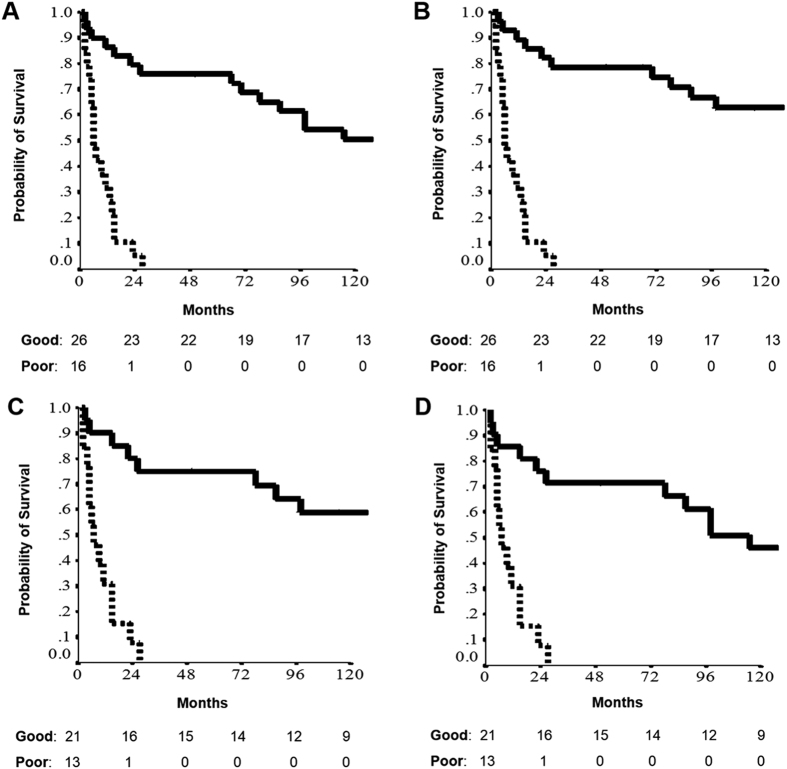
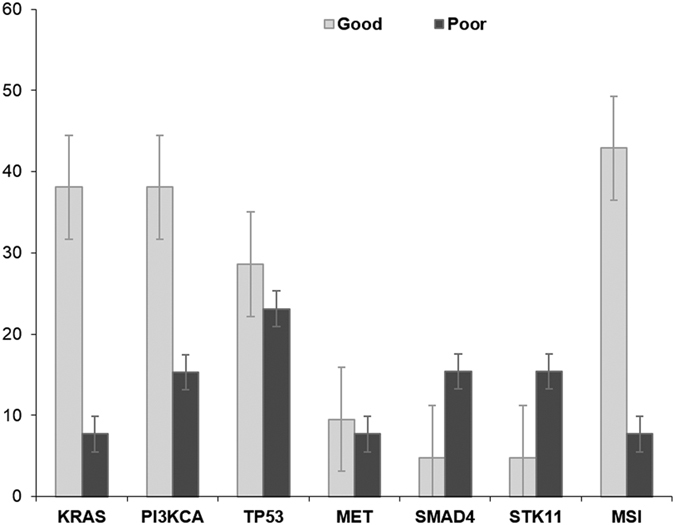
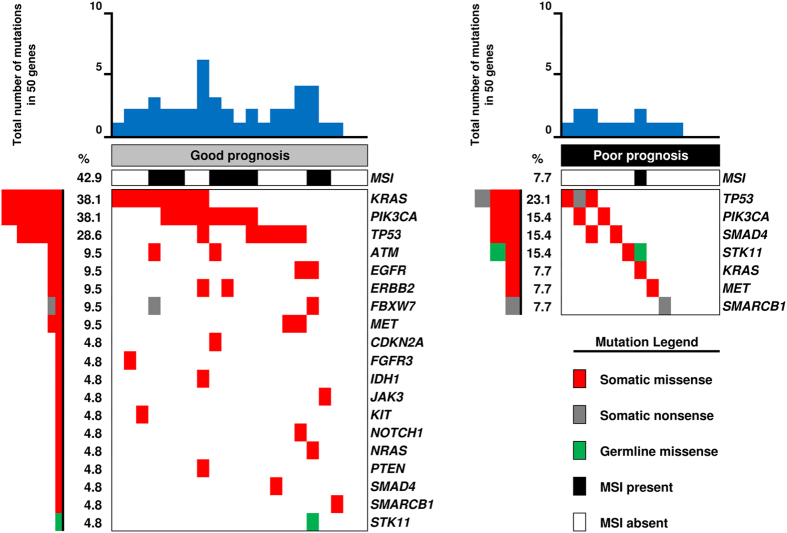
In this study, we evaluated whether the presence of genetic alterations detected by next generation sequencing may define outcome in a prognostically-selected and histology-restricted population of resected gastric cancer (RGC). Intestinal type RGC samples from 34 patients, including 21 best and 13 worst prognostic performers, were studied. Mutations in 50 cancer-associated genes were evaluated. A significant difference between good and poor prognosis was found according to clinico-pathologic factors. The most commonly mutated genes in the whole population were PIK3CA (29.4%), KRAS (26.5%), TP53 (26.5%) MET (8.8%), SMAD4 (8.8%) and STK11 (8.8%). Multiple gene mutations were found in 14/21 (67%) patients with good prognosis, and 3/13 (23%) in the poor prognosis group. A single gene alteration was found in 5/21 (24%) good and 6/13 (46%) poor prognosis patients. No mutation was found in 2/21 (9.5%) and 4/13 (31%) of these groups, respectively. In the overall series, ß-catenin expression was the highest (82.4%), followed by E-Cadherin (76.5%) and FHIT (52.9%). The good prognosis group was characterized by a high mutation rate and microsatellite instability. Our proof-of-principle study demonstrates the feasibility of a molecular profiling approach with the aim to identify potentially druggable pathways and drive the development of customized therapies for RGC.
在本研究中,我们评估了通过下一代测序检测到的基因改变是否可以在经过预后选择且组织学受限的切除性胃癌(RGC)人群中定义预后。对34例患者的肠型RGC样本进行了研究,其中包括21例预后最佳和13例预后最差的患者。评估了50个癌症相关基因的突变情况。根据临床病理因素,发现预后良好和不良之间存在显著差异。在整个人群中最常发生突变的基因是PIK3CA(29.4%)、KRAS(26.5%)、TP53(26.5%)、MET(8.8%)、SMAD4(8.8%)和STK11(8.8%)。在预后良好的14/21(67%)患者中发现了多个基因突变,而在预后不良组中为3/13(23%)。在预后良好的5/21(24%)和预后不良的6/13(46%)患者中发现了单个基因改变。在这些组中,分别有2/21(9.5%)和4/13(31%)未发现突变。在整个系列中,β-连环蛋白表达最高(82.4%),其次是E-钙黏蛋白(76.5%)和FHIT(52.9%)。预后良好组的特征是高突变率和微卫星不稳定性。我们的原理验证研究证明了分子谱分析方法的可行性,旨在识别潜在的可药物靶向途径,并推动RGC定制疗法的开发。