Kikuchi Ryogo, Toda Masahiro, Tomita Toshiki, Ogawa Kaoru, Yoshida Kazunari
Department of Neurosurgery, Head and Neck Surgery, Keio University School of Medicine, Shinjuku, Tokyo, Japan.
Department of Otorhinolaryngology, Head and Neck Surgery, Keio University School of Medicine, Shinjuku, Tokyo, Japan.
Surg Neurol Int. 2015 Oct 27;6:166. doi: 10.4103/2152-7806.168313. eCollection 2015.
The purpose of this study was to analyze sphenoid sinus lateral pneumatization (SSLP), especially in Asian populations, and to identify cautionary items when using the endoscopic endonasal approach (EEA) for parasellar/lateral lesions.
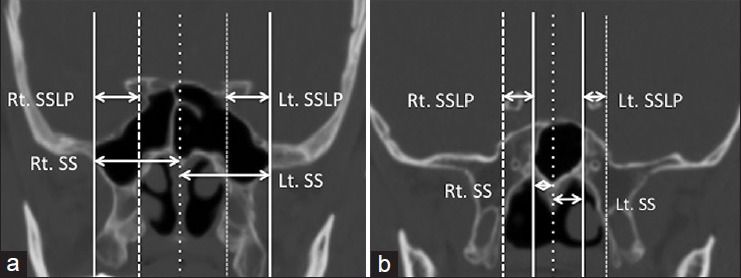
We analyzed SSLP and the width of SS (SSW) in 121 patients who had undergone EEA from 2008 to 2013 at the Division of Neurosurgery, Keio University Hospital. SSLP was defined as the distance between the SS lateral edge and the medial aspect of the pterygoid process on coronal reconstruction computed tomography. SSW was defined as the distance between the midline and lateral wall. We recorded SSLP and SSW for 242 sides. Further, we present two characteristic cases.
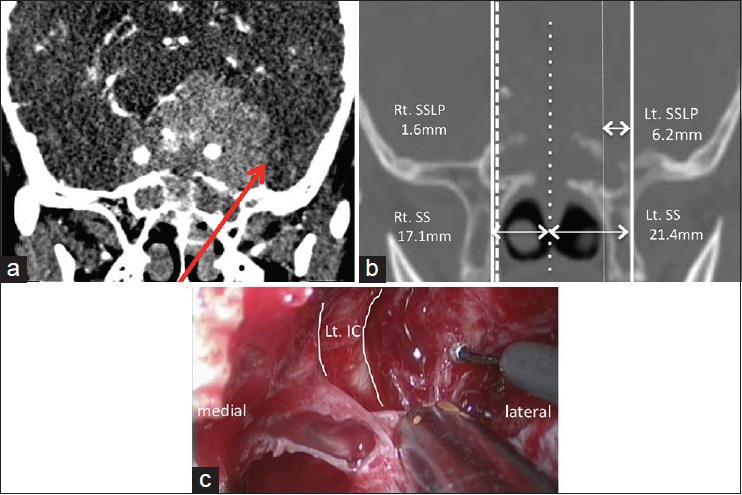
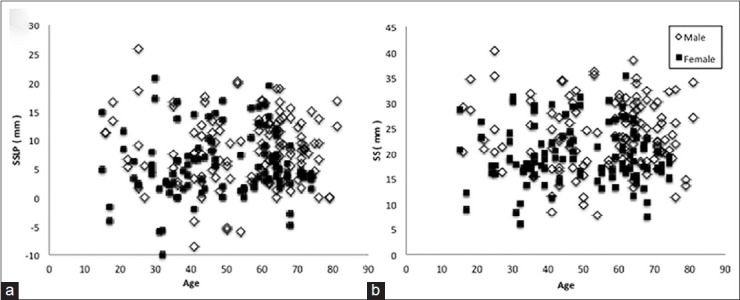
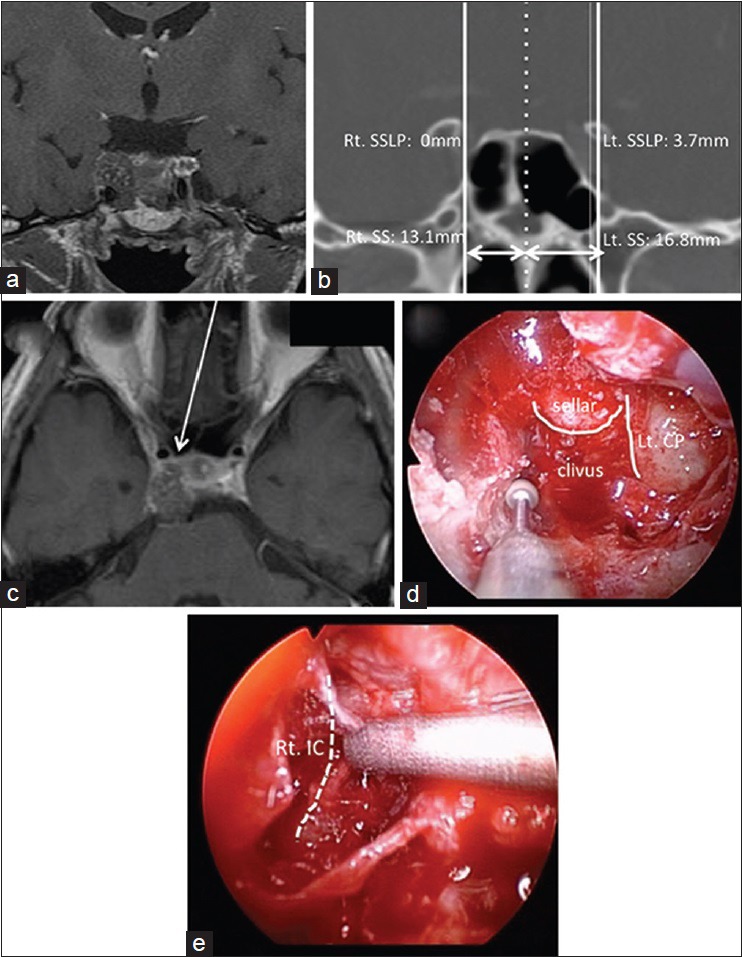
The average SSLP and SSW were 7.0 mm (-10.0-25.8 mm) and 21.8 mm (6.0-40.2 mm), respectively. No correlation between pneumatization and age was observed at age 15 or more. Sphenoid pneumatization was significantly wider in male than in female patients. There was no relationship between lateral and sagittal plane pneumatization. In a patient with recurrent chordoma who had an undeveloped SSLP, the tumor was removed via the medial space in the internal carotid artery. In another patient who had a giant pituitary adenoma and average SSLP, the tumor was located in the middle cranial fossa and was removed via the lateral internal carotid space through the left SSLP.
Wide variations were observed in SSLP and SSW. For EEA, pneumatization is an instrument corridor. Preoperative assessment of SSLP is important, especially for parasellar lesions.
本研究旨在分析蝶窦外侧气化(SSLP)情况,尤其是在亚洲人群中的情况,并确定在使用鼻内镜经鼻入路(EEA)治疗鞍旁/外侧病变时的注意事项。
我们分析了2008年至2013年在庆应义塾大学医院神经外科接受EEA治疗的121例患者的SSLP和蝶窦宽度(SSW)。SSLP定义为在冠状面重建计算机断层扫描上蝶窦外侧边缘与翼突内侧缘之间的距离。SSW定义为中线与外侧壁之间的距离。我们记录了242侧的SSLP和SSW。此外,我们还展示了两个典型病例。
SSLP和SSW的平均值分别为7.0毫米(-10.0至25.8毫米)和21.8毫米(6.0至40.2毫米)。在15岁及以上人群中,未观察到气化与年龄之间的相关性。男性蝶窦气化明显比女性更宽。外侧和矢状面气化之间没有关系。在一名复发性脊索瘤且SSLP未发育的患者中,肿瘤通过颈内动脉内侧间隙切除。在另一名患有巨大垂体腺瘤且SSLP为平均值的患者中,肿瘤位于中颅窝,通过左侧SSLP经颈内动脉外侧间隙切除。
SSLP和SSW存在广泛差异。对于EEA而言,气化是一个器械通道。术前评估SSLP很重要,尤其是对于鞍旁病变。