Sathappa Murugappan, Alder Nathan N
Department of Molecular and Cell Biology, University of Connecticut, Storrs, CT 06269, United States.
Department of Molecular and Cell Biology, University of Connecticut, Storrs, CT 06269, United States.
Biochim Biophys Acta. 2016 Jun;1858(6):1362-72. doi: 10.1016/j.bbamem.2016.03.007. Epub 2016 Mar 7.
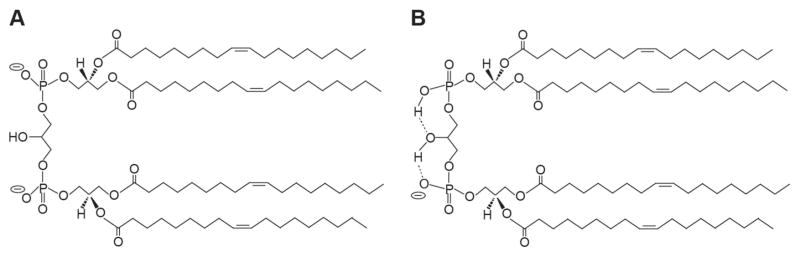
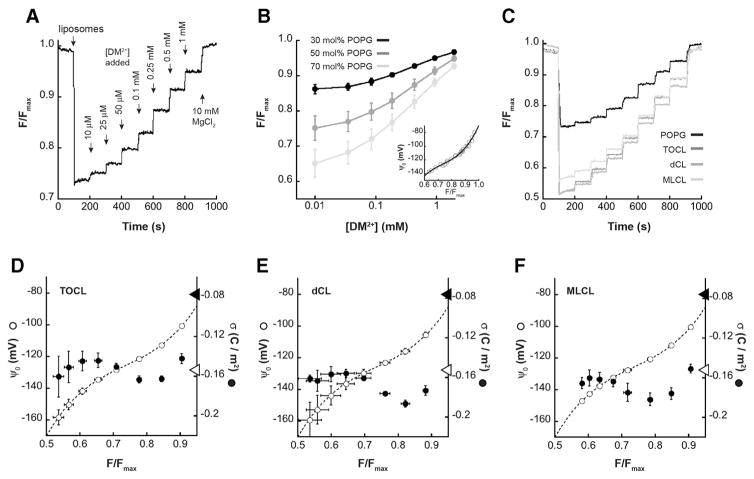
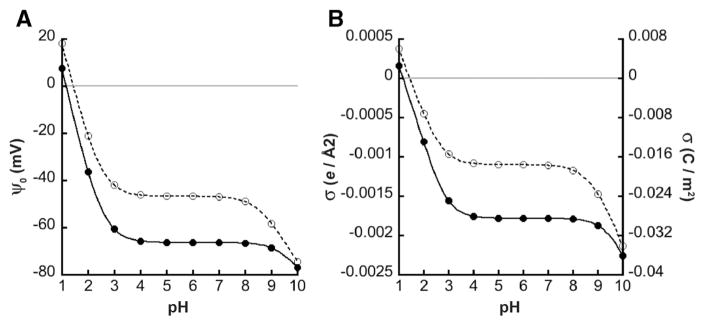
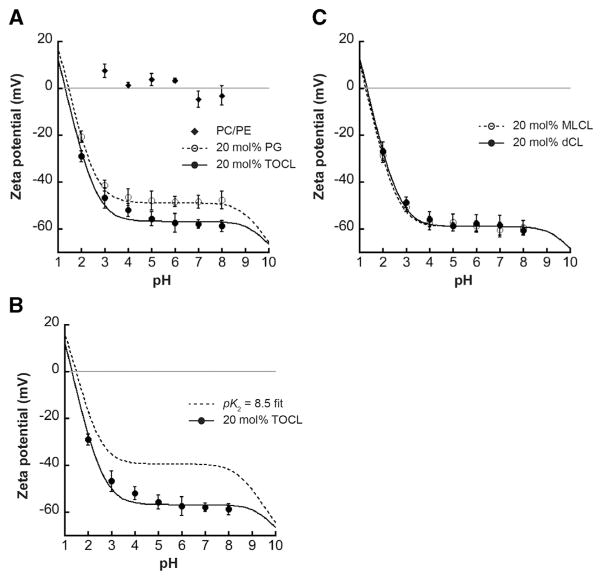
The anionic phospholipid cardiolipin has an unusual dimeric structure with a two-phosphate headgroup and four acyl chains. Cardiolipin is present in energy-transducing membranes that maintain electrochemical gradients, including most bacterial plasma membranes and the mitochondrial inner membrane, where it mediates respiratory complex assembly and activation, among many other roles. Dysfunctional biogenesis of cardiolipin is implicated in the pathogenesis of several diseases including Barth syndrome. Because cardiolipin is a dominant anionic lipid in energy-conserving membranes, its headgroup is a major contributor to surface charge density and the bilayer electrostatic profile. However, the proton dissociation behavior of its headgroup remains controversial. In one model, the pKa values of the phosphates differ by several units and the headgroup exists as a monoanion at physiological pH. In another model, both phosphates ionize as strong acids with low pKa values and the headgroup exists in dianionic form at physiological pH. Using independent electrokinetic and spectroscopic approaches, coupled with analysis using Gouy-Chapman-Stern formalism, we have analyzed the ionization properties of cardiolipin within biologically relevant lipid bilayer model systems. We show that both phosphates of the cardiolipin headgroup show strong ionization behavior with low pKa values. Moreover, cardiolipin variants lacking structural features proposed to be required to maintain disparate pKa values--namely the secondary hydroxyl on the central glycerol or a full complement of four acyl chains--were shown to have ionization behavior identical to intact cardiolipin. Hence, these results indicate that within the physiological pH range, the cardiolipin headgroup is fully ionized as a dianion. We discuss the implications of these results with respect to the role of cardiolipin in defining membrane surface potential, activating respiratory complexes, and modulating membrane curvature.
阴离子磷脂心磷脂具有不同寻常的二聚体结构,带有两个磷酸头部基团和四条酰基链。心磷脂存在于维持电化学梯度的能量转换膜中,包括大多数细菌质膜和线粒体内膜,在这些膜中,它在许多其他作用中介导呼吸复合物的组装和激活。心磷脂生物合成功能失调与包括巴特综合征在内的几种疾病的发病机制有关。由于心磷脂是能量保存膜中的主要阴离子脂质,其头部基团是表面电荷密度和双层静电分布的主要贡献者。然而,其头部基团的质子解离行为仍存在争议。在一种模型中,磷酸的pKa值相差几个单位,头部基团在生理pH下以单阴离子形式存在。在另一种模型中,两个磷酸都作为具有低pKa值的强酸电离,头部基团在生理pH下以双阴离子形式存在。我们使用独立的电动和光谱方法,并结合使用古依-查普曼-斯特恩形式主义进行分析,在生物学相关的脂质双层模型系统中分析了心磷脂的电离特性。我们表明,心磷脂头部基团的两个磷酸都表现出具有低pKa值的强电离行为。此外,缺乏被认为维持不同pKa值所需结构特征的心磷脂变体——即中心甘油上的仲羟基或四条酰基链的完整互补——被证明具有与完整心磷脂相同的电离行为。因此,这些结果表明,在生理pH范围内,心磷脂头部基团作为双阴离子完全电离。我们讨论了这些结果对于心磷脂在定义膜表面电位、激活呼吸复合物和调节膜曲率方面作用的意义。