Vytal Katherine E, Arkin Nicole E, Overstreet Cassie, Lieberman Lynne, Grillon Christian
Section on Neurobiology of Fear and Anxiety, National Institute of Mental Health, 15K North Drive, MSC 2670, Bethesda, MD, 20892-2670, USA.
BMC Psychiatry. 2016 Mar 15;16:62. doi: 10.1186/s12888-016-0748-2.
Anxiety is characterized by a bias towards threatening information, anxious apprehension, and disrupted concentration. Previous research in healthy subjects suggests that working memory (WM) is disrupted by induced anxiety, but that increased task-demand reduces anxiety and WM is preserved. However, it is unknown if patients with generalized anxiety disorder (GAD) can similarly normalize their performance on difficult WM tasks while reducing their anxiety. Increased threat-related bias and impoverished top-down control in trait anxiety suggests that patients may not reap the same cognitive and emotional benefits from demanding tasks that those low in anxiety. Here we examine this possibility using a WM task of varying difficulty.
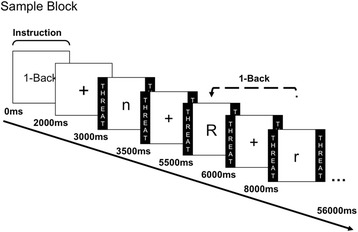
GAD patients (N = 30) and healthy controls (N = 30) performed an n-back task (no-load, 1-back, 2-back, and 3-back) while at risk for shock (threat) or safe from shock (safe). Anxiety was measured via startle reflex and self-report.
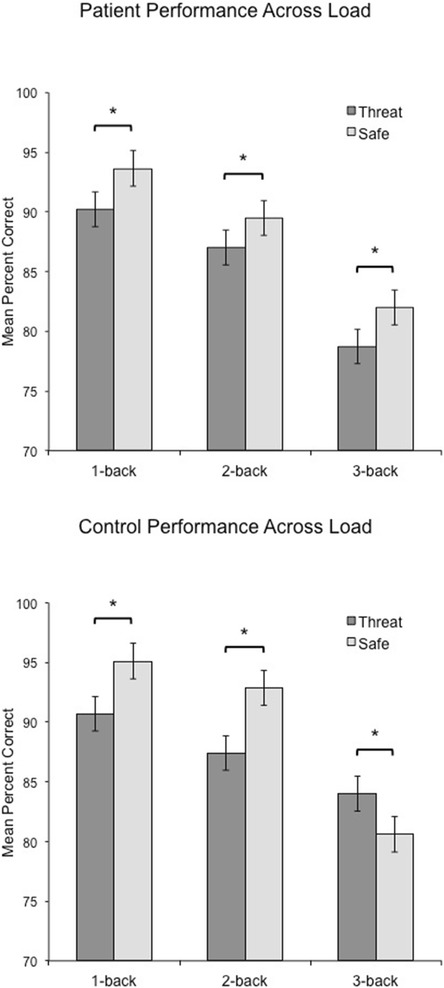
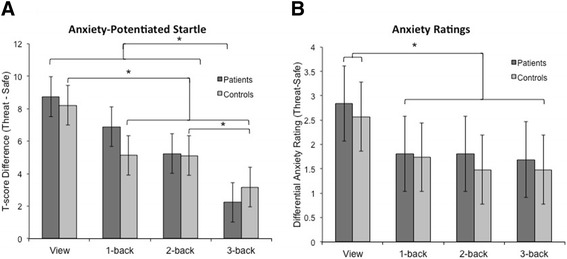
As predicted, healthy controls' performance was impaired under threat during low-load tasks and facilitated during high-load tasks. In contrast, GAD patients' performance was impaired under threat regardless of WM load. Anxiety was reduced as cognitive load increased in both groups.
The divergence of emotion regulation (reduction) and performance (persistent impairment) in the patient but not the control group, suggests that different top-down mechanisms may be operating to reduce anxiety. Continued WM disruption in patients indicates that attentional resources are allocated to emotion regulation instead of goal-directed behavior. Implications for our understanding of cognitive disruption in patients, and related therapeutic interventions are discussed.
焦虑的特征是对威胁性信息存在偏向、焦虑性担忧以及注意力分散。先前对健康受试者的研究表明,诱导性焦虑会干扰工作记忆(WM),但任务需求增加会降低焦虑并保持工作记忆。然而,广泛性焦虑症(GAD)患者在执行困难的工作记忆任务时能否在减轻焦虑的同时使表现同样恢复正常尚不清楚。特质焦虑中与威胁相关的偏向增加和自上而下控制的匮乏表明,患者可能无法像低焦虑者那样从高要求任务中获得相同的认知和情感益处。在此,我们使用难度各异的工作记忆任务来检验这种可能性。
GAD患者(N = 30)和健康对照者(N = 30)在有电击风险(威胁)或无电击风险(安全)的情况下执行n-back任务(无负荷、1-back、2-back和3-back)。通过惊吓反射和自我报告来测量焦虑。
正如预期的那样,健康对照者在低负荷任务的威胁条件下表现受损,而在高负荷任务中表现得到促进。相比之下,GAD患者在威胁条件下的表现无论工作记忆负荷如何均受损。两组的焦虑都随着认知负荷的增加而降低。
患者组而非对照组中情绪调节(减轻)和表现(持续受损)的差异表明,可能存在不同的自上而下机制来减轻焦虑。患者工作记忆持续受到干扰表明注意力资源被分配用于情绪调节而非目标导向行为。讨论了这对我们理解患者认知障碍及相关治疗干预的意义。