Nikiphorou Elena, Norton Sam, Young Adam, Carpenter Lewis, Dixey Josh, Walsh David Andrew, Kiely Patrick
Department of Rheumatology, Whittington Hospital NHS Trust, London, UK.
Early Rheumatoid Arthritis Study, Department of Rheumatology, St Albans City Hospital, St Albans, UK.
Ann Rheum Dis. 2016 Dec;75(12):2080-2086. doi: 10.1136/annrheumdis-2015-208669. Epub 2016 Mar 15.
To examine the association between disease activity in early rheumatoid arthritis (RA), functional limitation and long-term orthopaedic episodes.
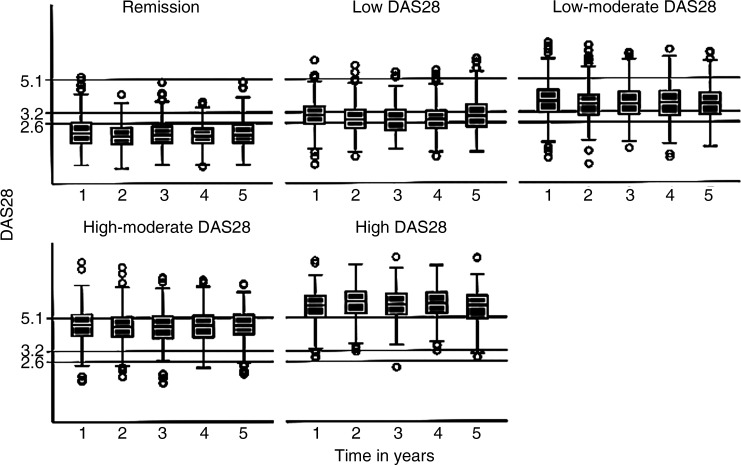
Health Assessment Questionnaire (HAQ) disability scores were collected from two longitudinal early RA inception cohorts in routine care; Early Rheumatoid Arthritis Study and Early Rheumatoid Arthritis Network from 1986 to 2012. The incidence of major and intermediate orthopaedic surgical episodes over 25 years was collected from national data sets. Disease activity was categorised by mean disease activity score (DAS28) annually between years 1 and 5; remission (RDAS≤2.6), low (LDAS>2.6-3.2), low-moderate (LMDAS≥3.2-4.19), high-moderate (HMDAS 4.2-5.1) and high (HDAS>5.1).
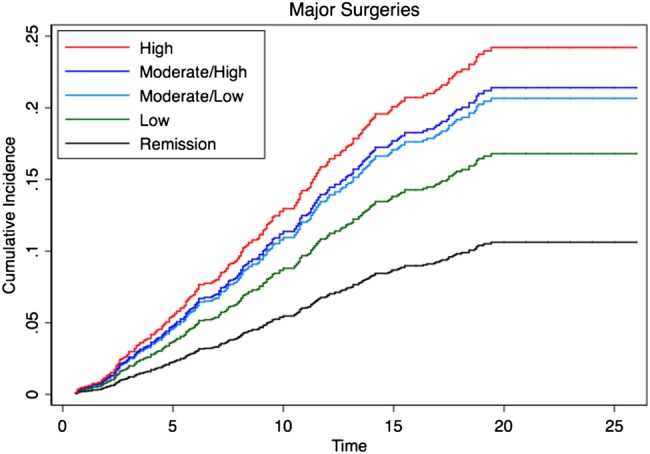
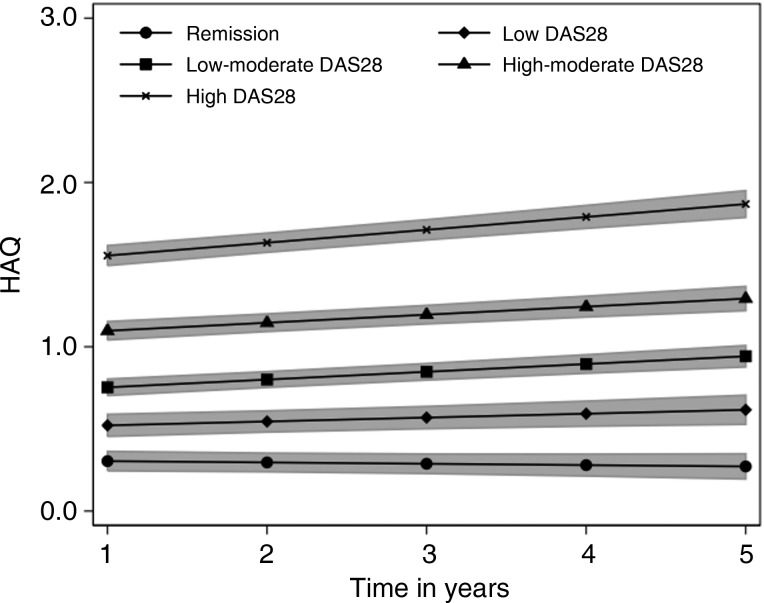
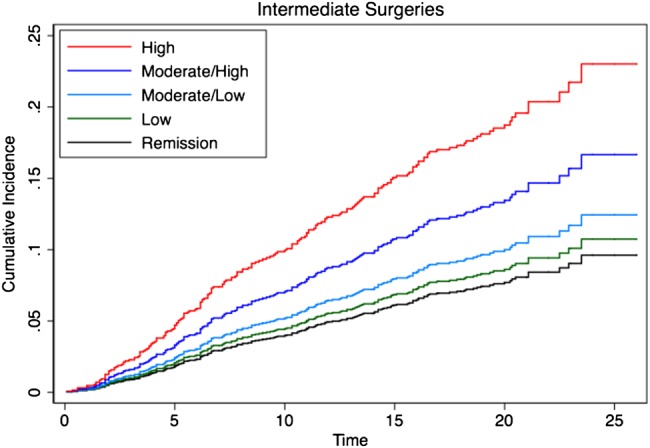
Data from 2045 patients were analysed. Patients in RDAS showed no HAQ progression over 5 years, whereas there was a significant relationship between rising DAS28 category and HAQ at 1 year, and the rate of HAQ progression between years 1 and 5. During 27 986 person-years follow-up, 392 intermediate and 591 major surgeries were observed. Compared with the RDAS category, there was a significantly increased cumulative incidence of intermediate surgery in HDAS (OR 2.59 CI 1.49 to 4.52) and HMDAS (OR 1.8 CI 1.05 to 3.11) categories, and for major surgery in HDAS (OR 2.48 CI 1.5 to 4.11), HMDAS (OR 2.16 CI 1.32 to 3.52) and LMDAS (OR 2.07 CI 1.28 to 3.33) categories. There was no significant difference in HAQ progression or orthopaedic episodes between RDAS and LDAS categories.
There is an association between disease activity and both poor function and long-term orthopaedic episodes. This illustrates the far from benign consequences of persistent moderate disease activity, and supports European League Against Rheumatism treat to target recommendations to secure low disease activity or remission in all patients.
研究早期类风湿关节炎(RA)的疾病活动度、功能受限与长期骨科事件之间的关联。
从两个常规护理中的早期RA起始队列收集健康评估问卷(HAQ)残疾评分;1986年至2012年的早期类风湿关节炎研究和早期类风湿关节炎网络。从国家数据集收集25年期间主要和中级骨科手术事件的发生率。在第1年至第5年期间,每年根据平均疾病活动评分(DAS28)对疾病活动度进行分类;缓解(DAS≤2.6)、低度(DAS>2.6 - 3.2)、低中度(DAS≥3.2 - 4.19)、高中度(DAS 4.2 - 5.1)和高度(DAS>5.1)。
分析了2045例患者的数据。处于缓解期(DAS)的患者在5年内HAQ无进展,而DAS28分类升高与1年时的HAQ以及第1年至第5年期间的HAQ进展率之间存在显著关系。在27986人年的随访期间,观察到392例中级手术和591例主要手术。与缓解期(DAS)分类相比,高度(DAS)组(OR 2.59,CI 1.49至4.52)和高中度(DAS)组(OR 1.8,CI 1.05至3.11)中级手术的累积发生率显著增加,高度(DAS)组(OR 2.48,CI 1.5至4.11)、高中度(DAS)组(OR 2.16,CI 1.32至3.52)和低中度(DAS)组(OR 2.07,CI 1.28至3.33)主要手术的累积发生率显著增加。缓解期(DAS)和低度(DAS)组之间在HAQ进展或骨科事件方面无显著差异。
疾病活动度与功能不佳和长期骨科事件之间存在关联。这说明了持续中度疾病活动度远非良性后果,并支持欧洲抗风湿病联盟的治疗目标建议,以确保所有患者达到低疾病活动度或缓解。