Landor Antoinette M, Halpern Carolyn Tucker
Department of Human Development and Family Science, University of Missouri, 407 Gentry Hall, Columbia, MO, 65211, USA.
Maternal and Child Health, Gillings School of Global Public Health, University of North Carolina at Chapel Hill, 206 W Franklin St, Room 281, Chapel Hill, NC, 27516, USA.
J Youth Adolesc. 2016 May;45(5):986-1002. doi: 10.1007/s10964-016-0456-8. Epub 2016 Mar 15.
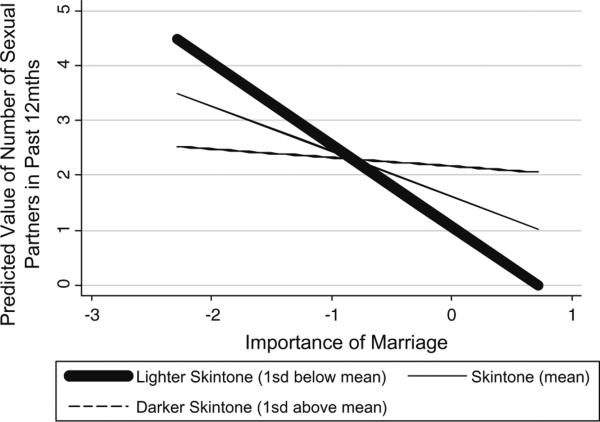
Past evidence has documented that attitudes toward marriage and cohabitation are related to sexual behavior in adolescence and young adulthood. This study extends prior research by longitudinally testing these associations across racial/ethnic groups and investigating whether culturally relevant variations within racial/ethnic minority groups, such as skin tone (i.e., lightness/darkness of skin color), are linked to attitudes toward marriage and cohabitation and sex. Drawing on family and public health literatures and theories, as well as burgeoning skin tone literature, it was hypothesized that more positive attitudes toward marriage and negative attitudes toward cohabitation would be associated with less risky sex, and that links differed for lighter and darker skin individuals. The sample included 6872 respondents (49.6 % female; 70.0 % White; 15.8 % African American; 3.3 % Asian; 10.9 % Hispanic) from the National Longitudinal Study of Adolescent to Adult Health. The results revealed that marital attitudes had a significantly stronger dampening effect on risky sexual behavior of lighter skin African Americans and Asians compared with their darker skin counterparts. Skin tone also directly predicted number of partners and concurrent partners among African American males and Asian females. We discuss theoretical and practical implications of these findings for adolescence and young adulthood.
过去的证据表明,对婚姻和同居的态度与青少年及青年时期的性行为有关。本研究通过纵向测试不同种族/族裔群体之间的这些关联,并调查种族/族裔少数群体内部与文化相关的差异,如肤色(即皮肤颜色的深浅),是否与对婚姻、同居和性的态度相关,从而扩展了先前的研究。借鉴家庭和公共卫生文献及理论,以及新兴的肤色文献,研究假设对婚姻持更积极的态度和对同居持消极的态度与风险较低的性行为相关,并且肤色较浅和较深的个体之间的关联有所不同。样本包括来自“青少年到成人健康全国纵向研究”的6872名受访者(49.6%为女性;70.0%为白人;15.8%为非裔美国人;3.3%为亚裔;10.9%为西班牙裔)。结果显示,与肤色较深的非裔美国人和亚裔相比,婚姻态度对肤色较浅的非裔美国人和亚裔的危险性性行为具有显著更强的抑制作用。肤色还直接预测了非裔美国男性和亚裔女性的性伴侣数量及同时交往的伴侣数量。我们讨论了这些发现对青少年和青年时期的理论及实际意义。