Sato Ko, Watanabe Satoshi, Ohtsubo Aya, Shoji Satoshi, Ishikawa Daisuke, Tanaka Tomohiro, Nozaki Koichiro, Kondo Rie, Okajima Masaaki, Miura Satoru, Tanaka Junta, Sakagami Takuro, Koya Toshiyuki, Kagamu Hiroshi, Yoshizawa Hirohisa, Narita Ichiei
Department of Medicine (II), Niigata University Medical and Dental Hospital, Niigata City, Niigata, Japan.
Bioscience Medical Research Center, Niigata University Medical and Dental Hospital, Niigata City, Niigata, Japan.
BMC Cancer. 2016 Mar 15;16:222. doi: 10.1186/s12885-016-2271-8.
Nephrotoxicity is the major side effect that limits the dose of cisplatin that can be safely administered, and it is a clinical problem in cancer patients who received cisplatin combination chemotherapy. Recent evidence has demonstrated that patients with chronic kidney disease (CKD) have an increased risk of developing acute kidney injury (AKI). The present study was conducted to evaluate the prevalence of CKD risk factors in patients who received cisplatin and to assess the correlation between CKD risk factors and cisplatin-induced AKI.
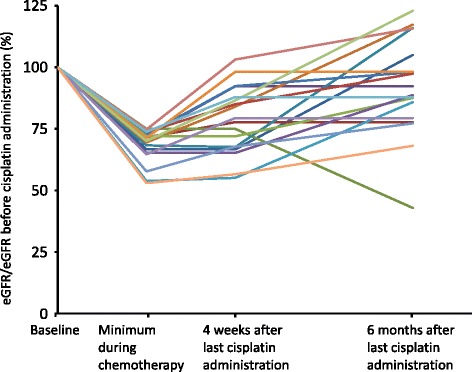
We retrospectively analyzed 84 patients treated with cisplatin combination chemotherapy for thoracic malignancies. AKI was defined as a decrease in the estimated glomerular filtration rate (eGFR) > 25% from base line, an increase in the serum creatinine (sCre) level of > 0.3 mg/dl or ≥ 1.5 times the baseline level.
Eighty of the 84 patients (95.2%) had at least one risk factor for CKD. All enrolled patients received cisplatin with hydration, magnesium supplementation and mannitol. Cisplatin-induced AKI was observed in 18 patients (21.4%). Univariate analysis revealed that cardiac disease and use of non-steroidal anti-inflammatory drugs (NSAIDs) were associated with cisplatin-induced nephrotoxicity (odds ratios [OR] 6 and 3.56, 95% confidence intervals [CI] 1.21-29.87 and 1.11-11.39, p = 0.04 and p = 0.04, respectively). Multivariate analysis revealed that cisplatin nephrotoxicity occurred significantly more often in patients with both risk factors (OR 13.64, 95% CI 1.11-326.83, p = 0.04). Patients with more risk factors for CKD tended to have a greater risk of developing cisplatin-induced AKI.
We should consider avoiding administration of cisplatin to patients with CKD risk factors, particularly cardiac disease and NSAID use.
肾毒性是限制顺铂安全给药剂量的主要副作用,也是接受顺铂联合化疗的癌症患者面临的临床问题。最近的证据表明,慢性肾脏病(CKD)患者发生急性肾损伤(AKI)的风险增加。本研究旨在评估接受顺铂治疗患者中CKD危险因素的患病率,并评估CKD危险因素与顺铂诱导的AKI之间的相关性。
我们回顾性分析了84例接受顺铂联合化疗治疗胸部恶性肿瘤的患者。AKI定义为估计肾小球滤过率(eGFR)较基线下降>25%,血清肌酐(sCre)水平升高>0.3mg/dl或≥基线水平的1.5倍。
84例患者中有80例(95.2%)至少有一项CKD危险因素。所有入选患者均接受了顺铂治疗,并进行了水化、补充镁和使用甘露醇。18例患者(21.4%)出现了顺铂诱导的AKI。单因素分析显示,心脏病和使用非甾体抗炎药(NSAIDs)与顺铂诱导的肾毒性相关(比值比[OR]分别为6和3.56,95%置信区间[CI]为1.21 - 29.87和1.11 - 11.39,p = 0.04和p = 0.04)。多因素分析显示,同时具有两种危险因素的患者发生顺铂肾毒性的频率显著更高(OR 13.64,95%CI 1.11 - 326.83,p = 0.04)。具有更多CKD危险因素的患者发生顺铂诱导的AKI的风险往往更高。
我们应考虑避免对具有CKD危险因素的患者使用顺铂,尤其是患有心脏病和使用NSAIDs的患者。