Kang Lin, Aggarwal Dau Dayal, Rashkovetsky Eugenia, Korol Abraham B, Michalak Pawel
Biocomplexity Institute, Virginia Tech, Blacksburg, VA, 24061, USA.
Institute of Evolution, University of Haifa, Abba Khoushy Ave 199, Haifa, Israel.
BMC Genomics. 2016 Mar 15;17:233. doi: 10.1186/s12864-016-2556-y.
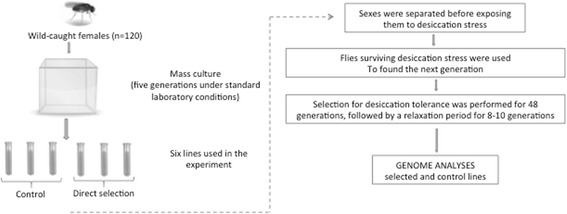
Experimental evolution studies, coupled with whole genome resequencing and advances in bioinformatics, have become a powerful tool for exploring how populations respond to selection at the genome-wide level, complementary to genome-wide association studies (GWASs) and linkage mapping experiments as strategies to connect genotype and phenotype. In this experiment, we analyzed genomes of Drosophila melanogaster from lines evolving under long-term directional selection for increased desiccation resistance in comparison with control (no-selection) lines.
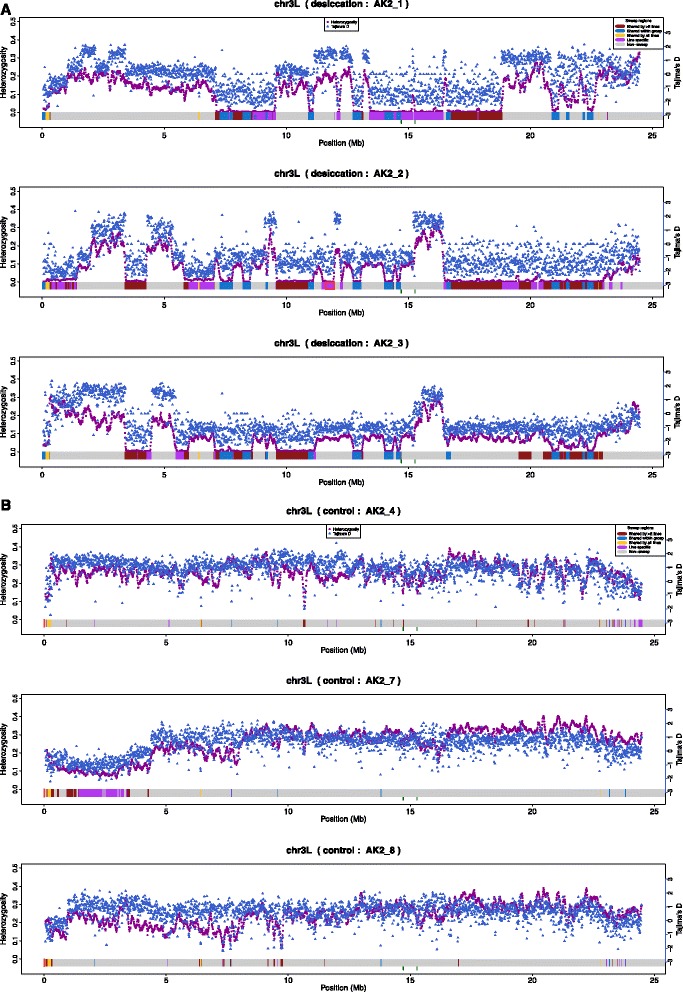
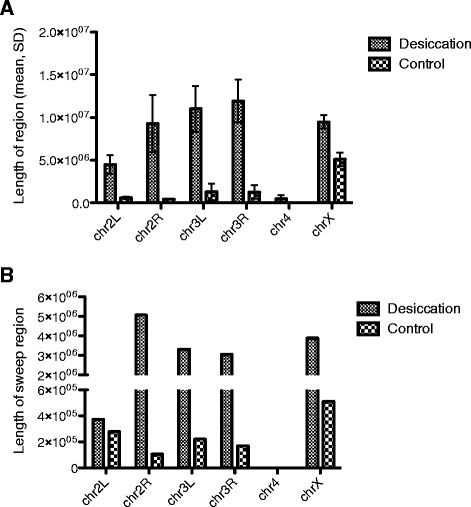
We demonstrate that adaptive responses to desiccation stress have exerted extensive footprints on the genomes, manifested through a high degree of fixation of alleles in surrounding neighborhoods of eroded heterozygosity. These patterns were highly convergent across replicates, consistent with signatures of 'soft' selective sweeps, where multiple alleles present as standing genetic variation become beneficial and sweep through the replicate populations at the same time. Albeit much less frequent, we also observed line-unique sweep regions with zero or near-zero heterozygosity, consistent with classic, or 'hard', sweeps, where novel rather than pre-existing adaptive mutations may have been driven to fixation. Genes responsible for cuticle and protein deubiquitination seemed to be central to these selective sweeps. High divergence within coding sequences between selected and control lines was also reflected by significant results of the McDonald-Kreitman and Ka/Ks tests, showing that as many as 347 genes may have been under positive selection.
Desiccation stress, a common challenge to many organisms inhabiting dry environments, proves to be a very potent selecting factor having a big impact on genome diversity.
实验进化研究,结合全基因组重测序和生物信息学的进展,已成为探索群体在全基因组水平上如何响应选择的有力工具,它是全基因组关联研究(GWAS)和连锁图谱实验的补充,这些实验是连接基因型和表型的策略。在本实验中,我们分析了与对照(无选择)品系相比,在长期定向选择下进化以提高抗干燥能力的黑腹果蝇品系的基因组。
我们证明,对干燥胁迫的适应性反应在基因组上留下了广泛的印记,表现为在侵蚀杂合性周围区域等位基因的高度固定。这些模式在重复实验中高度趋同,与“软”选择性清除的特征一致,即多个作为现存遗传变异存在的等位基因变得有益并同时在重复群体中扩散。尽管频率低得多,但我们也观察到具有零或接近零杂合性的品系特异性清除区域,这与经典的或“硬”清除一致,即新的而非预先存在的适应性突变可能已被固定。负责角质层和蛋白质去泛素化的基因似乎是这些选择性清除的核心。选择品系和对照品系之间编码序列内的高差异也通过McDonald-Kreitman和Ka/Ks测试的显著结果反映出来,表明多达347个基因可能受到正选择。
干燥胁迫是许多栖息在干燥环境中的生物面临的常见挑战,事实证明它是一个非常强大的选择因素,对基因组多样性有很大影响。