Heckman Michael G, Robinson Jessica L, Tzou Katherine S, Parker Alexander S, Wu Kevin J, Hilton Tracy W, Howat William J, Miller Jodi L, Kreinest Pamela A, Pisansky Thomas M, Schild Steven E, Peterson Jennifer L, Vallow Laura A, Carroll Jason S, Buskirk Steven J
Department of Health Sciences Research, Mayo Clinic, Jacksonville, Florida, United States of America.
Cancer Research UK Cambridge Institute, University of Cambridge, Cambridge, United Kingdom.
PLoS One. 2016 Mar 17;11(3):e0151785. doi: 10.1371/journal.pone.0151785. eCollection 2016.
Standardly collected clinical and pathological patient information has demonstrated only moderate ability to predict risk of biochemical recurrence (BCR) of prostate cancer in men undergoing salvage radiation therapy (SRT) for a rising PSA after radical prostatectomy (RP). Although elevated FOXA1 staining has been associated with poor patient outcomes following RP, it has not been studied in the specific setting of SRT after RP. The aim of this study was to evaluate the association between FOXA1 staining level and BCR after SRT for recurrent prostate cancer.
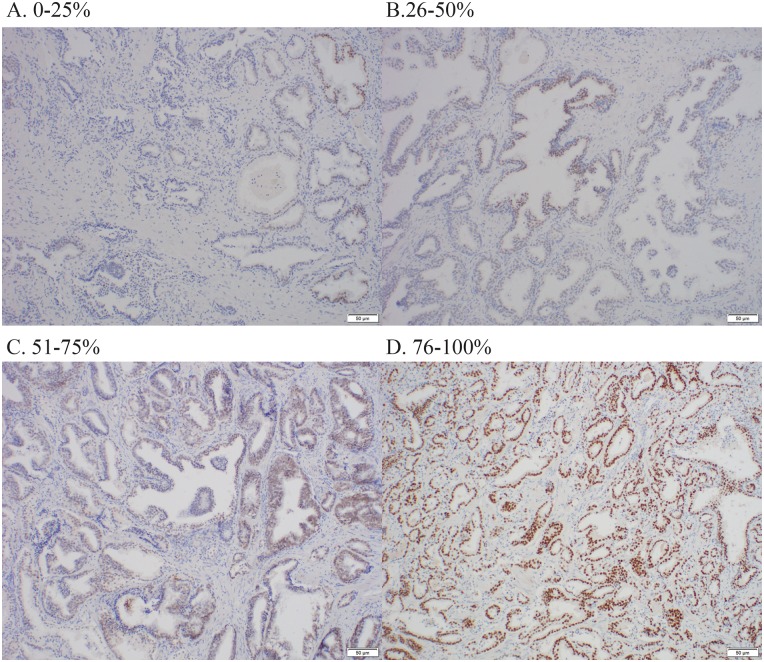
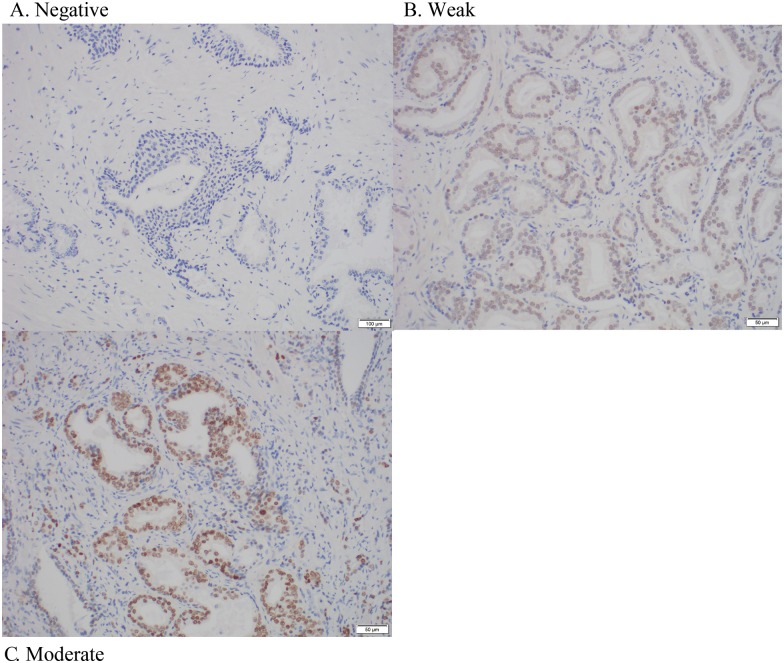
A total of 141 men who underwent SRT at our institution were included. FOXA1 staining levels in primary tumor samples were detected using immunohistochemistry. FOXA1 staining percentage and intensity were measured and multiplied together to obtain a FOXA1 H-score (range 0-12) which was our primary staining measure. P-values ≤ 0.0056 were considered as statistically significant after applying a Bonferroni correction for multiple comparisons.
There was not a significant association between FOXA1 H-score and risk of BCR when considering H-score as an ordinal variable or as a categorical variable (all P ≥ 0.090). Similarly, no significant associations with BCR were observed for FOXA1 staining percentage or staining intensity (all P ≥ 0.14).
FOXA1 staining level does not appear to have a major impact on risk of BCR after SRT.
对于根治性前列腺切除术(RP)后前列腺特异抗原(PSA)升高而接受挽救性放射治疗(SRT)的男性患者,标准收集的临床和病理患者信息显示,其预测前列腺癌生化复发(BCR)风险的能力仅为中等。尽管FOXA1染色升高与RP后患者不良预后相关,但在RP后SRT的特定情况下尚未进行研究。本研究的目的是评估复发性前列腺癌SRT后FOXA1染色水平与BCR之间的关联。
纳入了在我们机构接受SRT的141名男性。使用免疫组织化学检测原发肿瘤样本中的FOXA1染色水平。测量FOXA1染色百分比和强度并将两者相乘,以获得FOXA1 H评分(范围0 - 12),这是我们的主要染色测量指标。在应用Bonferroni校正进行多重比较后,P值≤0.0056被认为具有统计学意义。
将H评分视为有序变量或分类变量时,FOXA1 H评分与BCR风险之间均无显著关联(所有P≥0.090)。同样,FOXA1染色百分比或染色强度与BCR也无显著关联(所有P≥0.14)。
FOXA1染色水平似乎对SRT后BCR风险没有重大影响。