Vidlickova Ivana, Dequiedt Franck, Jelenska Lenka, Sedlakova Olga, Pastorek Michal, Stuchlik Stanislav, Pastorek Jaromir, Zatovicova Miriam, Pastorekova Silvia
Department of Molecular Medicine, Institute of Virology, Biomedical Research Center, Slovak Academy of Sciences, Dubravska cesta 9, 845 05, Bratislava, Slovak Republic.
Department of Molecular Biology, Faculty of Natural Sciences, Comenius University in Bratislava, Bratislava, Slovakia.
BMC Cancer. 2016 Mar 19;16:239. doi: 10.1186/s12885-016-2267-4.
Carbonic anhydrase IX (CA IX) is a tumor-associated, highly active, transmembrane carbonic anhydrase isoform regulated by hypoxia and implicated in pH control and adhesion-migration-invasion. CA IX ectodomain (ECD) is shed from the tumor cell surface to serum/plasma of patients, where it can signify cancer prognosis. We previously showed that the CA IX ECD release is mediated by disintegrin and metalloproteinase ADAM17. Here we investigated the CA IX ECD shedding in tumor cells undergoing apoptosis in response to cytotoxic drugs, including cycloheximide and doxorubicin.
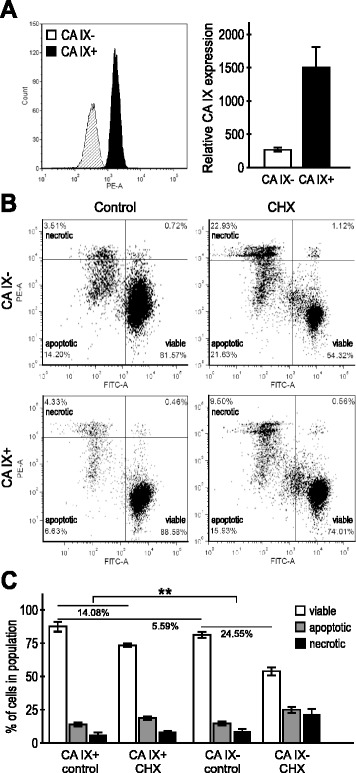
Presence of cell surface CA IX was correlated to the extent of apoptosis by flow cytometry in cell lines with natural or ectopic CA IX expression. CA IX ECD level was assessed by ELISA using CA IX-specific monoclonal antibodies. Effect of recombinant CA IX ECD on the activation of molecular pathways was evaluated using the cell-based dual-luciferase reporter assay.
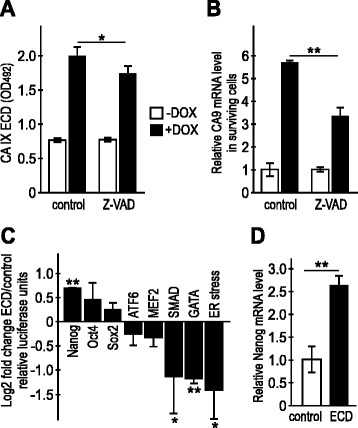
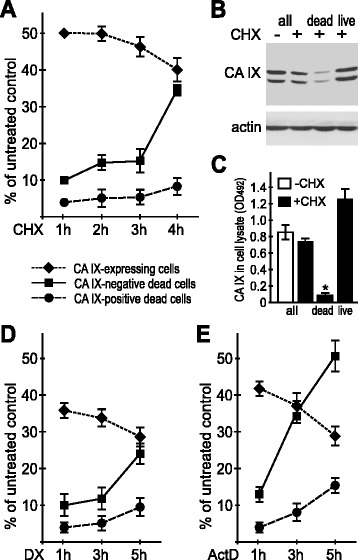
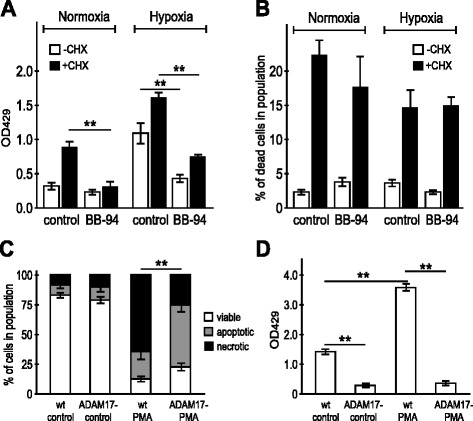
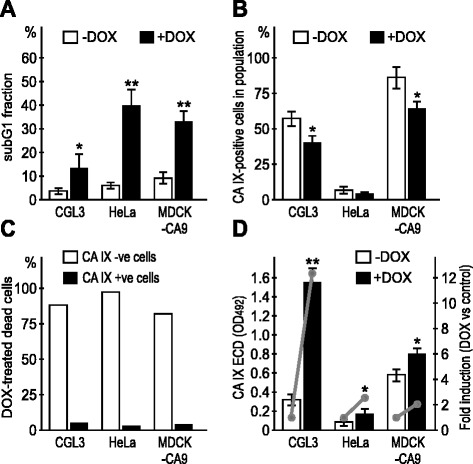
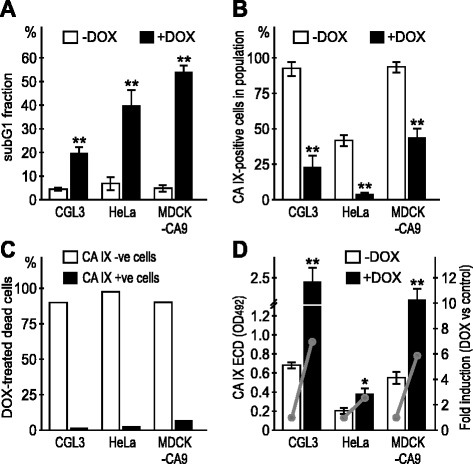
We found a significantly lower occurrence of apoptosis in the CA IX-positive cell subpopulation than in the CA IX-negative one. We also demonstrated that the cell-surface CA IX level dropped during the death progress due to an increased ECD shedding, which required a functional ADAM17. Inhibitors of metalloproteinases reduced CA IX ECD shedding, but not apoptosis. The CA IX ECD release induced by cytotoxic drugs was connected to elevated expression of CA IX in the surviving fraction of cells. Moreover, an externally added recombinant CA IX ECD activated a pathway driven by the Nanog transcription factor implicated in epithelial-mesenchymal transition and stemness.
These findings imply that the increased level of the circulating CA IX ECD might be useful as an indicator of an effective antitumor chemotherapy. Conversely, elevated CA IX ECD might generate unwanted effects through autocrine/paracrine signaling potentially contributing to resistance and tumor progression.
碳酸酐酶IX(CA IX)是一种与肿瘤相关的、高活性的跨膜碳酸酐酶同工型,受缺氧调节,参与pH调控以及黏附 - 迁移 - 侵袭过程。CA IX胞外结构域(ECD)从肿瘤细胞表面脱落至患者的血清/血浆中,可作为癌症预后的指标。我们之前表明,CA IX ECD的释放由去整合素和金属蛋白酶ADAM17介导。在此,我们研究了肿瘤细胞在接受包括环己酰亚胺和阿霉素在内的细胞毒性药物作用而发生凋亡时的CA IX ECD脱落情况。
通过流式细胞术,在天然表达或异位表达CA IX的细胞系中,将细胞表面CA IX的存在情况与凋亡程度相关联。使用CA IX特异性单克隆抗体通过酶联免疫吸附测定(ELISA)评估CA IX ECD水平。使用基于细胞的双荧光素酶报告基因测定法评估重组CA IX ECD对分子途径激活的影响。
我们发现CA IX阳性细胞亚群中的凋亡发生率明显低于CA IX阴性细胞亚群。我们还证明,由于ECD脱落增加,细胞表面CA IX水平在死亡过程中下降,这需要功能性的ADAM17。金属蛋白酶抑制剂减少了CA IX ECD的脱落,但不影响凋亡。细胞毒性药物诱导的CA IX ECD释放与存活细胞部分中CA IX表达的升高有关。此外,外源性添加的重组CA IX ECD激活了由与上皮 - 间质转化和干性相关的Nanog转录因子驱动的途径。
这些发现表明,循环中CA IX ECD水平的升高可能作为有效的抗肿瘤化疗指标。相反,升高的CA IX ECD可能通过自分泌/旁分泌信号产生不良影响,潜在地导致耐药性和肿瘤进展。