
多普勒效应引起的自旋弛豫激增。
Doppler effect induced spin relaxation boom.
作者信息
Zhao Xinyu, Huang Peihao, Hu Xuedong
机构信息
Department of Physics, University at Buffalo, SUNY, Buffalo, New York 14260, USA.
Quantum Measurement Division, National Institute of Standards and Technology, Gaithersburg, MD, 20899-8423, USA.
出版信息
Sci Rep. 2016 Mar 21;6:23169. doi: 10.1038/srep23169.
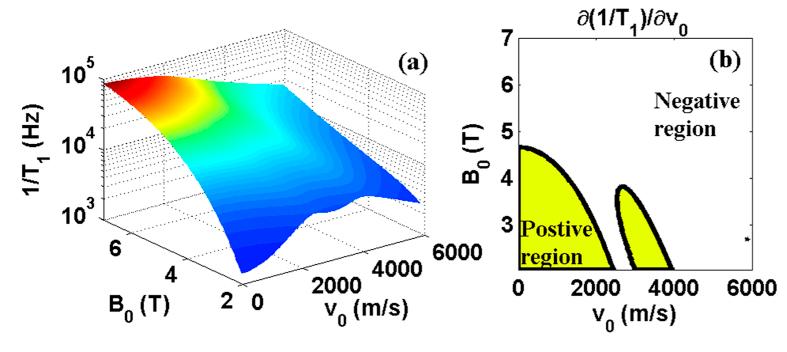
We study an electron spin qubit confined in a moving quantum dot (QD), with our attention on both spin relaxation, and the product of spin relaxation, the emitted phonons. We find that Doppler effect leads to several interesting phenomena. In particular, spin relaxation rate peaks when the QD motion is in the transonic regime, which we term a spin relaxation boom in analogy to the classical sonic boom. This peak indicates that a moving spin qubit may have even lower relaxation rate than a static qubit, pointing at the possibility of coherence-preserving transport for a spin qubit. We also find that the emitted phonons become strongly directional and narrow in their frequency range as the qubit reaches the supersonic regime, similar to Cherenkov radiation. In other words, fast moving excited spin qubits can act as a source of non-classical phonons. Compared to classical Cherenkov radiation, we show that quantum dot confinement produces a small but important correction on the Cherenkov angle. Taking together, these results have important implications to both spin-based quantum information processing and coherent phonon dynamics in semiconductor nanostructures.
我们研究了限制在移动量子点(QD)中的电子自旋量子比特,重点关注自旋弛豫以及自旋弛豫的产物——发射的声子。我们发现多普勒效应会导致几个有趣的现象。特别地,当量子点运动处于跨声速区域时,自旋弛豫率会出现峰值,我们将其称为自旋弛豫激波,类似于经典的音爆。这个峰值表明移动的自旋量子比特的弛豫率可能比静态量子比特更低,这意味着自旋量子比特有可能实现保持相干性的传输。我们还发现,当量子比特达到超声速区域时,发射的声子会变得具有强烈的方向性,并且频率范围变窄,这类似于切伦科夫辐射。换句话说,快速移动的激发自旋量子比特可以作为非经典声子的源。与经典切伦科夫辐射相比,我们表明量子点的限制对切伦科夫角产生了一个小但重要的修正。综上所述,这些结果对基于自旋的量子信息处理以及半导体纳米结构中的相干声子动力学都具有重要意义。


 Zotero 插件