
肺腺癌组织病理学亚型、F-氟脱氧葡萄糖摄取与表皮生长因子受体突变之间的关联
Association between histopathological subtype, F-fluorodeoxyglucose uptake and epidermal growth factor receptor mutations in lung adenocarcinoma.
作者信息
Qiang Guangliang, Huang Wei, Liang Chaoyang, Xu Rui, Yan Jue, Xu Yanyan, Wang Y E, DA Jiping, Shi Bin, Guo Yongqing, Liu Deruo
机构信息
Department of Thoracic Surgery, China-Japan Friendship Hospital, Beijing 100029, P.R. China.
State Key Laboratory of Natural and Biomimetic Drugs, School of Pharmaceutical Sciences, Peking University, Beijing 100191, P.R. China.
出版信息
Oncol Lett. 2016 Mar;11(3):1769-1777. doi: 10.3892/ol.2016.4154. Epub 2016 Jan 27.
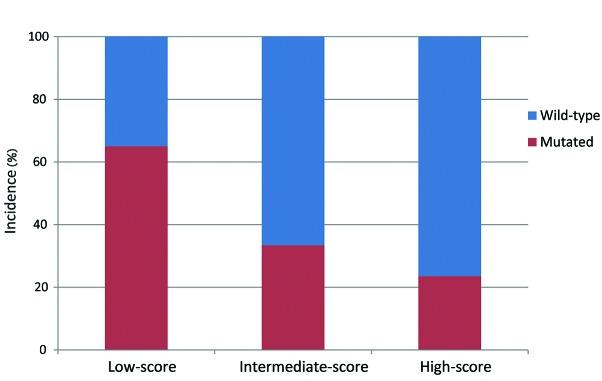
The aim of the present study was to investigate the association between histopathological subtypes, epidermal growth factor receptor (EGFR) mutations and F-fluorodeoxyglucose (FDG) uptake in patients with lung adenocarcinoma (ADC). The cases of 97 patients with lung ADC who underwent F-FDG positron emission tomography-computed tomography prior to surgical resection were retrospectively reviewed. The patients were stratified according to the International Association for the Study of Lung Cancer/American Thoracic Society/European Respiratory Society (IASLC/ATS/ERS) classification, and graded using a histopathological scoring system. EGFR mutations were identified. Clinicopathological characteristics associated with EGFR mutation status were evaluated using univariate and multivariate analyses. EGFR mutation was identified in 45.4% of the patients and was associated with gender, smoking history, maximum standardized uptake value (SUVmax) and histopathological score. ADC patients with a low SUVmax were more likely to exhibit EGFR mutations compared with patients with a high SUVmax (P=0.018). Patients with a lower histopathological score possessed a significantly lower SUVmax compared with patients with a higher score (P<0.001). Furthermore, the histopathological score and smoking history of the patients were identified to be independent predictors for EGFR mutations, according to multivariate logistic regression analysis. In conclusion, SUVmax and EGFR mutations were associated with lung ADC patients stratified according to the IASLC/ATS/ERS classification. Overall, SUVmax has the potential to be a useful marker in stratifying pre-operative patients with lung ADC and identifying EGFR mutations.
本研究的目的是调查肺腺癌(ADC)患者的组织病理学亚型、表皮生长因子受体(EGFR)突变与氟脱氧葡萄糖(FDG)摄取之间的关联。对97例在手术切除前接受F-FDG正电子发射断层扫描-计算机断层扫描的肺ADC患者的病例进行回顾性分析。根据国际肺癌研究协会/美国胸科学会/欧洲呼吸学会(IASLC/ATS/ERS)分类对患者进行分层,并使用组织病理学评分系统进行分级。检测EGFR突变。采用单因素和多因素分析评估与EGFR突变状态相关的临床病理特征。45.4%的患者检测到EGFR突变,且与性别、吸烟史、最大标准化摄取值(SUVmax)和组织病理学评分相关。与SUVmax高的患者相比,SUVmax低的ADC患者更有可能出现EGFR突变(P=0.018)。组织病理学评分较低的患者与评分较高的患者相比,SUVmax显著更低(P<0.001)。此外,根据多因素逻辑回归分析,患者的组织病理学评分和吸烟史被确定为EGFR突变的独立预测因素。总之,SUVmax和EGFR突变与根据IASLC/ATS/ERS分类分层的肺ADC患者相关。总体而言,SUVmax有可能成为术前分层肺ADC患者和识别EGFR突变的有用标志物。


 Zotero 插件