Chan Pak Hei, Hai Jo Jo, Chan Esther W, Li Wen Hua, Tse Hung Fat, Wong Ian C K, Lip Gregory Y H, Siu Chung Wah
Cardiology Division, Department of Medicine, Li Ka Shing Faculty of Medicine, the University of Hong Kong, Hong Kong SAR, China.
Department of Pharmacology and Pharmacy, Li Ka Shing Faculty of Medicine, the University of Hong Kong, Hong Kong SAR, China.
PLoS One. 2016 Mar 24;11(3):e0150674. doi: 10.1371/journal.pone.0150674. eCollection 2016.
The efficacy and safety of warfarin therapy for stroke prevention in atrial fibrillation (AF) depends on the time in therapeutic range (TTR). We aimed to assess the predictive ability of SAMe-TT2R2 score in Chinese AF patients on warfarin, whose TTR is notoriously poor.
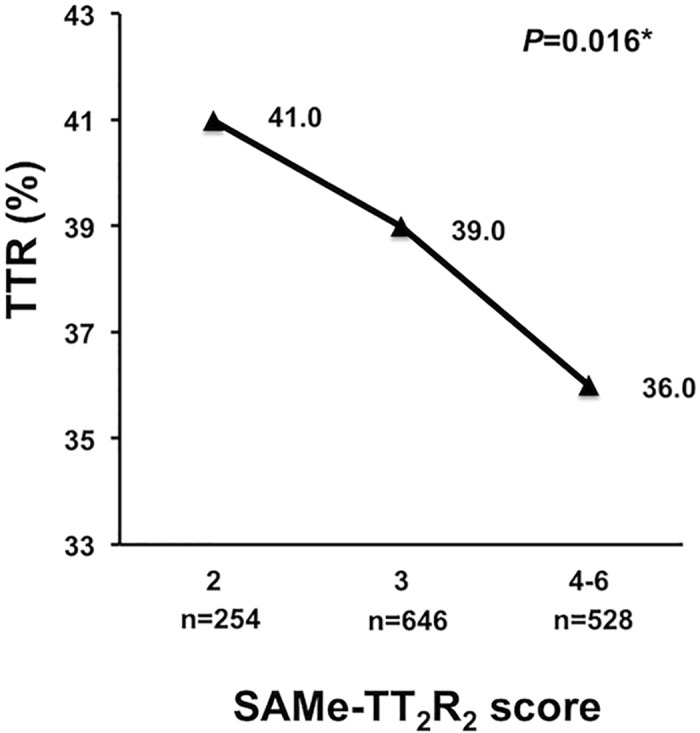
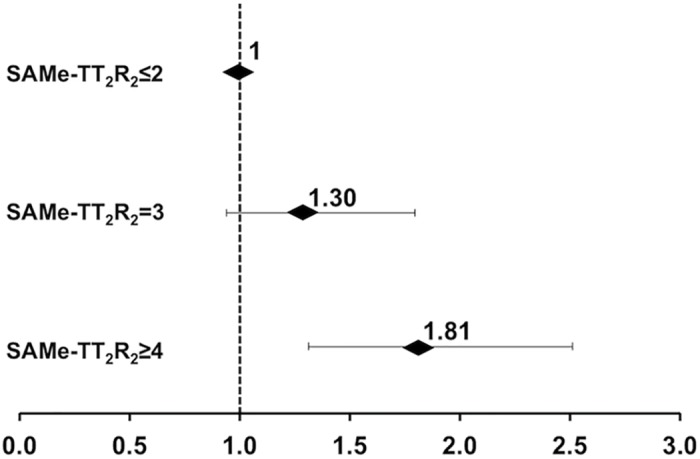
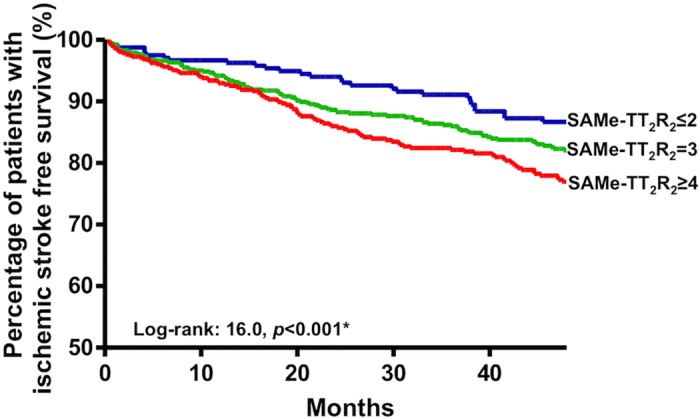
This is a single-centre retrospective study. Patients with non-valvular AF on warfarin diagnosed between 1997 and 2011 were stratified according to SAMe-TT2R2 score, and TTR was calculated using Rosendaal method. The predictive power of SAMe-TT2R2 scores for good TTR i.e. >70% was assessed. We included 1,428 Chinese patients (mean age 76.2±8.7 years, 47.5% male) with non-valvular AF on warfarin. The mean and median TTR were 38.2±24.4% and 38.8% (interquartile range: 17.9% and 56.2%) respectively. TTR decreased progressively with increasing SAMe-TT2R2 score (p = 0.016). When the cut-off value of SAMe-TT2R2 score was set to 2, the sensitivity and specificity to predict TTR<70% were 85.7% and 17.8%, respectively. The corresponding positive and negative predictive values were 10.1% and 92.0%. After a mean follow-up of 4.7±3.6 years, 338 patients developed an ischemic stroke (4.96%/year). Patients with TTR≥70% had a lower annual risk of ischemic stroke of 3.67%/year compared with than those with TTR<70% (5.13%/year)(p = 0.08). Patients with SAMe-TT2R2 score ≤2 had the lowest risk of annual risk of ischemic stroke (3.49%/year) compared with those with SAMe-TT2R2 score = 3 (4.56%/year), and those with SAMe-TT2R2 score ≥4 (6.41%/year) (p<0.001). There was also a non-significant trend towards more intracranial hemorrhage with increasing SAMe-TT2R2 score.
The SAMe-TT2R2 score correlates well with TTR in Chinese AF patients, with a score >2 having high sensitivity and negative predictive values for poor TTR. Ischemic stroke risk increased progressively with increasing SAMe-TT2R2 score, consistent with poorer TTRs at high SAMe-TT2R2 scores.
华法林治疗在心房颤动(AF)患者中预防卒中的疗效和安全性取决于治疗范围内时间(TTR)。我们旨在评估SAME-TT2R2评分对中国AF患者华法林治疗的预测能力,这些患者的TTR一直很差。
这是一项单中心回顾性研究。对1997年至2011年间诊断为非瓣膜性AF且接受华法林治疗的患者根据SAME-TT2R2评分进行分层,并使用Rosendaal法计算TTR。评估SAME-TT2R2评分对良好TTR(即>70%)的预测能力。我们纳入了1428例接受华法林治疗的中国非瓣膜性AF患者(平均年龄76.2±8.7岁,男性占47.5%)。TTR的均值和中位数分别为38.2±24.4%和38.8%(四分位间距:17.9%和56.2%)。TTR随着SAME-TT2R2评分的增加而逐渐降低(p = 0.016)。当SAME-TT2R2评分的临界值设定为2时,预测TTR<70%的敏感性和特异性分别为85.7%和17.8%。相应的阳性预测值和阴性预测值分别为10.1%和92.0%。平均随访4.7±3.6年后,338例患者发生缺血性卒中(每年4.96%)。TTR≥70%的患者每年发生缺血性卒中的风险为3.67%,低于TTR<70%的患者(每年5.13%)(p = 0.08)。SAME-TT2R2评分≤2的患者每年发生缺血性卒中的风险最低(每年3.49%),低于SAME-TT2R2评分为3的患者(每年4.56%)以及SAME-TT2R2评分≥4的患者(每年6.41%)(p<0.001)。随着SAME-TT2R2评分增加,颅内出血也有增加的趋势,但无统计学意义。
在中国AF患者中,SAME-TT2R2评分与TTR密切相关,评分>2对较差的TTR具有高敏感性和阴性预测值。缺血性卒中风险随着SAME-TT2R2评分增加而逐渐升高,这与SAME-TT2R2评分高时TTR较差一致。