Loomba Rohit S
Division of Cardiology, Children's Hospital of Wisconsin, Milwaukee, Wisconsin 53226, USA.
Ann Pediatr Cardiol. 2016 Jan-Apr;9(1):35-8. doi: 10.4103/0974-2069.171395.
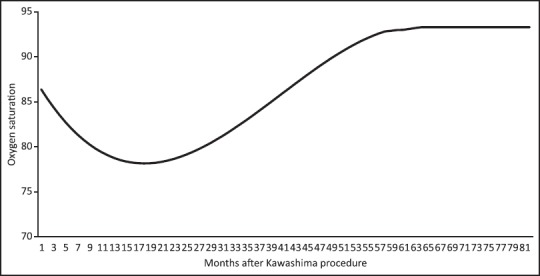
Arterial desaturation may occur after the Kawashima procedure and, in the absence of venovenous collaterals is usually due to pulmonary arteriovenous malformations. Stenting of the pulmonary arteries, oxygen therapy, and pulmonary vasodilators such as sildenafil have not been able to resolve the arterial desaturation and the only way to do this has been Fontan completion. The time course of the formation of these malformations after the Kawashima and the progression of cyanosis and its resolution after the Fontan has only been demonstrated in case reports and small case series. We pool the available data to model arterial saturations in patients with pulmonary arteriovenous malformations after the Kawashima procedure.
川岛手术后可能会出现动脉血氧饱和度降低,在没有静脉-静脉侧支循环的情况下,这通常是由于肺动静脉畸形所致。肺动脉支架置入术、氧疗以及西地那非等肺血管扩张剂均无法解决动脉血氧饱和度降低的问题,而解决这一问题的唯一方法是完成Fontan手术。这些畸形在川岛手术后的形成时间进程、发绀的进展情况以及Fontan手术后发绀的缓解情况仅在病例报告和小病例系列中有过描述。我们汇总现有数据,以模拟川岛手术后患有肺动静脉畸形患者的动脉血氧饱和度情况。