Nishida Motohiro, Kumagai Yoshito, Ihara Hideshi, Fujii Shigemoto, Motohashi Hozumi, Akaike Takaaki
Division of Cardiocirculatory Signaling, Okazaki Institute for Integrative Bioscience (National Institute for Physiological Sciences), National Institutes of Natural Sciences, 5-1 Higashiyama, Myodaiji-cho, Okazaki 444-8787, Japan; Department of Translational Pharmaceutical Sciences, Graduate School of Pharmaceutical Sciences, Kyushu University, 3-1-1 Maidashi, Higashi-ku, Fukuoka 812-8582, Japan; PRESTO, Japan Science and Technology Agency (JST), 4-1-8 Honcho, Kawaguchi 332-0012, Japan.
Environmental Biology Section, Faculty of Medicine, University of Tsukuba, 1-1-1 Tennodai, Tsukuba 305-8575, Japan.
J Clin Biochem Nutr. 2016 Mar;58(2):91-8. doi: 10.3164/jcbn.15-111. Epub 2016 Feb 17.
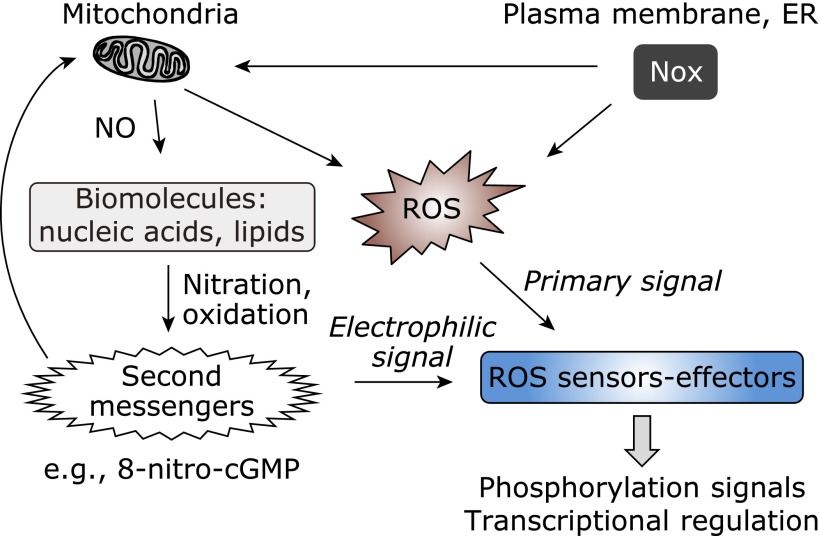
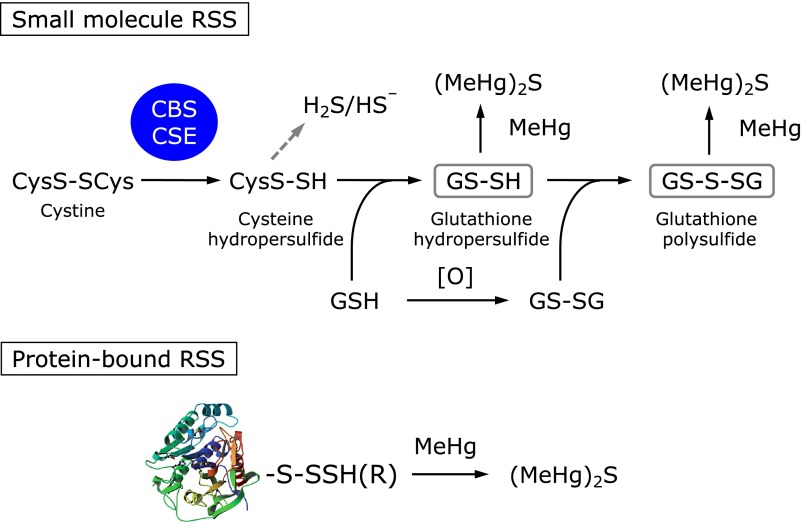
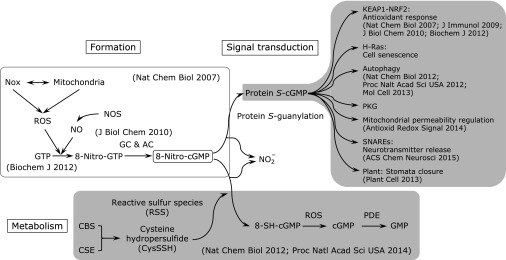
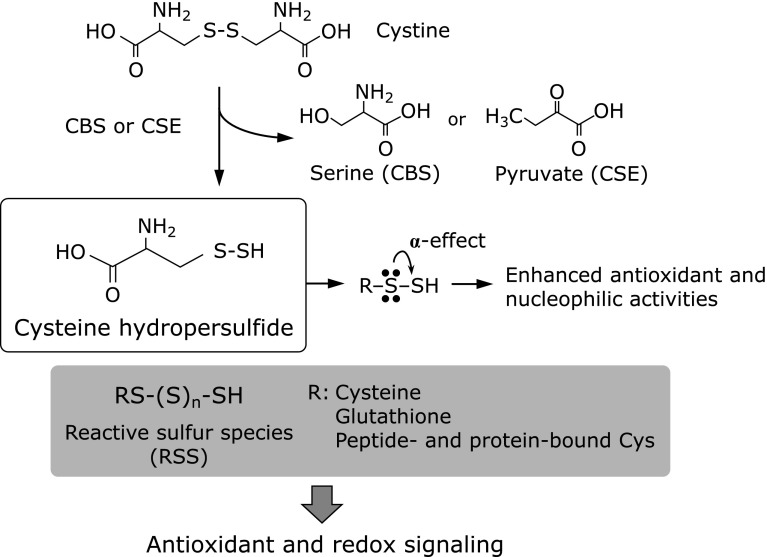
Redox signaling is a key modulator of oxidative stress induced by nonspecific insults of biological molecules generated by reactive oxygen species. Current redox biology is revisiting the traditional concept of oxidative stress, such that toxic effects of reactive oxygen species are protected by diverse antioxidant systems upregulated by oxidative stress responses that are physiologically mediated by redox-dependent cell signaling pathways. Redox signaling is thus precisely regulated by endogenous electrophilic substances that are generated from reactive oxygen species and nitric oxide and its derivative reactive species during stress responses. Among electrophiles formed endogenously, 8-nitroguanosine 3',5'-cyclic monophosphate (8-nitro-cGMP) has unique cell signaling functions, and pathways for its biosynthesis, signaling mechanism, and metabolism in cells have been clarified. Reactive sulfur species such as cysteine hydropersulfides that are abundant in cells are likely involved in 8-nitro-cGMP metabolism. These new aspects of redox biology may stimulate innovative and multidisciplinary research in cell and stem cell biology; infectious diseases, cancer, metabolic syndrome, ageing, and neurodegenerative diseases; and other oxidative stress-related disorders. This review focuses on the most recent progress in the biosynthesis, cell signaling, and metabolism of 8-nitro-cGMP, which is a likely target for drug development and lead to discovery of novel therapeutics for many diseases.
氧化还原信号传导是由活性氧产生的生物分子非特异性损伤所诱导的氧化应激的关键调节因子。当前的氧化还原生物学正在重新审视氧化应激的传统概念,即活性氧的毒性作用受到多种抗氧化系统的保护,这些抗氧化系统由氧化应激反应上调,而氧化应激反应由氧化还原依赖性细胞信号通路进行生理介导。因此,氧化还原信号传导由内源性亲电物质精确调节,这些亲电物质是在应激反应期间由活性氧、一氧化氮及其衍生的活性物质产生的。在细胞内源性形成的亲电物质中,8-硝基鸟苷3',5'-环一磷酸(8-硝基-cGMP)具有独特的细胞信号传导功能,其生物合成途径、信号传导机制以及在细胞中的代谢已经得到阐明。细胞中丰富的反应性硫物质,如半胱氨酸氢过硫化物,可能参与8-硝基-cGMP的代谢。氧化还原生物学的这些新方面可能会刺激细胞和干细胞生物学、传染病、癌症、代谢综合征、衰老和神经退行性疾病以及其他与氧化应激相关疾病的创新和多学科研究。本综述重点关注8-硝基-cGMP的生物合成、细胞信号传导和代谢的最新进展,8-硝基-cGMP可能是药物开发的靶点,并有望发现许多疾病的新型治疗方法。