Ranty Benoît, Aldon Didier, Cotelle Valérie, Galaud Jean-Philippe, Thuleau Patrice, Mazars Christian
Laboratoire de Recherche en Sciences Végétales, Université de Toulouse, CNRS, UPS Auzeville, Castanet-Tolosan, France.
Front Plant Sci. 2016 Mar 16;7:327. doi: 10.3389/fpls.2016.00327. eCollection 2016.
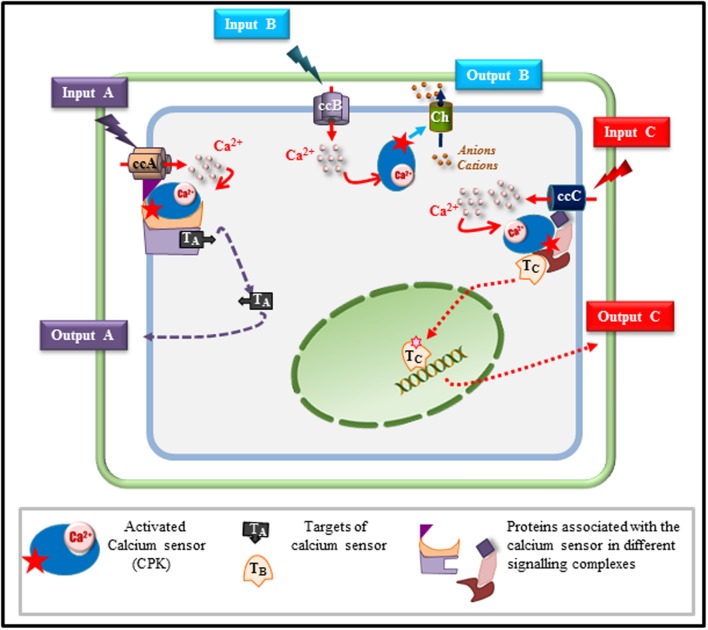
The Ca(2+) ion is recognized as a crucial second messenger in signaling pathways coupling the perception of environmental stimuli to plant adaptive responses. Indeed, one of the earliest events following the perception of environmental changes (temperature, salt stress, drought, pathogen, or herbivore attack) is intracellular variation of free calcium concentrations. These calcium variations differ in their spatio-temporal characteristics (subcellular location, amplitude, kinetics) with the nature and strength of the stimulus and, for this reason, they are considered as signatures encrypting information from the initial stimulus. This information is believed to drive a specific response by decoding via calcium-binding proteins. Based on recent examples, we illustrate how individual calcium sensors from the calcium-dependent protein kinase and calmodulin-like protein families can integrate inputs from various environmental changes. Focusing on members of these two families, shown to be involved in plant responses to both abiotic and biotic stimuli, we discuss their role as key hubs and we put forward hypotheses explaining how they can drive the signaling pathways toward the appropriate plant responses.
钙离子被认为是信号通路中至关重要的第二信使,该信号通路将环境刺激的感知与植物的适应性反应联系起来。事实上,在感知环境变化(温度、盐胁迫、干旱、病原体或食草动物攻击)后最早发生的事件之一是细胞内游离钙浓度的变化。这些钙变化在时空特征(亚细胞定位、幅度、动力学)上因刺激的性质和强度而异,因此,它们被视为加密来自初始刺激信息的信号特征。据信,这些信息通过与钙结合蛋白解码来驱动特定反应。基于最近的实例,我们阐述了来自钙依赖蛋白激酶和类钙调蛋白家族的单个钙传感器如何整合来自各种环境变化的输入。聚焦于这两个家族中已表明参与植物对非生物和生物刺激反应的成员,我们讨论了它们作为关键枢纽的作用,并提出假设解释它们如何驱动信号通路朝着适当的植物反应发展。