Maclellan Reid A, Chaudry Gulraiz, Greene Arin K
Department of Plastic and Oral Surgery, and Department of Radiology, Vascular Anomalies Center, Lymphedema Program Boston Children's Hospital, Harvard Medical School, Boston, Mass.
Plast Reconstr Surg Glob Open. 2016 Feb 10;4(2):e618. doi: 10.1097/GOX.0000000000000487. eCollection 2016 Feb.
Primary lymphedema and capillary malformation are independent vascular malformations that can cause overgrowth of the lower extremity. We report a series of patients who had both types of malformations affecting the same leg. The condition is unique but may be confused with other types of vascular malformation overgrowth conditions (eg, Klippel-Trenaunay and Parkes Weber).
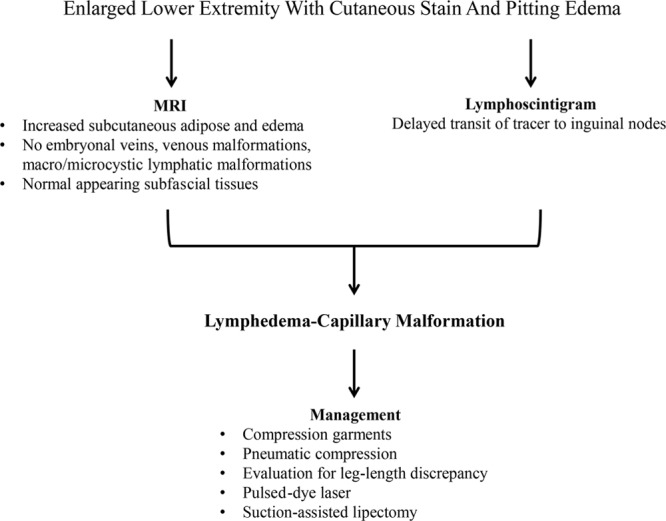
Our Vascular Anomalies Center and Lymphedema Program databases were searched for patients with both capillary malformation and lymphedema. Diagnosis of lymphedema-capillary malformation was made by history, physical examination, and imaging studies. Because lymphedema-capillary malformation has phenotypical overlap with other conditions, only patients who had imaging confirming their diagnosis were included in the analysis. Clinical and radiological features, morbidity, and treatment were recorded.
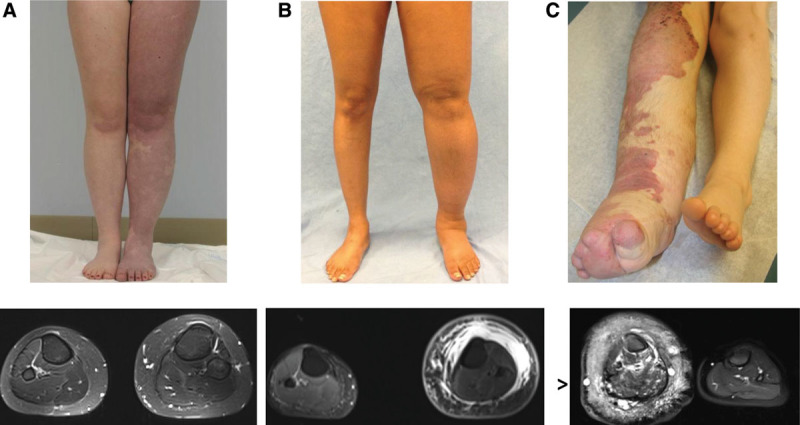
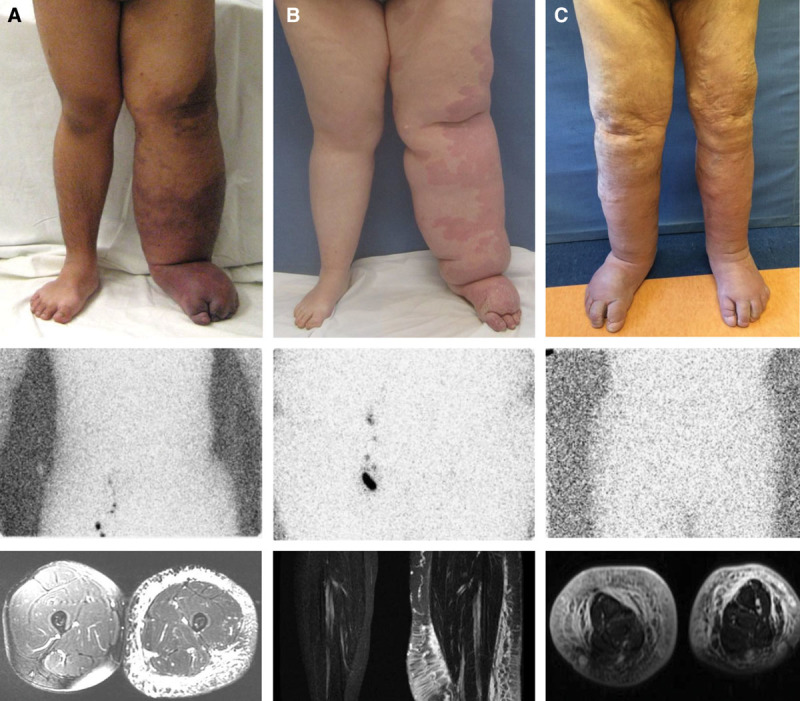
Eight patients (4 females and 4 males) had confirmed lymphedema-capillary malformation. Referring diagnosis was Klippel-Trenaunay syndrome (n = 4), diffuse capillary malformation with overgrowth (n = 3), or lymphatic malformation (n = 1). The condition was unilateral (n = 6) or bilateral (n = 2). Morbidity included infection (n = 6), difficulty fitting clothes (n = 6), bleeding or leaking vesicles (n = 5), leg length discrepancy (n = 4), and difficulty ambulating (n = 3). All patients were managed with compression regimens. Operative management was liposuction (n = 3), treatment of phlebectatic veins (n = 3), staged skin/subcutaneous excision (n = 1), and/or epiphysiodesis (n = 1).
Lymphedema and capillary malformation can occur together in the same extremity. Both conditions independently cause limb overgrowth primarily because of subcutaneous adipose deposition. Compression garments and suction-assisted lipectomy can improve the condition. Lymphedema-capillary malformation should not be confused with other vascular malformation overgrowth diseases that have different morbidities and treatments.
原发性淋巴水肿和毛细血管畸形是可导致下肢过度生长的独立血管畸形。我们报告了一系列同时患有这两种畸形且累及同一条腿的患者。这种情况较为独特,但可能会与其他类型的血管畸形过度生长疾病(如Klippel-Trenaunay综合征和Parkes Weber综合征)相混淆。
在我们的血管异常中心和淋巴水肿项目数据库中搜索同时患有毛细血管畸形和淋巴水肿的患者。通过病史、体格检查和影像学检查对淋巴水肿-毛细血管畸形进行诊断。由于淋巴水肿-毛细血管畸形与其他疾病存在表型重叠,因此仅将影像学确诊的患者纳入分析。记录临床和放射学特征、发病率及治疗情况。
8例患者(4例女性和4例男性)确诊为淋巴水肿-毛细血管畸形。转诊诊断为Klippel-Trenaunay综合征(4例)、弥漫性毛细血管畸形伴过度生长(3例)或淋巴管畸形(1例)。病变为单侧(6例)或双侧(2例)。发病率包括感染(6例)、衣服穿着困难(6例)、出血或水疱渗漏(5例)、腿长差异(4例)和行走困难(3例)。所有患者均采用加压治疗方案。手术治疗包括抽脂(3例)、曲张静脉治疗(3例)、分期皮肤/皮下切除(1例)和/或骨骺阻滞术(1例)。
淋巴水肿和毛细血管畸形可在同一肢体同时出现。这两种情况均主要因皮下脂肪沉积独立导致肢体过度生长。加压服装和抽脂辅助吸脂术可改善病情。淋巴水肿-毛细血管畸形不应与其他具有不同发病率和治疗方法的血管畸形过度生长疾病相混淆。