Mohammadzadeh Ghorban, Karimi Maryam, Bazyar Mohammad, Hosseini Seyed-Mohammad
Department of Biochemistry, Faculty of Medicine, Hyperlipidemia Research Center, Ahvaz Jundishapur University of Medical Sciences, Ahvaz, Iran.
Department of Biochemistry, Faculty of Medicine, Ahvaz Jundishapur University of Medical Sciences, Ahvaz, Iran.
Adv Biomed Res. 2016 Feb 15;5:26. doi: 10.4103/2277-9175.176352. eCollection 2016.
Association between C677T polymorphism of the methylenetetrahydrofolate reductase (MTHFR), a key enzyme involved in folate metabolism and DNA methylation, and breast cancer risk are inconsistent. We investigated in a case-control study, possible effect of the common MTHFR C677T polymorphism on breast cancer risk in a sample of Iranian patients.
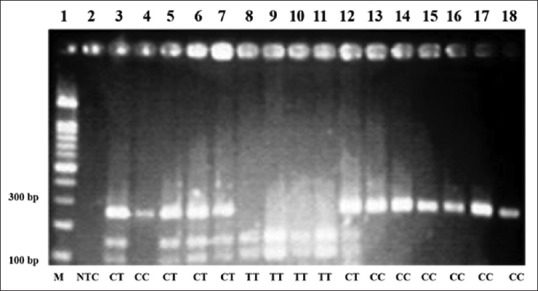
The study subjects comprised of 123 breast cancer cases and 110 cancer-free control, who were matched for age and body mass index (BMI). C677T genotypes were determined by polymerase chain reaction-restriction fragment length polymorphism (PCR-RFLP) assay. Lipid profile was measured in all subjects by standard method.
The genotypes distributions (CC, CT, and TT) were 55.3, 39, and 5.7% in breast cancer cases and 51.8, 44.5, and 3.6% in controls. Chi square analysis revealed that there was no significant association between breast cancer risk and MTHFR genotypes and alleles. Additionally, no significant association was observed between C677T genotypes and biochemistry parameters. A multinomial logistic regression model with MTHFR genotypes, lipid profiles, BMI and age as covariates revealed that there is no significant association between MTHFR genotypes and risk of breast cancer, but higher values of LDL and HDL significantly increase risk of breast cancer.
Our findings do not support the hypothesis that genetic variation in the MTHFR C677T polymorphism is implicated in the breast cancer risk in a sample of Iranian patients.
亚甲基四氢叶酸还原酶(MTHFR)是参与叶酸代谢和DNA甲基化的关键酶,其C677T多态性与乳腺癌风险之间的关联并不一致。我们在一项病例对照研究中,调查了常见的MTHFR C677T多态性对伊朗患者样本中乳腺癌风险的可能影响。
研究对象包括123例乳腺癌病例和110例无癌对照,他们在年龄和体重指数(BMI)方面进行了匹配。通过聚合酶链反应-限制性片段长度多态性(PCR-RFLP)分析确定C677T基因型。采用标准方法测量所有受试者的血脂谱。
乳腺癌病例中基因型分布(CC、CT和TT)分别为55.3%、39%和5.7%,对照组分别为51.8%、44.5%和3.6%。卡方分析显示,乳腺癌风险与MTHFR基因型和等位基因之间无显著关联。此外,未观察到C677T基因型与生化参数之间存在显著关联。以MTHFR基因型、血脂谱、BMI和年龄作为协变量的多项逻辑回归模型显示,MTHFR基因型与乳腺癌风险之间无显著关联,但低密度脂蛋白(LDL)和高密度脂蛋白(HDL)水平升高显著增加乳腺癌风险。
我们的研究结果不支持以下假设:在伊朗患者样本中,MTHFR C677T多态性的基因变异与乳腺癌风险有关。