Wright David D I, Paty Jean, Turner-Bowker Diane M, Bradbury Andrew
BTG International, Ltd., Lakeview, Riverside Way, Watchmoor Park, Camberley, Surrey, GU15 3YL, UK.
ERT, Pittsburgh, PA, USA.
Patient. 2016 Aug;9(4):335-48. doi: 10.1007/s40271-015-0159-3.
To evaluate the psychometric properties of the VVSymQ(®) instrument, a new 5-item patient-reported outcome (PRO) measure for symptoms of varicose veins.
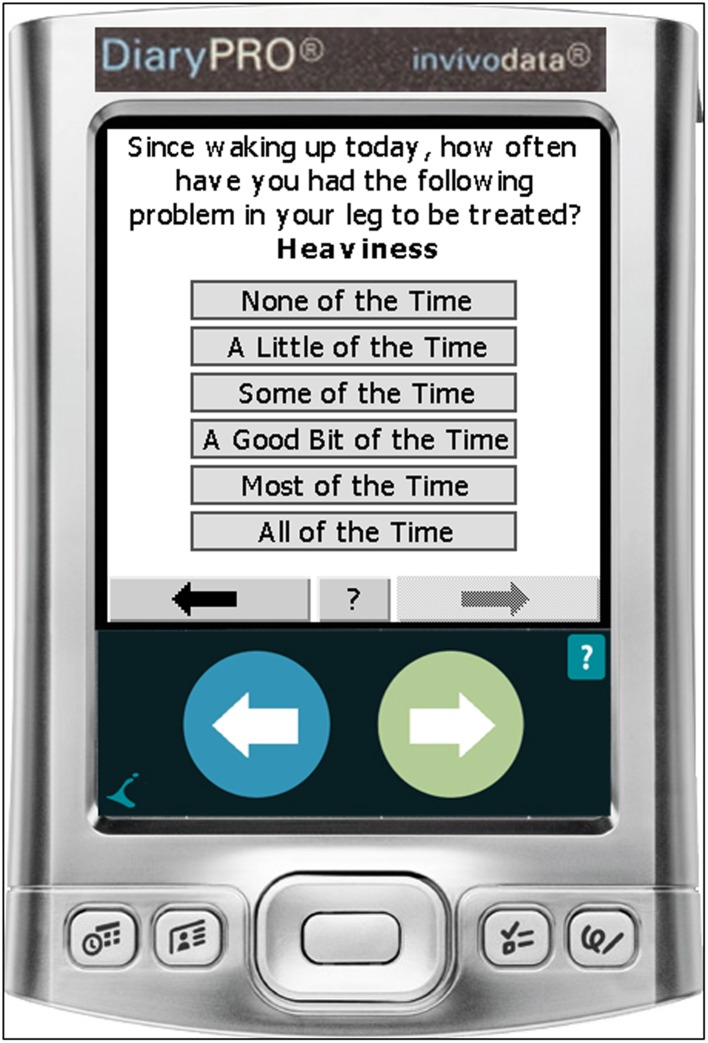
The VVSymQ(®) electronic daily diary was administered to outpatients who received routine treatment for varicose veins (N = 40). Compliance with diary administration and item score variability, reliability, construct validity, sensitivity to change, and clinically meaningful change were evaluated.
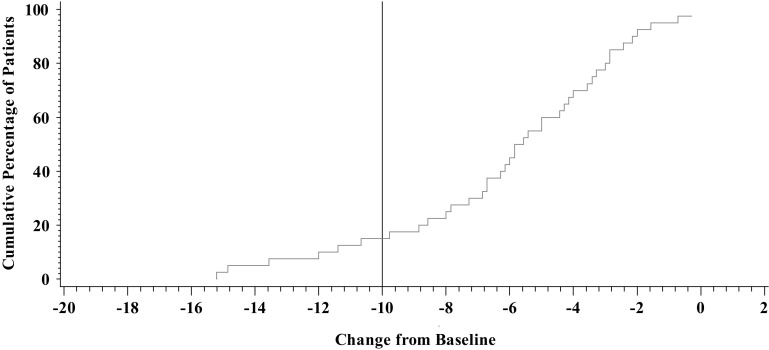
Patients completed >97 % of scheduled diary assessments (at screening, baseline, and week 8). The VVSymQ(®) instrument captured patients' pre-treatment symptoms (all VVSymQ(®) symptoms were endorsed by ≥75 % of patients at baseline), and the change post-treatment (mean change in score -6.1), with a large Cohen effect size (1.6). Test-retest reliability was high (intraclass correlation coefficient 0.96); internal consistency was good (Cronbach's alpha ≥0.76; baseline, week 8). VVSymQ(®) scores were more strongly associated with PRO scores that reflect symptoms and symptom impact (the Venous Insufficiency Epidemiological and Economic Study-Quality of Life/Symptoms [VEINES-QOL/Sym] instrument and the Chronic Venous Insufficiency Quality-of-Life Questionnaire [CIVIQ-20]) than with PRO scores that reflect appearance (the Patient Self-Assessment of Appearance of Visible Varicose Veins [PA-V(3)]) or clinician-reported outcome scores (the Clinical-Etiology-Anatomy-Pathophysiology [CEAP] Classification of Venous Disorders and Venous Clinical Severity Score [VCSS]), demonstrating construct validity. Patients reporting that symptoms were "moderately" or "much improved" on the Patient Global Impression of Change (PGIC) anchor (i.e., >97 % of patients) had mean improvements of -6.3 VVSymQ(®) points, while a cumulative distribution curve showed that 50 % of patients improved by ≥-5.8 points; thus, a score change of approximately -6 demonstrated a clinically meaningful change in this study. The clinically meaningful change in the VVSymQ(®) score was greater in patients with a greater baseline VVSymQ(®) symptom burden, and the VVSymQ(®) instrument captured clinically meaningful treatment benefit even in patients with a low baseline symptom burden.
The 5-item VVSymQ(®) instrument is a brief, psychometrically sound, useful tool for evaluating patient-reported varicose veins symptoms.
评估VVSymQ(®)工具的心理测量特性,这是一种新的用于评估静脉曲张症状的5项患者报告结局(PRO)指标。
对接受静脉曲张常规治疗的门诊患者(N = 40)使用VVSymQ(®)电子日记。评估日记填写的依从性、项目得分变异性、可靠性、结构效度、对变化的敏感性以及具有临床意义的变化。
患者完成了>97%的预定日记评估(在筛查、基线和第8周)。VVSymQ(®)工具捕捉到了患者的治疗前症状(所有VVSymQ(®)症状在基线时≥75%的患者认可)以及治疗后的变化(得分平均变化-6.1),科恩效应量较大(1.6)。重测信度较高(组内相关系数0.96);内部一致性良好(克朗巴哈α系数≥0.76;基线、第8周)。与反映外观的PRO得分(可见静脉曲张外观患者自我评估[PA-V(3)])或临床医生报告的结局得分(静脉疾病临床病因-解剖-病理生理学[CEAP]分类和静脉临床严重程度评分[VCSS])相比,VVSymQ(®)得分与反映症状及症状影响的PRO得分(静脉功能不全流行病学和经济研究-生活质量/症状[VEINES-QOL/Sym]工具和慢性静脉功能不全生活质量问卷[CIVIQ-20])的相关性更强,证明了结构效度。在患者总体印象变化(PGIC)锚定中报告症状“中度”或“明显改善”的患者(即>97%的患者)VVSymQ(®)得分平均改善-6.3分,而累积分布曲线显示50%的患者改善≥-5.8分;因此,在本研究中,得分变化约-6分表明具有临床意义的变化。VVSymQ(®)得分具有临床意义的变化在基线VVSymQ(®)症状负担较重的患者中更大,并且即使在基线症状负担较低的患者中,VVSymQ(®)工具也能捕捉到具有临床意义的治疗益处。
5项VVSymQ(®)工具是一种简短、心理测量学可靠、用于评估患者报告的静脉曲张症状的有用工具。