Luque-Cabal María, García-Teijido Paula, Fernández-Pérez Yolanda, Sánchez-Lorenzo Luisa, Palacio-Vázquez Isabel
Department of Medical Oncology, Hospital Universitario Central de Asturias, Oviedo, Asturias, Spain.
Department of Medical Oncology, Hospital San Agustín, Avilés, Asturias, Spain.
Clin Med Insights Oncol. 2016 Mar 28;10(Suppl 1):21-30. doi: 10.4137/CMO.S34537. eCollection 2016.
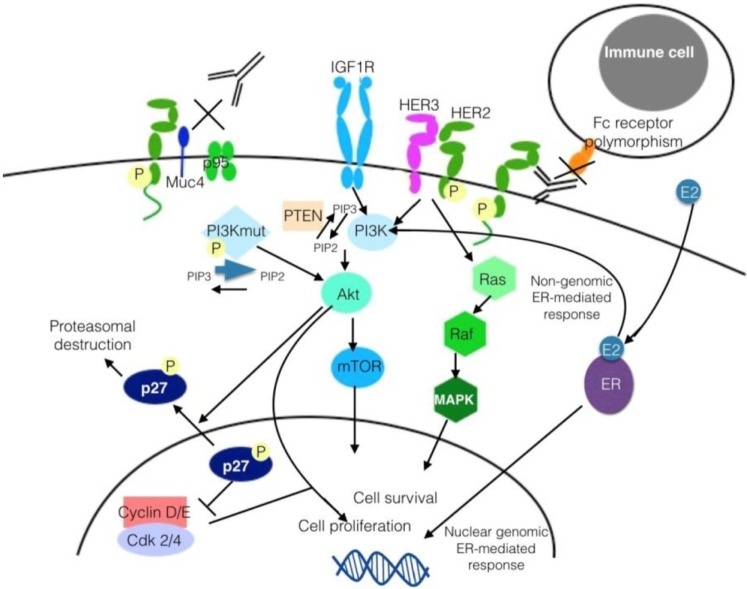
The introduction of trastuzumab therapy markedly improved the poor prognosis associated with HER2-amplified breast cancers. Despite this, the presence of primary and acquired resistance to trastuzumab treatment remains a significant common challenge. The identification of resistance mechanisms and the incorporation of new drugs that achieve a better blockade of HER family receptors signaling have resulted in improved outcomes. The phosphatidylinositol 3'-kinase/protein kinase B/mammalian target of rapamycin pathway, cross-talk with estrogen receptors, immune response, cell cycle control mechanisms, and other tyrosine kinase receptors such as insulin-like growth factor I receptor are potential pathways involved in trastuzumab resistance. Different therapeutic interventions targeting these pathways are currently under evaluation.
曲妥珠单抗疗法的引入显著改善了与HER2扩增型乳腺癌相关的不良预后。尽管如此,对曲妥珠单抗治疗的原发性和获得性耐药的存在仍然是一个重大的共同挑战。耐药机制的识别以及能够更好地阻断HER家族受体信号传导的新药的加入,已带来了更好的治疗结果。磷脂酰肌醇3'-激酶/蛋白激酶B/雷帕霉素哺乳动物靶点通路、与雌激素受体的相互作用、免疫反应、细胞周期调控机制以及其他酪氨酸激酶受体(如胰岛素样生长因子I受体)是参与曲妥珠单抗耐药的潜在通路。目前正在评估针对这些通路的不同治疗干预措施。