de Castro Nathalie, Braun Joséphine, Charreau Isabelle, Lafeuillade Alain, Viard Jean-Paul, Allavena Clotilde, Aboulker Jean-Pierre, Molina Jean-Michel
Department of Infectious Diseases, Assistance Publique Hôpitaux de Paris, Saint-Louis Hospital, University of Paris Diderot Paris 7, 1 avenue Claude Vellefaux, 75010 Paris, France.
INSERM SC10-US019, Villejuif, France.
AIDS Res Ther. 2016 Apr 2;13:17. doi: 10.1186/s12981-016-0101-3. eCollection 2016.
In the ANRS EASIER trial where treatment-experienced patients switched from enfuvirtide (ENF) to raltegravir (RAL), a high incidence of transaminase elevation was reported in the RAL arm.
We compared the incidence of emergent liver enzyme elevations (LEE) of grade 2 or more among patients randomized to the maintenance ENF arm or the switch RAL arm up to W24. We also assessed the overall incidence of LEE over the 48-week duration of the trial and baseline risk factors for grade 2 or more alanine aminotransferase (ALT) elevation using univariate and multivariate analyses.
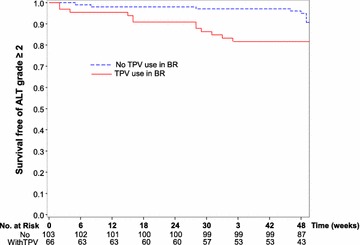
During the first 24 weeks, 6/84 (7.1 %) and 2/85 patients (2.4 %) presented with ALT elevation of grade 2 or more in the RAL and ENF arms, respectively (p = 0.21). Grade 2 or more γGT and ALP elevations were seen in 18 and 11 % (p = 0.35), and 5 and 1 % (p = 0.14) of patients in the RAL and ENF arms, respectively. The 48-week incidence of grade 2 or more LEE was 11.6 per 100-pts-years for ALT, 24.5 per 100-pts-years for γ-GT and 4.5 per 100-pts-years for ALP, respectively. In the multivariate analysis, tipranavir/ritonavir use (OR 3.66; 95 % CI [1.20-11.1], p = 0.022) and elevated ALT at baseline (OR 10.3; 95 % CI [2.67-39.6], p < 10(-3)) were significantly associated with a grade 2 or more ALT elevation during follow-up.
The incidence of LEE was relatively high in these highly treatment-experienced patients switching to a RAL-based regimen. Both tipranavir/ritonavir use and high baseline ALT levels were associated with an increased risk of ALT.
ClinicalTrials.gov identifier: NCT00454337.
在ANRS EASIER试验中,有治疗经验的患者从恩夫韦肽(ENF)换用拉替拉韦(RAL),RAL组报告了较高的转氨酶升高发生率。
我们比较了随机分配至维持ENF组或换用RAL组的患者至第24周时2级及以上新发肝酶升高(LEE)的发生率。我们还评估了试验48周期间LEE的总体发生率以及使用单因素和多因素分析方法分析2级及以上丙氨酸氨基转移酶(ALT)升高的基线危险因素。
在最初24周内,RAL组和ENF组分别有6/84(7.1%)和2/85例患者(2.4%)出现2级及以上ALT升高(p = 0.21)。RAL组和ENF组分别有18%和11%的患者出现2级及以上γ-GT升高(p = 0.35),以及5%和1%的患者出现2级及以上碱性磷酸酶(ALP)升高(p = 0.14)。2级及以上LEE的48周发生率分别为:ALT每100人年11.6例、γ-GT每100人年24.5例、ALP每100人年4.5例。在多因素分析中,使用替拉那韦/利托那韦(比值比[OR] 3.66;95%置信区间[CI][1.20 - 11.1],p = 0.022)和基线ALT升高(OR 10.3;95% CI[2.67 - 39.6],p < 10⁻³)与随访期间2级及以上ALT升高显著相关。
在这些换用基于RAL方案的高度有治疗经验的患者中,LEE的发生率相对较高。使用替拉那韦/利托那韦和高基线ALT水平均与ALT升高风险增加相关。
ClinicalTrials.gov标识符:NCT00454337。