Du Wenjing, Li Xue, Chi Ying, Ma Fengxia, Li Zongjin, Yang Shaoguang, Song Baoquan, Cui Junjie, Ma Tao, Li Juanjuan, Tian Jianjian, Yang Zhouxin, Feng Xiaoming, Chen Fang, Lu Shihong, Liang Lu, Han Zhi-Bo, Han Zhong-Chao
The State Key Laboratory of Experimental Hematology, Institute of Hematology and Hospital of Blood Diseases, Chinese Academy of Medical Sciences & Peking Union Medical College, No.288, Nanjing Road, Heping District, Tianjin, 300020, China.
Beijing Institute of Health and Stem Cells, No.1 Kangding Road, BDA, Beijing, 100176, China.
Stem Cell Res Ther. 2016 Apr 4;7:49. doi: 10.1186/s13287-016-0297-0.
Mesenchymal stem cells (MSCs) represent a heterogeneous cell population that is promising for regenerative medicine. The present study was designed to assess whether VCAM-1 can be used as a marker of MSC subpopulation with superior angiogenic potential.
MSCs were isolated from placenta chorionic villi (CV). The VCAM-1(+/-) CV-MSCs population were separated by Flow Cytometry and subjected to a comparative analysis for their angiogenic properties including angiogenic genes expression, vasculo-angiogenic abilities on Matrigel in vitro and in vivo, angiogenic paracrine activities, cytokine array, and therapeutic angiogenesis in vascular ischemic diseases.
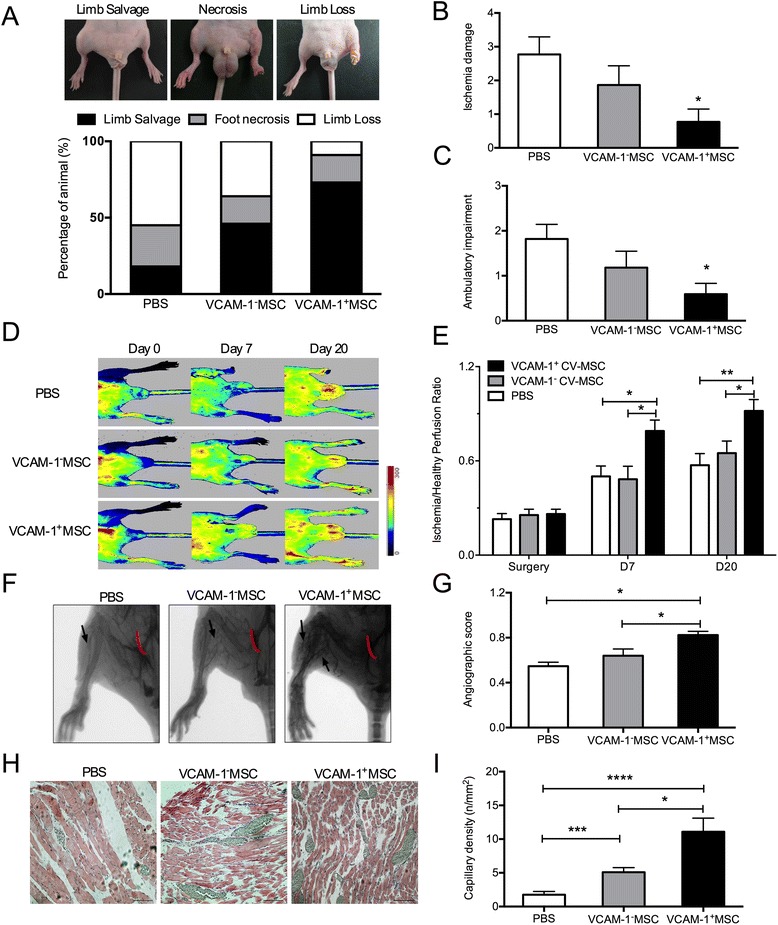
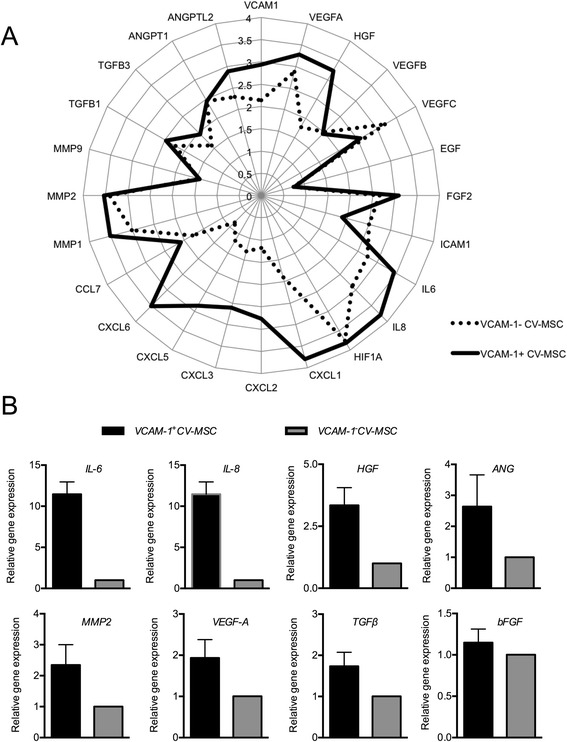
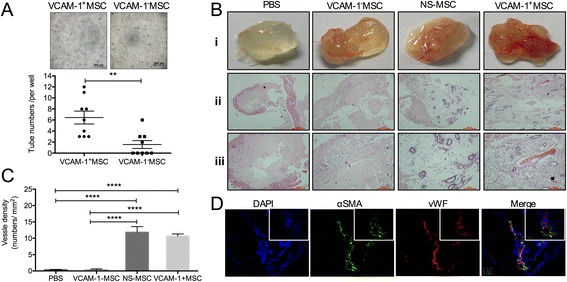
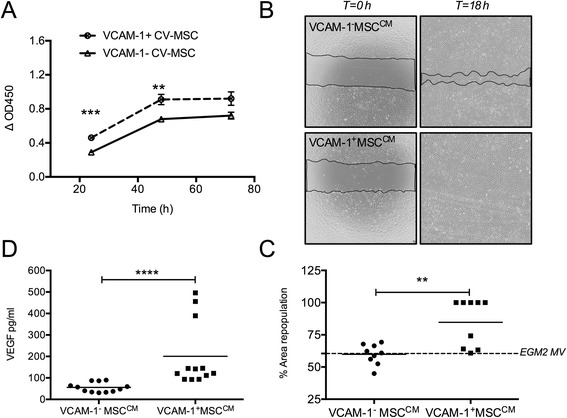
Angiogenic genes, including HGF, ANG, IL8, IL6, VEGF-A, TGFβ, MMP2 and bFGF, were up-regulated in VCAM-1(+)CV-MSCs. Consistently, angiogenic cytokines especially HGF, IL8, angiogenin, angiopoitin-2, μPAR, CXCL1, IL-1β, IL-1α, CSF2, CSF3, MCP-3, CTACK, and OPG were found to be significantly increased in VCAM-1(+) CV-MSCs. Moreover, VCAM-1(+)CV-MSCs showed remarkable vasculo-angiogenic abilities by angiogenesis analysis with Matrigel in vitro and in vivo and the conditioned medium of VCAM-1(+) CV-MSCs exerted markedly pro-proliferative and pro-migratory effects on endothelial cells compared to VCAM-1(-)CV-MSCs. Finally, transplantation of VCAM-1(+)CV-MSCs into the ischemic hind limb of BALB/c nude mice resulted in a significantly functional improvement in comparison with VCAM-1(-)CV-MSCs transplantation.
VCAM-1(+)CV-MSCs possessed a favorable angiogenic paracrine activity and displayed therapeutic efficacy on hindlimb ischemia. Our results suggested that VCAM-1(+)CV-MSCs may represent an important subpopulation of MSC for efficient therapeutic angiogenesis.
间充质干细胞(MSCs)是一类具有异质性的细胞群体,在再生医学领域具有广阔前景。本研究旨在评估血管细胞黏附分子-1(VCAM-1)是否可作为具有更高血管生成潜能的间充质干细胞亚群的标志物。
从胎盘绒毛膜(CV)中分离间充质干细胞。通过流式细胞术分离出VCAM-1(+/-)的CV-MSCs群体,并对其血管生成特性进行比较分析,包括血管生成基因表达、在体外和体内基质胶上的血管生成能力、血管生成旁分泌活性、细胞因子阵列以及在血管缺血性疾病中的治疗性血管生成作用。
在VCAM-1(+)CV-MSCs中,包括肝细胞生长因子(HGF)、血管生成素(ANG)、白细胞介素8(IL8)、白细胞介素6(IL6)、血管内皮生长因子A(VEGF-A)、转化生长因子β(TGFβ)、基质金属蛋白酶2(MMP2)和碱性成纤维细胞生长因子(bFGF)在内的血管生成基因上调。一致地,在VCAM-1(+)CV-MSCs中发现血管生成细胞因子尤其是HGF、IL8、血管生成素、血管生成素-2、尿激酶型纤溶酶原激活物受体(μPAR)、CXC趋化因子配体1(CXCL1)、白细胞介素-1β(IL-1β)、白细胞介素-1α(IL-1α)、集落刺激因子2(CSF2)、集落刺激因子3(CSF3)、单核细胞趋化蛋白-3(MCP-3)、皮肤T细胞趋化因子(CTACK)和骨保护素(OPG)显著增加。此外,通过体外和体内基质胶血管生成分析,VCAM-1(+)CV-MSCs显示出显著的血管生成能力,与VCAM-(-)CV-MSCs相比,VCAM-1(+)CV-MSCs的条件培养基对内皮细胞具有明显的促增殖和促迁移作用。最后,将VCAM-1(+)CV-MSCs移植到BALB/c裸鼠的缺血后肢,与VCAM-1(-)CV-MSCs移植相比,功能有显著改善。
VCAM-1(+)CV-MSCs具有良好的血管生成旁分泌活性,并对后肢缺血显示出治疗效果。我们的结果表明,VCAM-1(+)CV-MSCs可能代表间充质干细胞的一个重要亚群,可用于高效的治疗性血管生成。