Tramboo S R, Shahardar R A, Allaie I M, Wani Z A, Bushra M S
Division of Veterinary Parasitology, Faculty of Veterinary Science and Animal Husbandry, Sher-E-Kashmir University of Agricultural Sciences and Technology of Kashmir, Shuhama Campus, Alusteng, Srinagar - 190 006, Jammu and Kashmir, India.
Vet World. 2015 Oct;8(10):1199-204. doi: 10.14202/vetworld.2015.1199-1204. Epub 2015 Oct 17.
Gastrointestinal (GI) helminth parasitism is one of the major constraints for profitable sheep production. Due to variations in the prevalence of GI helminths from region to region, it becomes important to map out accurately the parasitic fauna of a particular region for development of suitable control measures.
An extensive study of GI helminths was carried out in Budgam district of Kashmir Valley over a period of 1 year. A total of 1200 fresh ovine faecal samples from both sexes of young ones and adults were collected in sterilized plastic bags and examined by standard sedimentation and floatation techniques. Positive faecal samples (15-20%) in each season were examined by Stoll's dilution method to determine the parasitic load. A total of 120 faecal samples (30 samples in each season) positive for strongyle eggs were subjected to coproculture using Petridish method and the third stage larvae were harvested to find out prevalence of different genera of strongyle worms.
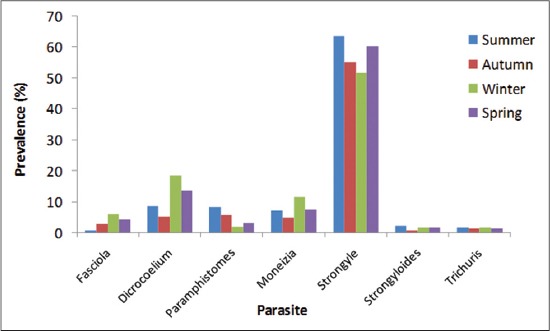
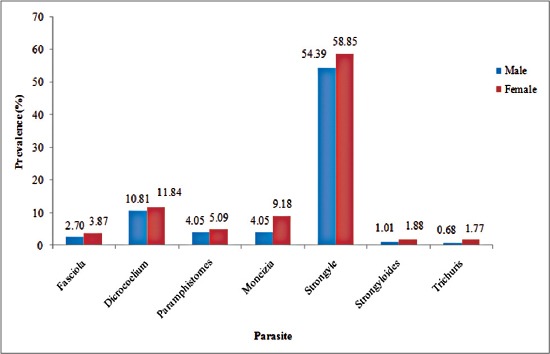
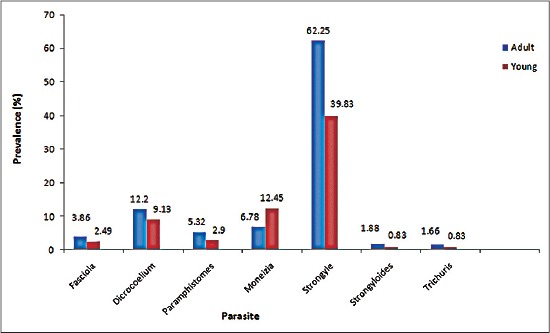
The overall prevalence of GI helminths was found to be 77% with platyhelminths and nemathelminthes in 26.58 and 60.92% animals, respectively. The overall prevalence of mixed GI helminths was found to be 8.67%. Eggs of various helminths encountered in the present study were those of Fasciola spp. (3.58%), Dicrocoelium spp. (11.58%), paramphistomes (4.83%), Moniezia spp. (7.92%), strongyle worms including Nematodirus spp. (57.75%), Strongyloides spp. (1.67%), and Trichuris spp. (1.5%). On coprocultural examination Haemonchus spp. (55%) was found to be most predominant strongyle worm followed by Trichostrongylus spp. (17.5%), Ostertagia spp. (11.67%), Oesophagostomum spp. (9.17%), and Chabertia spp. (6.67%). On seasonal basis, highest prevalence of GI helminths was recorded in summer (83.00%) followed by spring (78.67%), winter (76.33%), and autumn (70.00%), the difference being statistically non-significant (p>0.05). The prevalence of platyhelminths (Fasciola spp., Dicrocoelium spp. and Moniezia spp.) was found to be non-significantly higher in winter, but paramphistomes showed the highest prevalence in the summer season. Nemathelminth infection was found highest in summer season and lowest during the winter season. Eggs per gram (EPG) ranged from 0 to 1800, and an average EPG count was found to be 454.35±27.85. EPG was found to be highest in summer (684.00±69.83) and lowest in winter (202.38±18.82). The overall prevalence of GI helminths was found more in adult sheep (83.00%) compared to young ones (53.11%), the difference being statistically significant (p<0.05). Similarly, the prevalence of helminths was found to be higher in females (78.32%) as compared to males (72.97%), the variation being statistically non-significant (p>0.05).
Seasonal variation plays an important role in the prevalence of GI helminths in addition to age and sex of the animal.
胃肠道蠕虫寄生是盈利性养羊生产的主要制约因素之一。由于不同地区胃肠道蠕虫的流行率存在差异,准确查明特定地区的寄生虫区系对于制定合适的控制措施至关重要。
在克什米尔山谷的布德甘姆地区对胃肠道蠕虫进行了为期1年的广泛研究。共收集了1200份来自幼羊和成羊两性的新鲜粪便样本,装入无菌塑料袋中,并采用标准沉淀和漂浮技术进行检测。每个季节的阳性粪便样本(15 - 20%)采用斯托尔稀释法检测以确定寄生虫负荷。对总共120份圆线虫卵阳性的粪便样本(每个季节30份)采用培养皿法进行粪便培养,并收集第三期幼虫以查明不同属圆线虫的流行情况。
发现胃肠道蠕虫的总体流行率为77%,其中吸虫和线虫分别感染26.58%和60.92%的动物。混合胃肠道蠕虫的总体流行率为8.67%。本研究中遇到的各种蠕虫卵为肝片吸虫属(3.58%)、双腔吸虫属(11.58%)、同盘吸虫(4.83%)、莫尼茨绦虫属(7.92%)、包括细颈线虫属在内的圆线虫(57.75%)、类圆线虫属(1.67%)和毛首线虫属(1.5%)的卵。粪便培养检查发现血矛线虫属(55%)是最主要的圆线虫,其次是毛圆线虫属(17.5%)、奥斯特他线虫属(11.67%)、食道口线虫属(9.17%)和夏伯特线虫属(6.67%)。按季节来看,胃肠道蠕虫的最高流行率出现在夏季(83.00%),其次是春季(78.67%)、冬季(76.33%)和秋季(70.00%),差异无统计学意义(p>0.05)。发现吸虫(肝片吸虫属、双腔吸虫属和莫尼茨绦虫属)的流行率在冬季略高但无统计学意义,但同盘吸虫在夏季的流行率最高。线虫感染在夏季最高,冬季最低。每克粪便虫卵数(EPG)范围为0至1800,平均EPG计数为454.35±27.85。EPG在夏季最高(684.00±69.83),冬季最低(202.38±18.82)。发现成年羊胃肠道蠕虫的总体流行率(83.00%)高于幼羊(53.11%),差异有统计学意义(p<0.05)。同样,蠕虫在雌性中的流行率(78.32%)高于雄性(72.97%),差异无统计学意义(p>0.05)。
除动物的年龄和性别外,季节变化在胃肠道蠕虫的流行中起着重要作用。