
使用台式螺旋式热解器生产的日本雪松生物油的特性分析。
Characterization of Japanese cedar bio-oil produced using a bench-scale auger pyrolyzer.
作者信息
Kato Yoshiaki, Enomoto Ryohei, Akazawa Minami, Kojima Yasuo
机构信息
Department of Applied Biochemistry, Faculty of Agriculture, Niigata University, Niigata, 950-2181 Japan.
Graduate School of Science and Technology, Niigata University, Niigata, 950-2181 Japan.
出版信息
Springerplus. 2016 Apr 1;5:177. doi: 10.1186/s40064-016-1848-7. eCollection 2016.
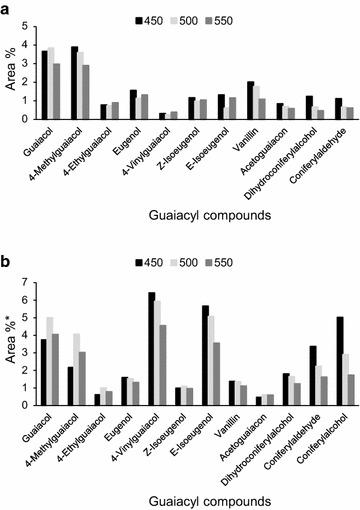
A bench-scale auger reactor was designed for use as a laboratory-scale fast pyrolyzer for producing bio-oil from Japanese cedar. An analytical pyrolysis method was performed simultaneously to determine the distribution of pyrolysis products. The pyrolysis temperature was found to have the greatest influence on the bio-oil characteristics; bio-oil yields increased as the pyrolysis temperature increased from 450 to 550 °C. The concentration of levoglucosan in the bio-oil, however, decreased significantly with increasing pyrolysis temperature, while it increased following analytical pyrolysis. The same results were obtained for 4-vinylguaiacol and E-isoeugenol, which were the major secondary products produced in the present study. Compared to the yields of these major products obtained via analytical pyrolysis, the yields from the auger reactor were very low, indicating that the auger reactor process had a longer vapor residence time than the analytical pyrolysis process, resulting in the acceleration of secondary reactions of the pyrolysates. The pH values and densities of the bio-oils produced in the auger reactor were similar to those reported by researchers using woody biomass, despite their lower viscosities. From these results, it was concluded that the pyrolysis temperature and residence time of the pyrolysates played a significant role in determining the characteristics of the cedar bio-oil.
设计了一种实验室规模的螺旋式反应器,用作从日本雪松生产生物油的实验室规模快速热解器。同时采用分析热解方法来确定热解产物的分布。发现热解温度对生物油特性影响最大;随着热解温度从450℃升高到550℃,生物油产率增加。然而,生物油中左旋葡聚糖的浓度随着热解温度的升高而显著降低,而在分析热解后其浓度增加。本研究中产生的主要次级产物4-乙烯基愈创木酚和E-异丁香酚也得到了相同的结果。与通过分析热解获得的这些主要产物的产率相比,螺旋式反应器的产率非常低,这表明螺旋式反应器过程的蒸汽停留时间比分析热解过程长,导致热解产物的次级反应加速。尽管螺旋式反应器生产的生物油粘度较低,但其pH值和密度与使用木质生物质的研究人员报告的相似。从这些结果可以得出结论,热解温度和热解产物的停留时间在决定雪松生物油的特性方面起着重要作用。


 Zotero 插件