Ezzine-de-Blas Driss, Dutilly Céline, Lara-Pulido José-Alberto, Le Velly Gwenolé, Guevara-Sanginés Alejando
CIRAD (Centre de Coopération Internationale en Recherche Agronomique pour le Développement), Montpellier, France.
Universidad Iberoamericana del Distrito Federal, Mexico City, Mexico.
PLoS One. 2016 Apr 6;11(4):e0152514. doi: 10.1371/journal.pone.0152514. eCollection 2016.
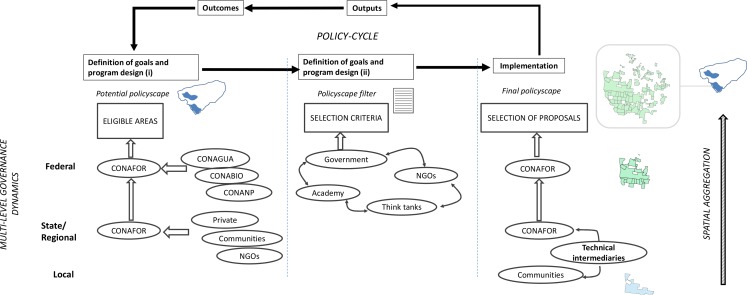
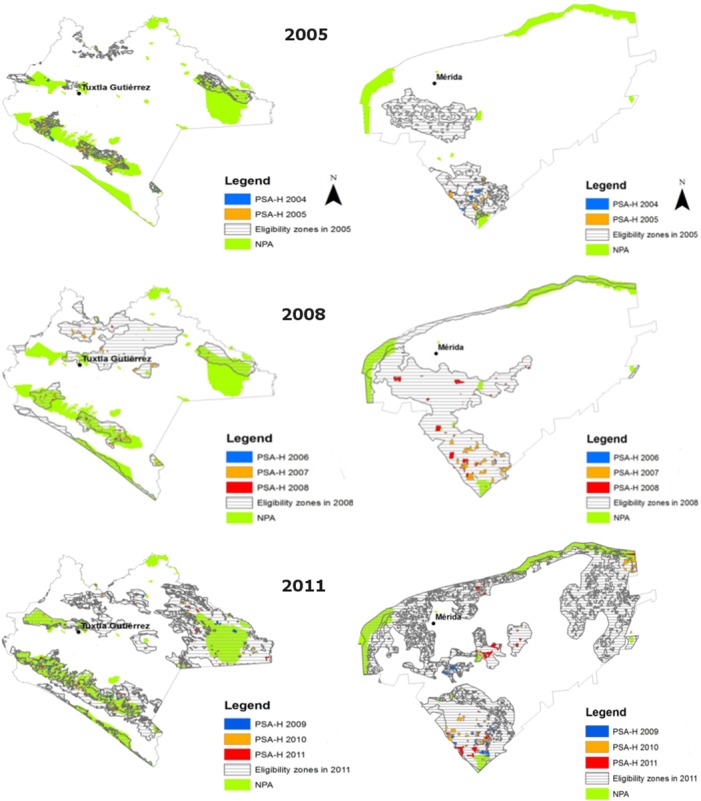
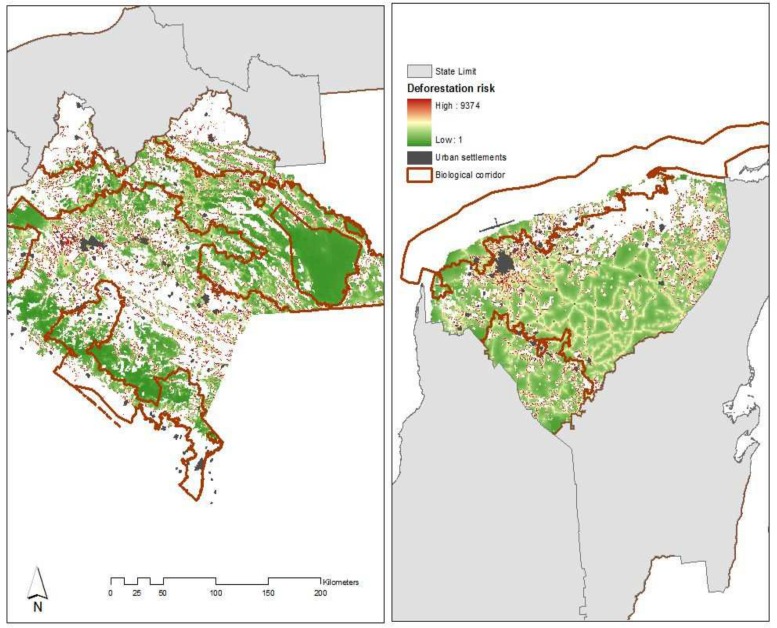
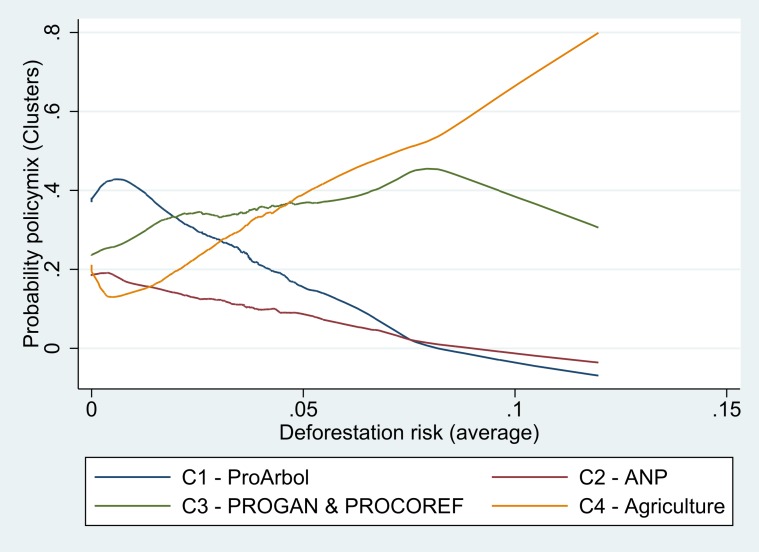
Government based Payments for Ecosystem Services (PES) have been criticized for not maximizing environmental effectiveness through appropriate targeting, while instead prioritizing social side-objectives. In Mexico, existing literature on how the Payments for Ecosystem Services-Hydrological program (PSA-H) has targeted deforestation and forest degradation shows that both the process of identifying the eligible areas and the choice of the selection criteria for enrolling forest parcels have been under the influence of competing agendas. In the present paper we study the influence of the PSA-H multi-level governance on the environmental effectiveness of the program-the degree to which forest at high risk of deforestation is enrolled- building from a "policyscape" framework. In particular, we combine governance analysis with two distinct applications of the policyscape framework: First, at national level we assess the functional overlap between the PSA-H and other environmental and rural programs with regard to the risk of deforestation. Second, at regional level in the states of Chiapas and Yucatan, we describe the changing policy agenda and the role of technical intermediaries in defining the temporal spatialization of the PSA-H eligible and enrolled areas with regard to key socio-economic criteria. We find that, although at national level the PSA-H program has been described as coping with both social and environmental indicators thanks to successful adaptive management, our analysis show that PSA-H is mainly found in communities where deforestation risk is low and in combination with other environmental programs (protected areas and forest management programs). Such inertia is reinforced at regional level as a result of the eligible areas' characteristics and the behaviour of technical intermediaries, which seek to minimise transaction costs and sources of uncertainty. Our project-specific analysis shows the importance of integrating the governance of a program in the policyscape framework as a way to better systematize complex interactions at different spatial and institutional scales between policies and landscape characteristics.
基于政府的生态系统服务付费(PES)因未通过适当的目标定位实现环境效益最大化,而是将社会次要目标置于优先地位而受到批评。在墨西哥,关于生态系统服务 - 水文计划(PSA - H)如何针对森林砍伐和森林退化的现有文献表明,确定 eligible areas 的过程以及纳入森林地块的选择标准的选择都受到相互竞争议程的影响。在本文中,我们从“政策景观”框架出发,研究 PSA - H 多层次治理对该计划环境效益的影响——即砍伐森林高风险地区的森林被纳入的程度。具体而言,我们将治理分析与政策景观框架的两种不同应用相结合:首先,在国家层面,我们评估 PSA - H 与其他环境和农村计划在森林砍伐风险方面的功能重叠。其次,在恰帕斯州和尤卡坦州的区域层面,我们描述不断变化的政策议程以及技术中介在根据关键社会经济标准确定 PSA - H eligible 和已纳入地区的时空空间化方面的作用。我们发现,尽管在国家层面 PSA - H 计划因成功的适应性管理而被描述为兼顾社会和环境指标,但我们的分析表明,PSA - H 主要出现在森林砍伐风险较低的社区,并且与其他环境计划(保护区和森林管理计划)相结合。由于 eligible areas 的特征和技术中介的行为,这种惯性在区域层面得到加强,技术中介试图将交易成本和不确定性来源降至最低。我们针对项目的分析表明,将计划治理纳入政策景观框架作为一种更好地系统化政策与景观特征在不同空间和机构尺度上复杂相互作用的方式具有重要意义。