Ståhlberg Anders, Krzyzanowski Paul M, Jackson Jennifer B, Egyud Matthew, Stein Lincoln, Godfrey Tony E
Department of Surgery, Boston University School of Medicine, 700 Albany Street, Boston, MA 02118, USA Department of Pathology, Sahlgrenska Cancer Center, Institute of Biomedicine, Sahlgrenska Academy at University of Gothenburg, Medicinaregatan 1F, 405 30 Gothenberg, Sweden
Ontario Institute for Cancer Research, MaRS Centre, 661 University Avenue, Suite 510, Toronto, Ontario M5G 0A3, Canada.
Nucleic Acids Res. 2016 Jun 20;44(11):e105. doi: 10.1093/nar/gkw224. Epub 2016 Apr 7.
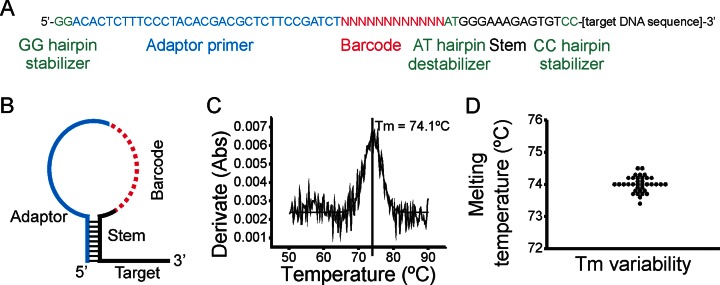
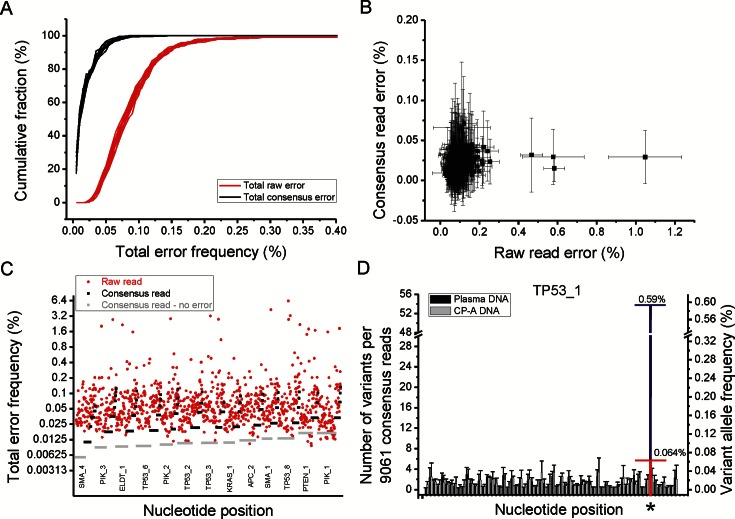
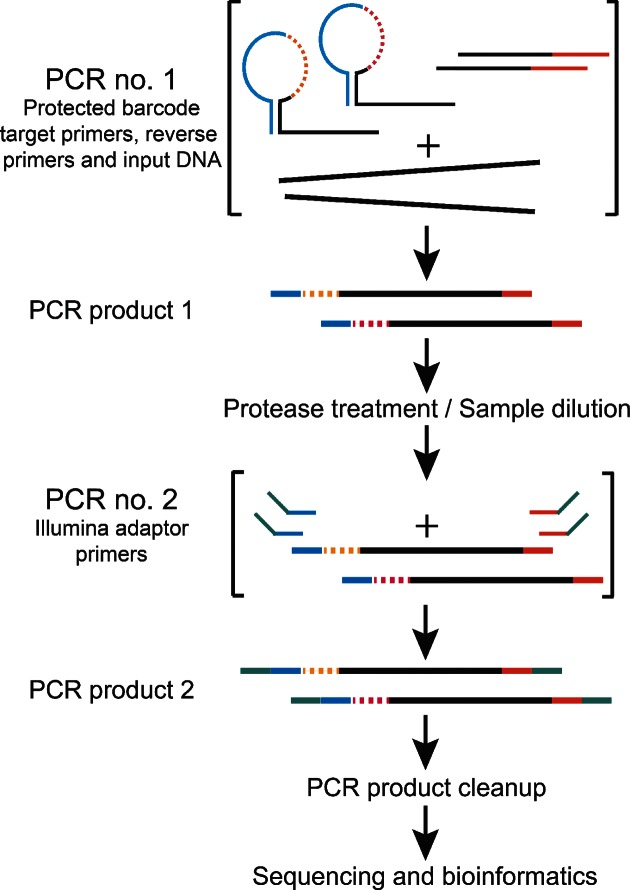
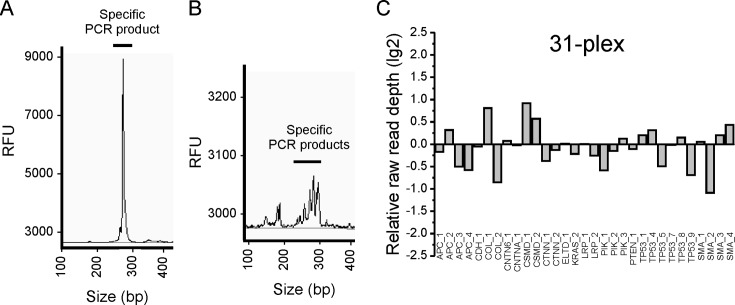
Detection of cell-free DNA in liquid biopsies offers great potential for use in non-invasive prenatal testing and as a cancer biomarker. Fetal and tumor DNA fractions however can be extremely low in these samples and ultra-sensitive methods are required for their detection. Here, we report an extremely simple and fast method for introduction of barcodes into DNA libraries made from 5 ng of DNA. Barcoded adapter primers are designed with an oligonucleotide hairpin structure to protect the molecular barcodes during the first rounds of polymerase chain reaction (PCR) and prevent them from participating in mis-priming events. Our approach enables high-level multiplexing and next-generation sequencing library construction with flexible library content. We show that uniform libraries of 1-, 5-, 13- and 31-plex can be generated. Utilizing the barcodes to generate consensus reads for each original DNA molecule reduces background sequencing noise and allows detection of variant alleles below 0.1% frequency in clonal cell line DNA and in cell-free plasma DNA. Thus, our approach bridges the gap between the highly sensitive but specific capabilities of digital PCR, which only allows a limited number of variants to be analyzed, with the broad target capability of next-generation sequencing which traditionally lacks the sensitivity to detect rare variants.
在液体活检中检测游离DNA在无创产前检测和作为癌症生物标志物方面具有巨大潜力。然而,这些样本中的胎儿和肿瘤DNA片段可能极低,需要超灵敏方法来进行检测。在此,我们报告了一种极其简单快速的方法,可将条形码引入由5 ng DNA构建的DNA文库中。带条形码的衔接子引物设计有寡核苷酸发夹结构,以在第一轮聚合酶链反应(PCR)期间保护分子条形码,并防止它们参与错配引物事件。我们的方法能够实现高水平的多重分析以及具有灵活文库内容的下一代测序文库构建。我们展示了可以生成1重、5重、13重和31重的均匀文库。利用条形码为每个原始DNA分子生成一致读数可降低背景测序噪声,并能够检测克隆细胞系DNA和游离血浆DNA中频率低于0.1%的变异等位基因。因此,我们的方法弥合了数字PCR高灵敏度但特异性强(仅允许分析有限数量的变异)与下一代测序广泛的目标检测能力(传统上缺乏检测罕见变异的灵敏度)之间的差距。