Lin Kuo-Hsing, Chang Li-Sheng, Tian Chun-Yuan, Yeh Yi-Chen, Chen Yu-Jie, Chuang Tsung-Hsien, Liu Shih-Jen, Leng Chih-Hsiang
National Institute of Infectious Diseases and Vaccinology, National Health Research Institutes, Zhunan Town, Miaoli 350, Taiwan ROC.
Institute of Biotechnology and Department of Life Science, National Tsing-Hua University, Hsinchu 305, Taiwan ROC.
Sci Rep. 2016 Apr 11;6:24199. doi: 10.1038/srep24199.
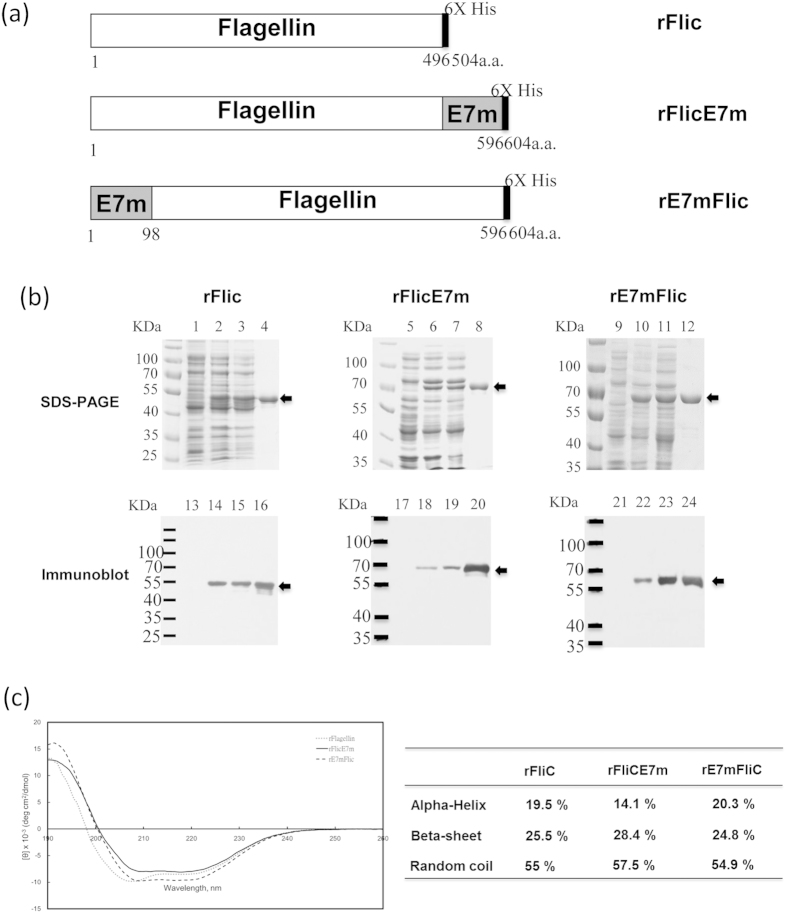
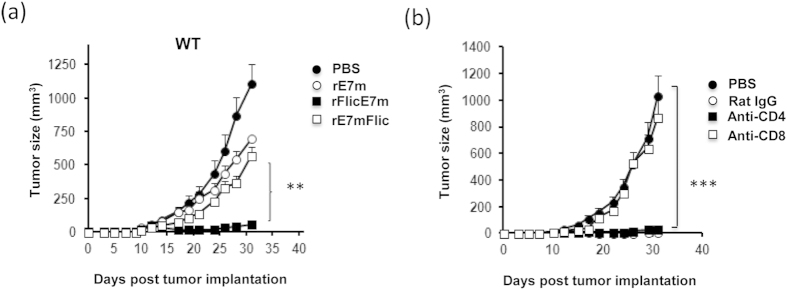
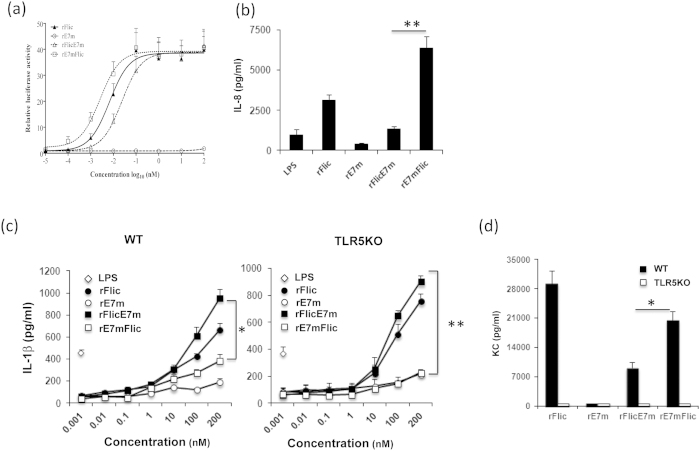
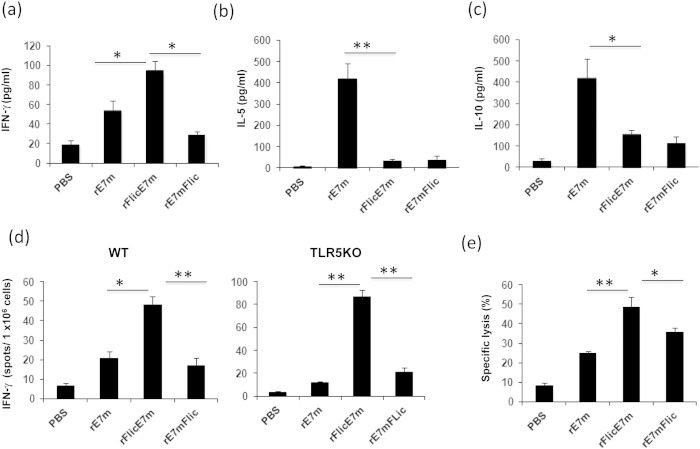
Flagellin has the capacity to activate both Toll-like receptor 5 (TLR5) and Nod-like receptor C4 (NLRC4)/neuronal apoptosis inhibitory protein 5 (NAIP5) inflammasome signaling. We fused E7m (the inactivated E7 of human papillomavirus) to either end of the flagellin protein, and the resulting recombinant flagellin-E7m proteins (rFliCE7m and rE7mFliC) were used as immunogens. Both fusion proteins activated receptor signaling to different degrees. rE7mFliC-induced TLR5 activity was 10-fold higher than that of rFliCE7m, whereas rFliCE7m activated the NLRC4/NAIP5 pathway more strongly. Therefore, these recombinant proteins provided a tool to investigate which signaling pathway is critical for the induction of antigen-specific T cell responses and anti-tumor immunity. We demonstrated that rFliCE7m induced higher levels of E7-specific IFN-gamma-secreting cells and cytotoxic T lymphocytes (CTLs) than rE7mFliC, and a single injection with rFliCE7m but not rE7mFliC inhibited E7-expressing tumor growth in vivo. Furthermore, we confirmed that CD8(+) T cells played a major role in the anti-tumor immunity induced by rFliCE7m. These findings suggested that the NLRC4/NAIP5 intracellular signaling pathway was critical for the induction of anti-tumor immunity. These observations provide important information for the rational design of flagellin-based immunotherapy.
鞭毛蛋白能够激活Toll样受体5(TLR5)和Nod样受体C4(NLRC4)/神经元凋亡抑制蛋白5(NAIP5)炎性小体信号通路。我们将E7m(人乳头瘤病毒的灭活E7)融合到鞭毛蛋白的两端,所得的重组鞭毛蛋白-E7m蛋白(rFliCE7m和rE7mFliC)用作免疫原。两种融合蛋白均不同程度地激活受体信号通路。rE7mFliC诱导的TLR5活性比rFliCE7m高10倍,而rFliCE7m对NLRC4/NAIP5途径的激活更强。因此,这些重组蛋白为研究哪种信号通路对于诱导抗原特异性T细胞应答和抗肿瘤免疫至关重要提供了一种工具。我们证明,rFliCE7m比rE7mFliC诱导产生更高水平的分泌E7特异性干扰素-γ的细胞和细胞毒性T淋巴细胞(CTL),单次注射rFliCE7m而非rE7mFliC可在体内抑制表达E7的肿瘤生长。此外,我们证实CD8(+) T细胞在rFliCE7m诱导的抗肿瘤免疫中起主要作用。这些发现表明,NLRC4/NAIP5细胞内信号通路对于诱导抗肿瘤免疫至关重要。这些观察结果为基于鞭毛蛋白的免疫疗法的合理设计提供了重要信息。