Ying Ling-Xiao, Zhang Ting-Ting, Chiu Ching-An, Chen Tze-Ying, Luo Shu-Jin, Chen Xiao-Yong, Shen Ze-Hao
Department of Ecology College of Urban and Environmental Sciences The MOE Key Laboratory of Earth Surface Processes Peking University Beijing 100871 China.
School of Life Sciences Peking-Tsinghua Center for Life Sciences Peking University Beijing 100871 China.
Ecol Evol. 2016 Mar 21;6(9):2805-16. doi: 10.1002/ece3.2042. eCollection 2016 May.
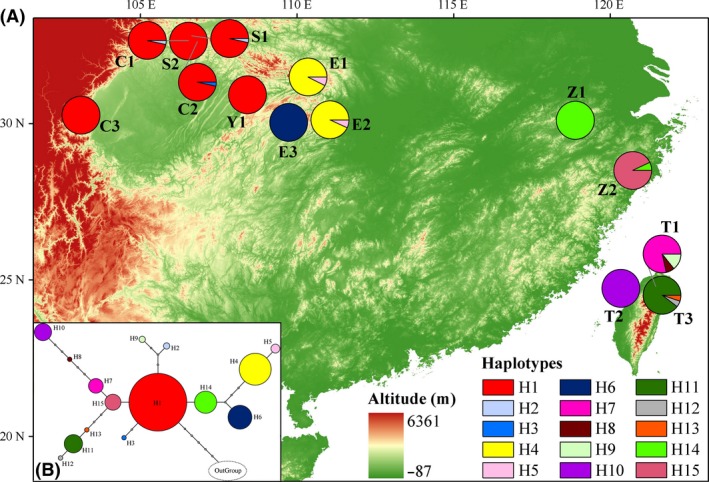
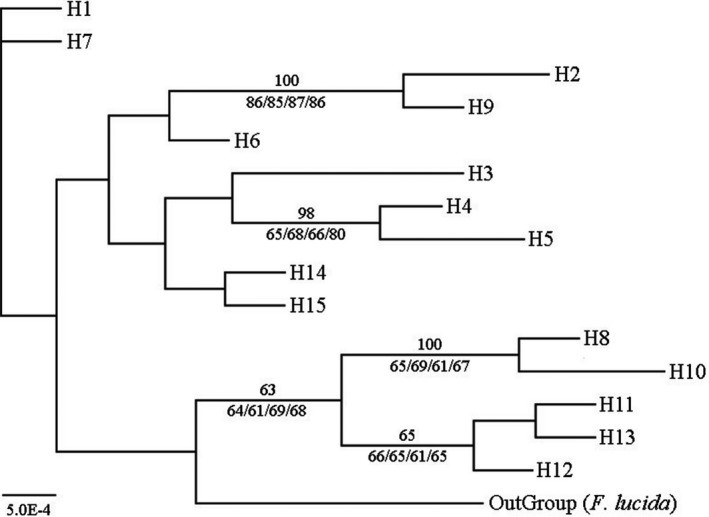
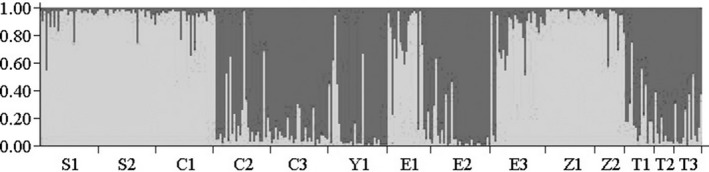
The beech species Fagus hayatae is an important relict tree species in subtropical China, whose biogeographical patterns may reflect floral responses to climate change in this region during the Quaternary. Previous studies have revealed phylogeography for three of the four Fagus species in China, but study on F. hayatae, the most sparsely distributed of these species, is still lacking. Here, molecular methods based on eight simple sequence repeat (SSR) loci of nuclear DNA (nDNA) and three chloroplast DNA (cpDNA) sequences were applied for analyses of genetic diversity and structure in 375 samples from 14 F. hayatae populations across its whole range. Both nDNA and cpDNA indicated a high level of genetic diversity in this species. Significant fixation indexes and departures from the Hardy-Weinberg equilibrium, with a genetic differentiation parameter of R st of 0.233, were detected in nDNA SSR loci among populations, especially those on Taiwan Island, indicating strong geographic partitioning. The populations were classified into two clusters, without a prominent signal of isolation-by-distance. For the 15 haplotypes detected in the cpDNA sequence fragments, there was a high genetic differentiation parameter (G st = 0.712) among populations. A high G st of 0.829 was also detected outside but not within the Sichuan Basin. Consistent with other Fagus species in China, no recent population expansion was detected from tests of neutrality and mismatch distribution analysis. Overall, genetic isolation with limited gene flow was prominent for this species and significant phylogeographic structures existed across its range except for those inside the Sichuan Basin. Our study suggested long-term geographic isolation in F. hayatae with limited population admixture and the existence of multiple refugia in the mountainous regions of the Sichuan Basin and southeast China during the Quaternary. These results may provide useful information critical for the conservation of F. hayatae and other Chinese beech species.
台湾榉木是中国亚热带地区重要的孑遗树种,其生物地理格局可能反映了该地区第四纪期间植物区系对气候变化的响应。先前的研究揭示了中国四种榉属植物中三种的系统地理学,但对这些物种中分布最稀疏的台湾榉木的研究仍很缺乏。在此,基于核DNA(nDNA)的八个简单序列重复(SSR)位点和三个叶绿体DNA(cpDNA)序列的分子方法被应用于分析来自台湾榉木整个分布范围内14个种群的375个样本的遗传多样性和结构。nDNA和cpDNA均表明该物种具有高水平的遗传多样性。在种群间,尤其是台湾岛上的种群间,nDNA SSR位点检测到显著的固定指数和偏离哈迪-温伯格平衡的情况,遗传分化参数R st为0.233,表明存在强烈的地理分区。种群被分为两个聚类,没有明显的距离隔离信号。在cpDNA序列片段中检测到的15个单倍型中,种群间存在较高的遗传分化参数(G st = 0.712)。在四川盆地外部而非内部也检测到高达0.829的G st。与中国其他榉属物种一致,从中性检验和错配分布分析中未检测到近期种群扩张。总体而言,该物种遗传隔离明显,基因流有限,除四川盆地内部外,其分布范围内存在显著的系统地理结构。我们的研究表明,台湾榉木长期处于地理隔离状态,种群混合有限,并且在第四纪期间四川盆地和中国东南部山区存在多个避难所。这些结果可能为台湾榉木和其他中国榉属物种的保护提供关键的有用信息。