Lisenko K, McClanahan F, Schöning T, Schwarzbich M A, Cremer M, Dittrich T, Ho A D, Witzens-Harig M
Department of Hematology, Oncology and Rheumatology, University Hospital Heidelberg, Im Neuenheimer Feld 410, Heidelberg, 69120, Germany.
Centre for Haemato-Oncology/Barts Cancer Institute, Queen Mary University of London, London, UK.
BMC Cancer. 2016 Apr 11;16:267. doi: 10.1186/s12885-016-2289-y.
Rituximab (R) in combination with DHAP is a widely accepted salvage regimen for patients with relapsed or refractory diffuse large B-cell lymphoma (DLBCL). A common adverse effect of this protocol is renal toxicity which may result in treatment discontinuation. Assuming that a lower single dose of cisplatin over several days would reduce renal toxicity, our institution has chosen to administer cisplatin in a dosage of 25 mg/m(2) per day as a 3-h infusion over 4 consecutive days.
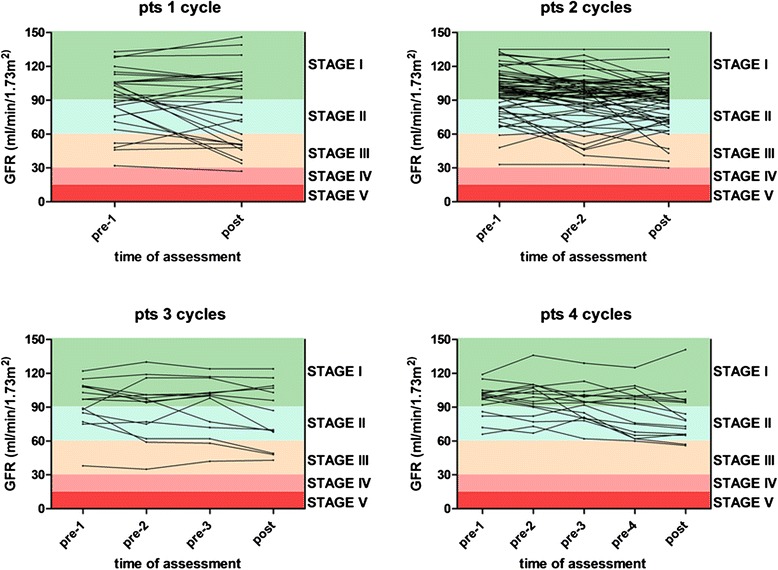
In this study, we analyzed the renal function of 122 patients with relapsed or refractory DLBCL treated with R-DHAP at our institution. Overall, 256 R-DHAP cycles were administered. 31 (25%), 61 (50%), 14 (12%) and 16 (13%) patients received one, two, three or four R-DHAP courses, respectively.
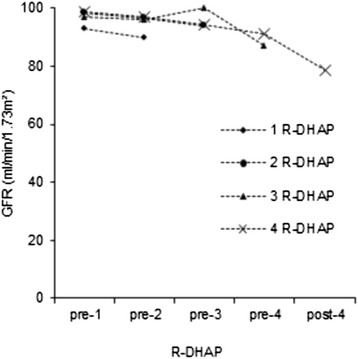
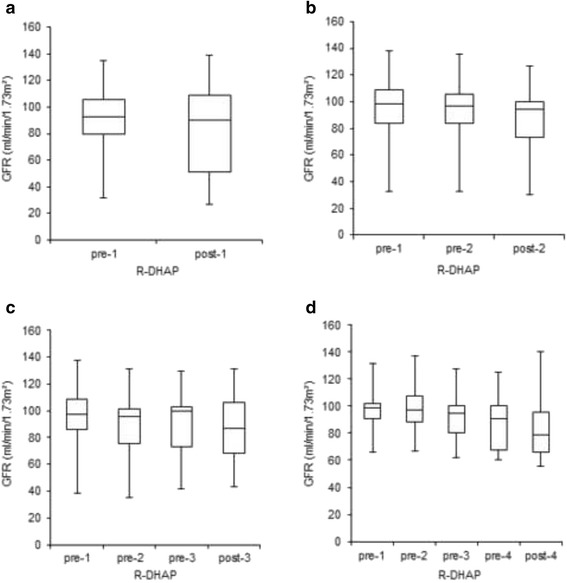
A glomerular filtration rate (GFR) decrease was observed after each R-DHAP cycle. However, in none of the subgroups the median GFR was lower than 60 ml/min/1.73 m(2). In most patients, only renal impairment stage I and II was observed. Renal impairment stage III was seen in 10% and stage IV only in 1% of patients.
We conclude that a modified R-DHAP regimen with administration of cisplatin 25 mg/m(2) over 4 consecutive cycles leads only to minimal renal toxicity.
利妥昔单抗(R)联合DHAP是复发或难治性弥漫性大B细胞淋巴瘤(DLBCL)患者广泛接受的挽救方案。该方案的常见不良反应是肾毒性,这可能导致治疗中断。假设在几天内较低剂量的顺铂单药治疗会降低肾毒性,我们机构选择以25mg/m²的剂量连续4天每天3小时输注顺铂。
在本研究中,我们分析了在我们机构接受R-DHAP治疗的122例复发或难治性DLBCL患者的肾功能。总共进行了256个R-DHAP周期。分别有31例(25%)、61例(50%)、14例(12%)和16例(13%)患者接受了1个、2个、3个或4个R-DHAP疗程。
每个R-DHAP周期后均观察到肾小球滤过率(GFR)下降。然而,在任何亚组中,GFR中位数均不低于60ml/min/1.73m²。大多数患者仅观察到I期和II期肾功能损害。10%的患者出现III期肾功能损害,仅1%的患者出现IV期肾功能损害。
我们得出结论,连续4个周期给予25mg/m²顺铂的改良R-DHAP方案仅导致最小程度的肾毒性。