Department of Therapeutics Production & Quality, St. Jude Children's Research Hospital , Memphis, Tennessee, USA.
Department of Surgery, St. Jude Children's Research Hospital , Memphis, Tennessee, USA.
Mol Ther Methods Clin Dev. 2016 Mar 30;3:16015. doi: 10.1038/mtm.2016.15. eCollection 2016.
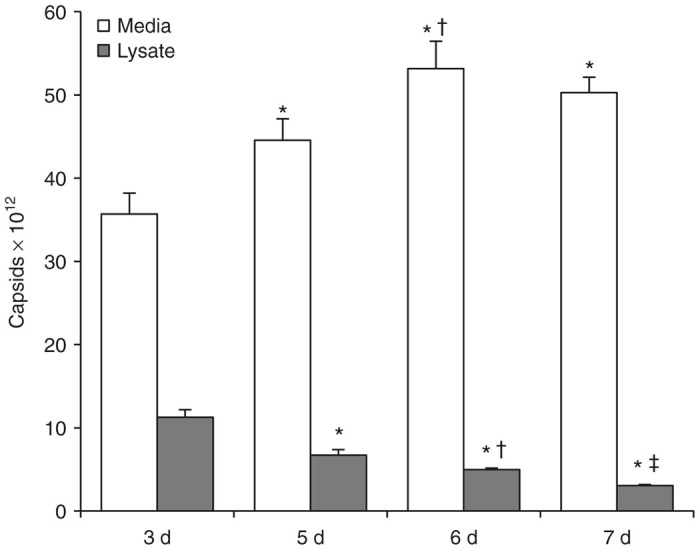
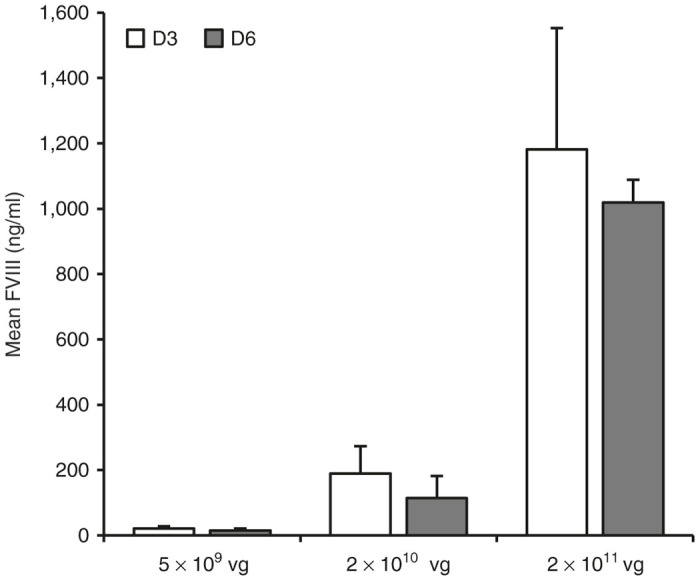
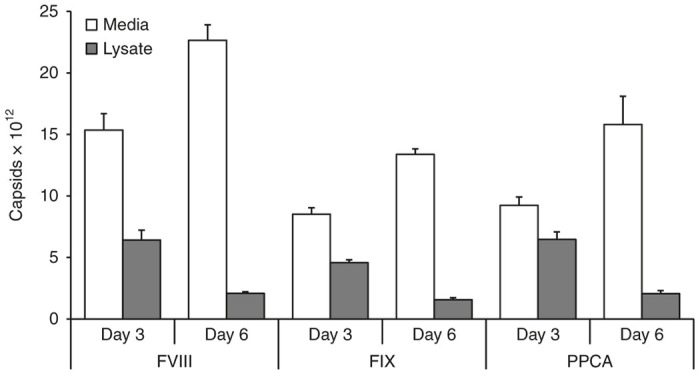
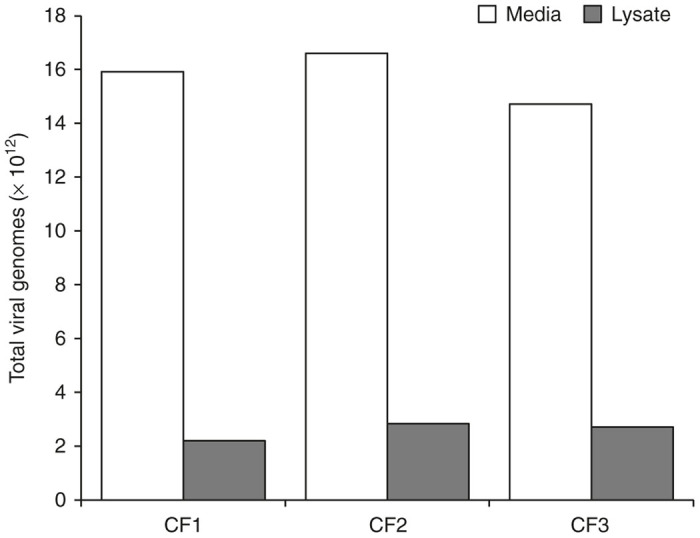
With clinical trials ongoing, efficient clinical production of adeno-associated virus (AAV) to treat large numbers of patients remains a challenge. We compared distribution of AAV8 packaged with Factor VIII (FVIII) in cell culture media and lysates on days 3, 5, 6, and 7 post-transfection and found increasing viral production through day 6, with the proportion of viral particles in the media increasing from 76% at day 3 to 94% by day 7. Compared to FVIII, AAV8 packaged with Factor IX and Protective Protein/Cathepsin A vectors demonstrated a greater shift from lysate towards media from day 3 to 6, implying that particle distribution is dependent on recombinant vector. Larger-scale productions showed that the ratio of full-to-empty AAV particles is similar in media and lysate, and that AAV harvested on day 6 post-transfection provides equivalent function in mice compared to AAV harvested on day 3. This demonstrates that AAV8 production can be optimized by prolonging the duration of culture post-transfection, and simplified by allowing harvest of media only, with disposal of cells that contain 10% or less of total vector yield. Additionally, the difference in particle distribution with different expression cassettes implies a recombinant vector-dependent processing mechanism which should be taken into account during process development.
在临床试验进行的同时,如何高效地临床生产腺相关病毒(AAV)以治疗大量患者仍然是一个挑战。我们比较了第 3、5、6 和 7 天转染后细胞培养物和裂解物中包装有 FVIII(FVIII)的 AAV8 的分布,发现病毒产量在第 6 天增加,第 3 天时病毒颗粒在培养基中的比例为 76%,第 7 天增加到 94%。与 FVIII 相比,第 3 天至第 6 天,包装有因子 IX 和 Protective Protein/Cathepsin A 载体的 AAV8 从裂解物向培养基的转移比例更大,这意味着颗粒分布取决于重组载体。更大规模的生产表明,在培养基和裂解物中,完整 AAV 颗粒与空颗粒的比例相似,并且与第 3 天收获的 AAV 相比,第 6 天收获的 AAV 在小鼠中具有同等功能。这表明通过延长转染后培养时间可以优化 AAV8 的生产,并且可以通过仅收获培养基来简化生产过程,而丢弃含有小于 10%总载体产量的细胞。此外,不同表达盒之间的颗粒分布差异意味着存在与重组载体相关的加工机制,在工艺开发过程中应考虑到这一点。