
在转移性结直肠癌的靶向治疗期间,使用氟代脱氧葡萄糖正电子发射断层扫描-计算机断层扫描(FDG PET-CT)监测代谢反应。
Monitoring metabolic response using FDG PET-CT during targeted therapy for metastatic colorectal cancer.
作者信息
Woff Erwin, Hendlisz Alain, Garcia Camilo, Deleporte Amelie, Delaunoit Thierry, Maréchal Raphaël, Holbrechts Stéphane, Van den Eynde Marc, Demolin Gauthier, Vierasu Irina, Lhommel Renaud, Gauthier Namur, Guiot Thomas, Ameye Lieveke, Flamen Patrick
机构信息
Nuclear Medicine Department, Institut Jules Bordet, Université libre de Bruxelles, 1 rue Héger-Bordet, 1000, Brussels, Belgium.
Medical Oncology Department, Institut Jules Bordet, Université libre de Bruxelles, Brussels, Belgium.
出版信息
Eur J Nucl Med Mol Imaging. 2016 Sep;43(10):1792-801. doi: 10.1007/s00259-016-3365-x. Epub 2016 Apr 12.
INTRODUCTION
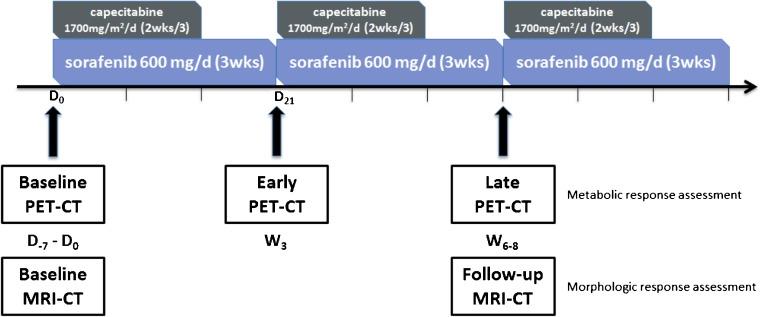
The introduction of targeted drugs has had a significant impact on the approach to assessing tumour response. These drugs often induce a rapid cytostatic effect associated with a less pronounced and slower tumoural volume reduction, thereby impairing the correlation between the absence of tumour shrinkage and the patient's unlikelihood of benefit. The aim of the study was to assess the predictive value of early metabolic response (mR) evaluation after one cycle, and its interlesional heterogeneity to a later metabolic and morphological response assessment performed after three cycles in metastatic colorectal cancer (mCRC) patients treated with combined sorafenib and capecitabine.
METHODS
This substudy was performed within the framework of a wider prospective multicenter study on the predictive value of early FDG PET-CT response assessment (SoMore study). A lesion-based response analysis was performed, including all measurable lesions identified on the baseline PET. On a per-patient basis, a descriptive 4-class response categorization was applied based upon the presence and proportion of non-responding lesions. For dichotomic response comparison, all patients with at least one resistant lesion were classified as non-responding.
RESULTS
On baseline FDG PET-CT, 124 measurable "target" lesions were identified in 38 patients. Early mR assessments showed 18 patients (47 %) without treatment resistant lesions and 12 patients (32 %) with interlesional response heterogeneity. The NPV and PPV of early mR were 85 % (35/41) and 84 % (70/83), respectively, on a per-lesion basis and 95 % (19/20) and 72 % (13/18), respectively, on a dichotomized per-patient basis.
CONCLUSIONS
Early mR assessment performed after one cycle of sorafenib-capecitabine in mCRC is highly predictive of non-response at a standard response assessment time. The high NPV (95 %) of early mR could be useful as the basis for early treatment discontinuation or adaptation to spare patients from exposure to non-effective drugs.
引言
靶向药物的引入对肿瘤反应评估方法产生了重大影响。这些药物通常会诱导快速的细胞抑制作用,同时肿瘤体积缩小不明显且速度较慢,从而削弱了肿瘤无缩小与患者不太可能获益之间的相关性。本研究的目的是评估在接受索拉非尼和卡培他滨联合治疗的转移性结直肠癌(mCRC)患者中,一个周期后早期代谢反应(mR)评估的预测价值,及其对三个周期后进行的后期代谢和形态学反应评估的病灶间异质性。
方法
本亚研究是在一项关于早期FDG PET-CT反应评估预测价值的更广泛前瞻性多中心研究(SoMore研究)框架内进行的。进行了基于病灶的反应分析,包括在基线PET上识别的所有可测量病灶。在每位患者的基础上,根据无反应病灶的存在情况和比例应用描述性的四级反应分类。对于二分反应比较,所有至少有一个耐药病灶的患者被分类为无反应。
结果
在基线FDG PET-CT上,38例患者中识别出124个可测量的“靶”病灶。早期mR评估显示,18例患者(47%)无治疗耐药病灶,12例患者(32%)存在病灶间反应异质性。早期mR的阴性预测值(NPV)和阳性预测值(PPV)在每个病灶基础上分别为85%(35/41)和84%(70/83),在每位患者二分基础上分别为95%(19/20)和72%(13/18)。
结论
在mCRC患者中,索拉非尼-卡培他滨一个周期后进行的早期mR评估对标准反应评估时间的无反应具有高度预测性。早期mR的高NPV(95%)可作为早期停药或调整治疗的依据,以使患者避免接触无效药物。



 Zotero 插件