Fox Caroline S, Hwang Shih-Jen, Nieto Kenneth, Valentino Maureen, Mutalik Karen, Massaro Joseph M, Benjamin Emelia J, Murabito Joanne M
National Heart, Lung, and Blood Institute Center for Population Studies, National Institutes of Health, Framingham, MA Division of Endocrinology, Hypertension, and Metabolism, Brigham and Women's Hospital, Harvard Medical School, Boston, MA
National Heart, Lung, and Blood Institute Center for Population Studies, National Institutes of Health, Framingham, MA.
J Am Heart Assoc. 2016 Apr 13;5(4):e003193. doi: 10.1161/JAHA.116.003193.
New avenues of data collection such as eHealth and mobile technology have the potential to revolutionize the way large populations can be assessed and managed outside of standard research and clinical settings.
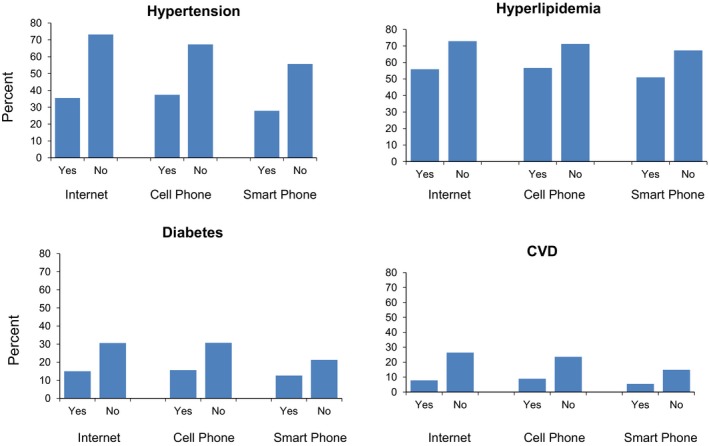
A digital connectedness survey was administered within the Framingham Heart Study from 2014 to 2015. The exposure was usage of the Internet, email, cell phones, and smartphones in relation to demographic and cardiovascular disease risk factors; all results were adjusted for age and sex. Among 8096 living study participants, 6503 (80.3%) completed the digital survey. Among survey responders, 5678 (87.4%) reported regular Internet use. Participants reporting regular Internet use were younger (aged 59.1 versus 76.5 years, P<0.0001), were more likely to be employed (70.3% versus 23.7%, P=0.002), and had more favorable cardiovascular disease risk factors than those who did not use the Internet (all P≤0.05). Overall, 5946 (92.1%) responders reported using cell phones. Among cell phone users, 3907 (67.8%) had smartphones. Smartphone users were younger (aged 55.4 versus 68.5 years, P<0.0001), more likely to be employed (81.1% versus 43.9%, P<0.0001) and to have a college education, and less likely to have hypertension (27.9% versus 55.7%, P=0.0002) than those who did not use smartphones.
Digital connectedness varies substantially by age; connected persons tend to be younger and better educated and to have more favorable cardiovascular disease risk factor profiles. Less than two-thirds of study participants who completed the survey had a smartphone. The generalizability of studies focused on digitally connected persons may have limitations.
电子健康和移动技术等新的数据收集途径有可能彻底改变在标准研究和临床环境之外对大量人群进行评估和管理的方式。
2014年至2015年在弗雷明汉心脏研究中进行了一项数字连接性调查。暴露因素是互联网、电子邮件、手机和智能手机的使用情况与人口统计学及心血管疾病风险因素的关系;所有结果均根据年龄和性别进行了调整。在8096名在世的研究参与者中,6503名(80.3%)完成了数字调查。在调查回复者中,5678名(87.4%)报告经常使用互联网。报告经常使用互联网的参与者更年轻(年龄分别为59.1岁和76.5岁,P<0.0001),更有可能就业(70.3%对23.7%,P=0.002),并且与不使用互联网的人相比,具有更有利的心血管疾病风险因素(所有P≤0.05)。总体而言,5946名(92.1%)回复者报告使用手机。在手机用户中,3907名(67.8%)拥有智能手机。智能手机用户更年轻(年龄分别为55.4岁和68.5岁,P<0.0001),更有可能就业(81.1%对43.9%,P<0.0001)且拥有大学学历,与不使用智能手机的人相比,患高血压的可能性更小(27.9%对55.7%,P=0.0002)。
数字连接性因年龄差异很大;有连接的人往往更年轻、受教育程度更高,并且具有更有利的心血管疾病风险因素特征。完成调查的研究参与者中不到三分之二拥有智能手机。专注于有数字连接的人的研究的普遍性可能存在局限性。