Erion Renske, King Anna N, Wu Gang, Hogenesch John B, Sehgal Amita
Howard Hughes Medical Institute, University of Pennsylvania, Philadelphia, United States.
Department of Systems Pharmacology and Translational Therapeutics, University of Pennsylvania, Philadelphia, United States.
Elife. 2016 Apr 14;5:e13552. doi: 10.7554/eLife.13552.
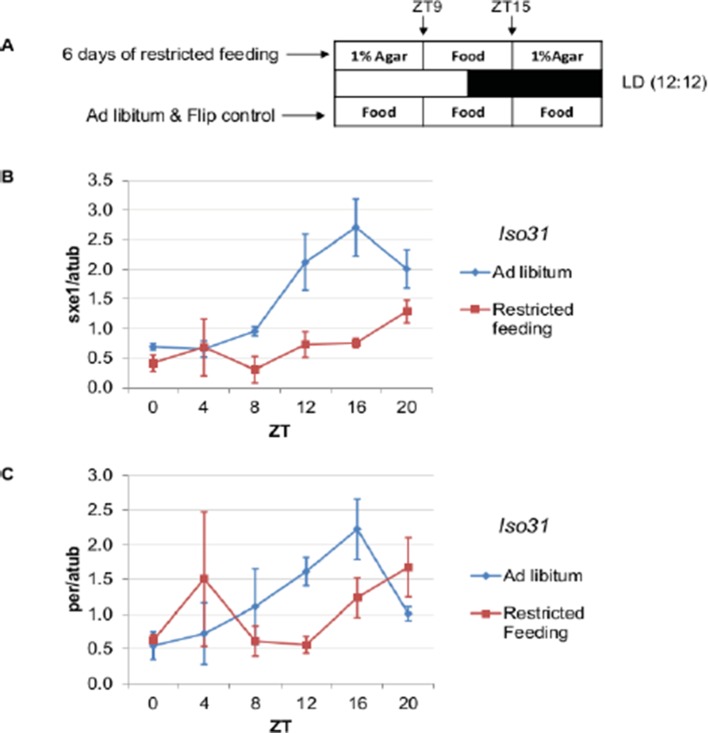
Metabolic homeostasis requires coordination between circadian clocks in different tissues. Also, systemic signals appear to be required for some transcriptional rhythms in the mammalian liver and the Drosophila fat body. Here we show that free-running oscillations of the fat body clock require clock function in the PDF-positive cells of the fly brain. Interestingly, rhythmic expression of the cytochrome P450 transcripts, sex-specific enzyme 1 (sxe1) and Cyp6a21, which cycle in the fat body independently of the local clock, depends upon clocks in neurons expressing neuropeptide F (NPF). NPF signaling itself is required to drive cycling of sxe1 and Cyp6a21 in the fat body, and its mammalian ortholog, Npy, functions similarly to regulate cycling of cytochrome P450 genes in the mouse liver. These data highlight the importance of neuronal clocks for peripheral rhythms, particularly in a specific detoxification pathway, and identify a novel and conserved role for NPF/Npy in circadian rhythms.
代谢稳态需要不同组织中的生物钟之间进行协调。此外,系统性信号似乎是哺乳动物肝脏和果蝇脂肪体中某些转录节律所必需的。在这里,我们表明脂肪体生物钟的自由振荡需要果蝇大脑中PDF阳性细胞的生物钟功能。有趣的是,细胞色素P450转录本、性别特异性酶1(sxe1)和Cyp6a21的节律性表达在脂肪体中独立于局部生物钟而循环,这取决于表达神经肽F(NPF)的神经元中的生物钟。NPF信号本身是驱动脂肪体中sxe1和Cyp6a21循环所必需的,其哺乳动物同源物Npy在调节小鼠肝脏中细胞色素P450基因的循环方面具有类似功能。这些数据突出了神经元生物钟对外周节律的重要性,特别是在特定的解毒途径中,并确定了NPF/Npy在昼夜节律中的一种新的保守作用。