Shih Kai-Lun, Su Wei-Wen, Chang Chia-Chu, Kor Chew-Teng, Chou Chen-Te, Chen Ting-Yu, Wu Hung-Ming
Department of Gastroenterology, Changhua Christian Hospital, Changhua, Taiwan.
Department of Nephrology, Changhua Christian Hospital, Changhua, Taiwan.
Sci Rep. 2016 Apr 15;6:24031. doi: 10.1038/srep24031.
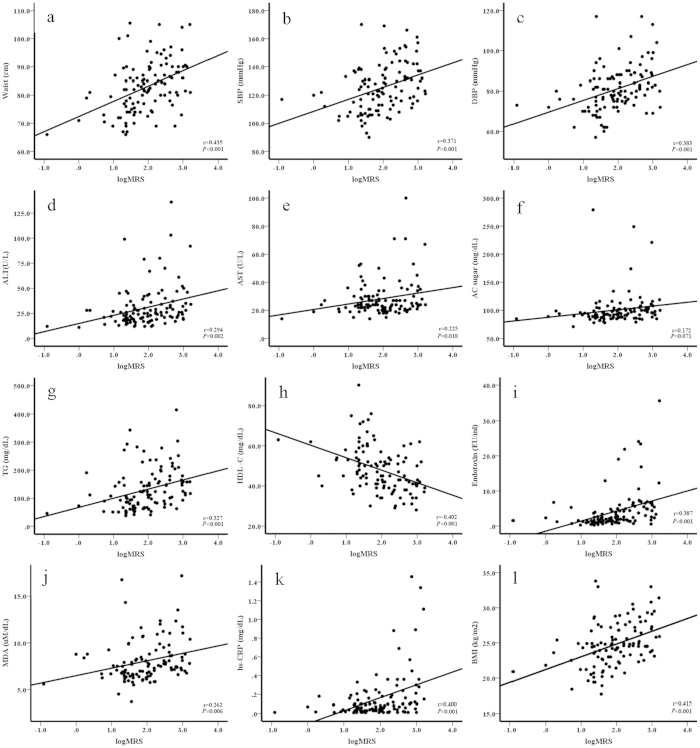
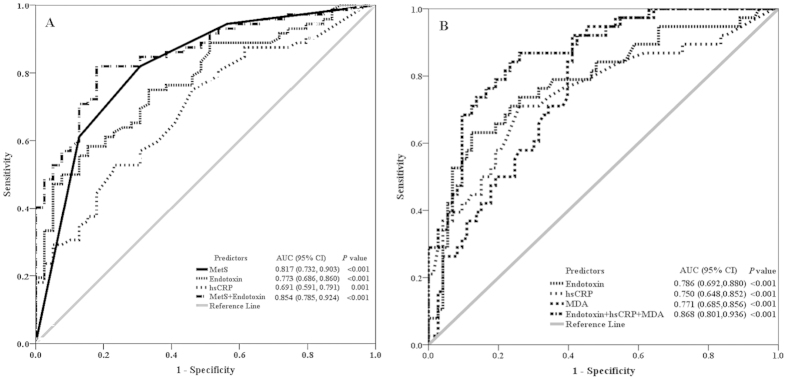
Non-alcoholic fatty liver disease (NAFLD) is the main cause of chronic liver disease. This cross-sectional study aimed to evaluate whether parallel clinical features and serum markers are related to the severity of NAFLD. We enrolled 111 participants with different metabolic syndrome (MetS) scores (zero, n = 22; one, n = 19; two, n = 22; and ≥ three, n = 48) and used 1H-MRS to measure liver fat content. Biochemical profiles and potential biomarkers of NAFLD were measured in fasting plasma. We found that 1H-MRS-measured fat content was significantly associated with MetS score ≥1, endotoxin, and hs-CRP. Ordinal logistic regression analysis revealed that MetS score ≥2 and endotoxin were predictive of NAFLD (1H-MRS > 5%) and that endotoxin, hs-CRP, and malondialdehyde (MDA) were predictive of NAFLD with liver injury (1H-MRS > 9.67%). Endotoxin plus MetS score was shown to be the most accurate predictor of overall NAFLD (AUC = 0.854; (95% CI: 0.785-0.924), P < 0.001), and endotoxin plus hs-CRP and MDA was found to be predictive of NAFLD with liver injury (0.868; (0.801-0.936), P < 0.001). These results suggest that MetS score plus certain serum biomarkers with 1H-MRS findings may hold promise for developing an effective model for monitoring the severity of NAFLD.
非酒精性脂肪性肝病(NAFLD)是慢性肝病的主要病因。这项横断面研究旨在评估平行的临床特征和血清标志物是否与NAFLD的严重程度相关。我们纳入了111名具有不同代谢综合征(MetS)评分的参与者(评分为零,n = 22;评分为一,n = 19;评分为二,n = 22;评分≥三,n = 48),并使用1H-MRS测量肝脏脂肪含量。在空腹血浆中测量NAFLD的生化指标和潜在生物标志物。我们发现,1H-MRS测量的脂肪含量与MetS评分≥1、内毒素和hs-CRP显著相关。有序逻辑回归分析显示,MetS评分≥2和内毒素可预测NAFLD(1H-MRS>5%),内毒素、hs-CRP和丙二醛(MDA)可预测伴有肝损伤的NAFLD(1H-MRS>9.67%)。内毒素加MetS评分被证明是总体NAFLD最准确的预测指标(AUC = 0.854;(95%CI:0.785 - 0.924),P < 0.001),内毒素加hs-CRP和MDA被发现可预测伴有肝损伤的NAFLD(0.868;(0.801 - 0.936),P < 0.001)。这些结果表明,MetS评分加上某些血清生物标志物以及1H-MRS检查结果可能有望开发出一种有效的模型来监测NAFLD的严重程度。