Hofmeyr G Justus, Singata-Madliki Mandisa, Lawrie Theresa A, Bergel Eduardo, Temmerman Marleen
Effective Care Research Unit, Eastern Cape Department of Health/Universities of the Witwatersrand, Walter Sisulu and Fort Hare, Mthatha, Eastern Cape, South Africa.
Royal United Hospital, Bath, UK.
Reprod Health. 2016 Apr 18;13:42. doi: 10.1186/s12978-016-0153-9.
The copper intrauterine device (IUD) is under-utilised in South Africa, where injectable progestin contraception (IPC) dominates contraception usage. There is a lack of robust comparative data on these contraceptive options to inform policy, programs, clinical counseling, and women's choices.
Within the context of a South African program to increase women's access to the IUD, we conducted a pragmatic, open-label, parallel-arm, randomised controlled trial of the IUD versus IPC at two South African hospitals. The target sample size was 7,000 women and the randomisation ratio was 1:1. The random sequence was computer-generated and group allocation was concealed in sealed, opaque, consecutively-numbered envelopes. Counselled, consenting women attending termination of pregnancy services were randomly assigned to IUD or IPC immediately post-termination. Condoms were promoted for the prevention of sexually-transmitted infections. The primary outcome was pregnancy; secondary outcomes were discontinuation, side-effects, and HIV acquisition and disease progression. Pregnancy and discontinuation outcomes are reported here.
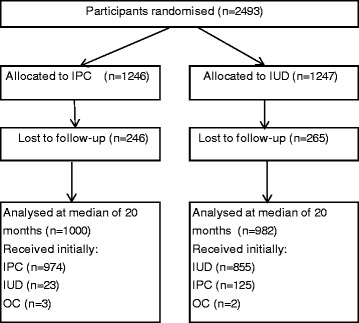
The trial closed early with 2,493 participants randomised (IUD = 1,247, IPC = 1,246), due to international concerns regarding a possible association between IPC and HIV acquisition. Median follow-up was 20 months; 982 and 1000 participants were followed up in the IUD and IPC groups, respectively. Baseline group characteristics were comparable. Pregnancy occurred significantly less frequently among women allocated to the IUD than IPC: 56/971 (5.8%) versus 83/992 (8.4%), respectively; risk ratio (RR) 0.69, 95% confidence interval (CI) 0.50 to 0.96; P = 0.025. There were more protocol violations in the IUD group; however, discontinuation rates were similar between IUD and IPC groups (141/855 [16.5%] and 143/974 [14.7%], respectively). Women in the IUD group were more likely to discontinue contraceptive use due to abdominal pain or backache and non-specific symptoms, and those in the IPC group due to oligo- or amenorhoea and lack of sexual activity.
The IUD was significantly more effective in preventing pregnancy than IPC. Efforts to expand contraception options and improve access to the IUD in settings where it is under-utilised are worthwhile. This trial shows that randomising long-acting, reversible contraceptives is feasible.
Pan African Clinical Trials Registry number PACTR201409000880157 (04-09-2014).
在南非,铜宫内节育器(IUD)的使用率较低,而注射用孕激素避孕法(IPC)在避孕方法的使用中占主导地位。缺乏关于这些避孕选择的有力比较数据,无法为政策制定、项目实施、临床咨询和女性选择提供参考。
在南非一项旨在增加女性获得宫内节育器机会的项目背景下,我们在两家南非医院开展了一项实用、开放标签、平行组、随机对照试验,比较宫内节育器与注射用孕激素避孕法。目标样本量为7000名女性,随机化比例为1:1。随机序列由计算机生成,组分配情况隐藏在密封、不透明、连续编号的信封中。接受咨询并同意参与的终止妊娠服务女性在终止妊娠后立即被随机分配至宫内节育器组或注射用孕激素避孕法组。推广使用避孕套以预防性传播感染。主要结局为妊娠;次要结局为停用、副作用以及HIV感染和疾病进展。此处报告妊娠和停用结局。
由于国际上对注射用孕激素避孕法与HIV感染之间可能存在的关联表示担忧,该试验提前结束,共有2493名参与者被随机分组(宫内节育器组 = 1247人,注射用孕激素避孕法组 = 1246人)。中位随访时间为20个月;宫内节育器组和注射用孕激素避孕法组分别有982名和1000名参与者接受了随访。两组基线特征具有可比性。分配至宫内节育器组的女性妊娠发生率显著低于注射用孕激素避孕法组:分别为56/971(5.8%)和83/992(8.4%);风险比(RR)为0.69,95%置信区间(CI)为0.50至0.96;P = 0.025。宫内节育器组的方案违反情况更多;然而,宫内节育器组和注射用孕激素避孕法组的停用率相似(分别为141/855 [16.5%] 和143/974 [14.7%])。宫内节育器组的女性因腹痛或背痛以及非特异性症状而更有可能停用避孕方法,而注射用孕激素避孕法组的女性则因月经过少或闭经以及缺乏性活动而停用。
宫内节育器在预防妊娠方面比注射用孕激素避孕法显著更有效。在宫内节育器使用率较低的地区,努力扩大避孕选择并改善获得宫内节育器的机会是值得的。该试验表明,对长效、可逆性避孕方法进行随机分组是可行的。
泛非临床试验注册号PACTR201409000880157(2014年9月4日)。