Wang Lei, Zhang Yu, Gao Yu, Fan Yang, Chen Luyao, Liu Kan, Meng Qingyu, Zhao Chaofei, Ma Xin
Department of Urology, State Key Laboratory of Kidney Diseases, Chinese PLA General Hospital, Chinese PLA Medical Academy, Beijing 100853, China.
Dis Markers. 2016;2016:6870470. doi: 10.1155/2016/6870470. Epub 2016 Mar 22.
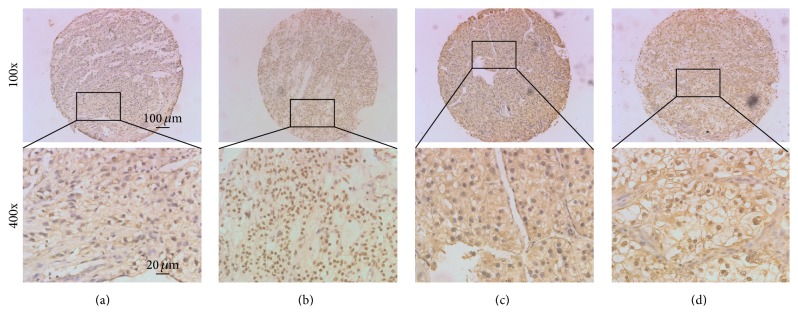
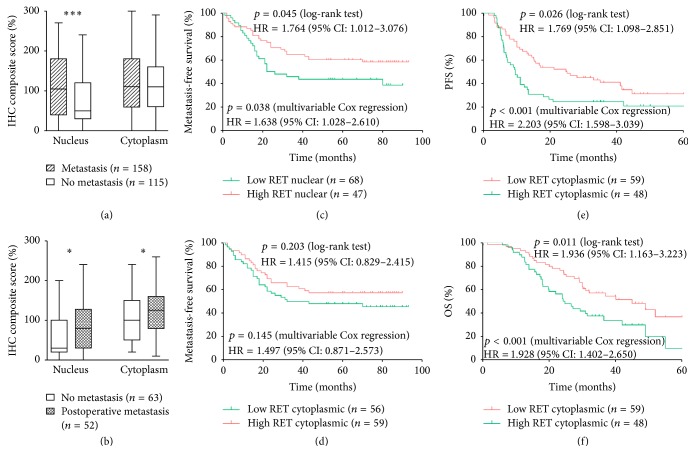
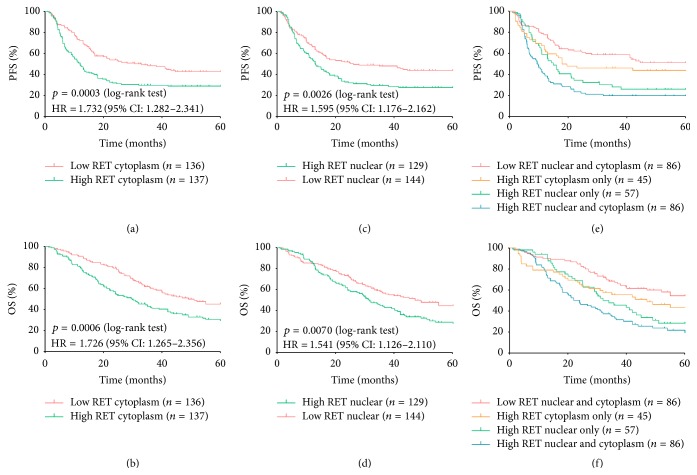
Metastatic renal cell carcinoma (RCC) presents a poor prognosis and an unpredictable course. To date, no validated biomarkers can predict the outcome of RCC. Ongoing efforts are conducted to identify the molecular markers of RCC progression, as well as the targets for novel therapeutic approaches. RET is a tyrosine kinase receptor which has been investigated as a possible target in other cancers because it is involved in oncogenic activation. To evaluate the predictive and prognostic functions of RET in ccRCC, a tissue microarray study was conducted on 273 ccRCC patients. Results showed that both RET cytoplasmic and nuclear expression were independently associated with PFS and OS, and the combined RET cytoplasmic and nuclear statuses demonstrated that the ratio of high nuclear RET and cytoplasmic RET was the strongest predictor of both PFS and OS. The high cytoplasmic RET expression retained its independent poor prognostic value in targeted drug treated patients. The RET nuclear expression was associated with distant metastasis. Moreover, the RET nuclear expression was an independent predictor of ccRCC postoperative metastasis. In conclusion, RET may be useful in prognostication and can be used at initial diagnosis to identify patients with high potential to develop metastasis.
转移性肾细胞癌(RCC)预后较差且病程难以预测。迄今为止,尚无经过验证的生物标志物能够预测RCC的预后。目前正在努力寻找RCC进展的分子标志物以及新型治疗方法的靶点。RET是一种酪氨酸激酶受体,因其参与致癌激活,已被研究作为其他癌症的潜在靶点。为了评估RET在透明细胞肾细胞癌(ccRCC)中的预测和预后功能,对273例ccRCC患者进行了组织芯片研究。结果显示,RET的胞质和核表达均与无进展生存期(PFS)和总生存期(OS)独立相关,并且RET胞质和核状态的联合分析表明,高核RET与胞质RET的比例是PFS和OS最强的预测指标。在接受靶向药物治疗的患者中,高胞质RET表达仍保留其独立的不良预后价值。RET核表达与远处转移相关。此外,RET核表达是ccRCC术后转移的独立预测指标。总之,RET可能有助于预后评估,并可在初诊时用于识别具有高转移潜能的患者。