Terzi Yunus Kasım, Bulakbaşı Balcı Tuğçe, Boğa Can, Koç Zafer, Yılmaz Çelik Zerrin, Özdoğu Hakan, Karakuş Sema, Şahin Feride İffet
Başkent University Faculty of Medicine, Department of Medical Genetics, Ankara, Turkey, Phone: +90 312 232 44 00, E-mail:
Turk J Haematol. 2016 Dec 1;33(4):320-325. doi: 10.4274/tjh.2015.0254. Epub 2016 Apr 18.
Hemochromatosis is an autosomal recessive disease that is one of the most important reasons for iron overload. Sickle cell disease is a hemoglobinopathy that occurs as a result of a homozygous mutation in the hemoglobin gene. Erythrocyte transfusion is frequently used in the treatment of this disease. Iron overload as a result of transfusion is important in the mortality and morbidity of sickle cell anemia patients as well as in other hemoglobinopathies. In this study, the effect of hemochromatosis gene (HFE) p.H63D and p.C282Y mutations on transfusion-related cardiac and liver iron overload in sickle cell disease patients who carry homozygous hemoglobin S mutation has been investigated.
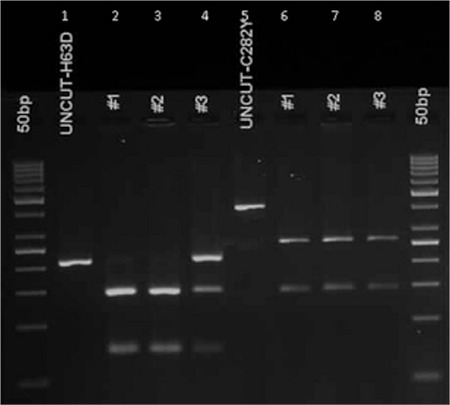
This is a prospective single-center cross-sectional study in patients with homozygous hemoglobin S mutation between the years 2008 and 2013. The patients were divided into two groups. The first group (group A, n=31) was receiving chelation therapy and the second group (group B, n=13) was not. Direct and indirect iron loads were analyzed by magnetic resonance imaging and biochemically, respectively. HFE gene mutations were analyzed by polymerase chain reaction-restriction fragment length polymorphism method. Statistical analyses were performed by independent samples t-test.
p.H63D mutation was detected in 10 (32.3%) patients in group A and in only 1 patient (7.7%) in group B. When the 2 groups were compared for iron overload, iron deposition in the liver was significantly higher in group B (p=0.046). In addition, in group A, iron deposition was significantly higher in HFE mutation carriers compared to patients without the mutation (p=0.05).
Results of this study showed that HFE gene mutations are important in iron deposition in the liver in patients with sickle cell disease.
血色素沉着症是一种常染色体隐性疾病,是铁过载的最重要原因之一。镰状细胞病是一种血红蛋白病,由血红蛋白基因的纯合突变引起。红细胞输血常用于治疗该疾病。输血导致的铁过载对镰状细胞贫血患者以及其他血红蛋白病的死亡率和发病率都很重要。在本研究中,调查了血色素沉着症基因(HFE)p.H63D和p.C282Y突变对携带纯合血红蛋白S突变的镰状细胞病患者输血相关的心脏和肝脏铁过载的影响。
这是一项针对2008年至2013年间携带纯合血红蛋白S突变患者的前瞻性单中心横断面研究。患者分为两组。第一组(A组,n = 31)接受螯合疗法,第二组(B组,n = 13)未接受。分别通过磁共振成像和生化方法分析直接和间接铁负荷。通过聚合酶链反应-限制性片段长度多态性方法分析HFE基因突变。采用独立样本t检验进行统计分析。
A组10例(32.3%)患者检测到p.H63D突变,B组仅1例(7.7%)检测到该突变。比较两组的铁过载情况时,B组肝脏中的铁沉积显著更高(p = 0.046)。此外,在A组中,HFE基因突变携带者的铁沉积显著高于未发生突变的患者(p = 0.05)。
本研究结果表明,HFE基因突变对镰状细胞病患者肝脏中的铁沉积具有重要影响。