van der Woude J A D, Wiegant K, van Heerwaarden R J, Spruijt S, van Roermund P M, Custers R J H, Mastbergen S C, Lafeber F P J G
Limb and Knee Reconstruction Unit, Department of Orthopedic Surgery, Maartenskliniek Woerden, Woerden, The Netherlands.
Rheumatology and Clinical Immunology, University Medical Center Utrecht, F02.217, PO Box 85500, 3508 GA, Utrecht, The Netherlands.
Knee Surg Sports Traumatol Arthrosc. 2017 Mar;25(3):876-886. doi: 10.1007/s00167-016-4131-0. Epub 2016 Apr 22.
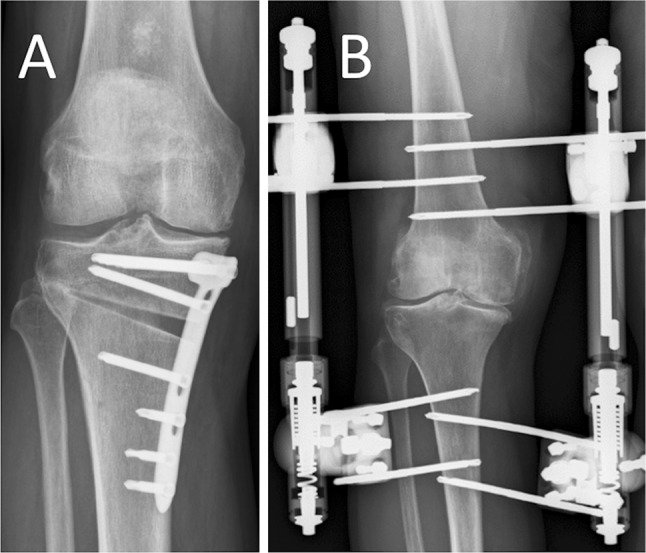
Both, knee joint distraction as a relatively new approach and valgus-producing opening-wedge high tibial osteotomy (HTO), are knee-preserving treatments for knee osteoarthritis (OA). The efficacy of knee joint distraction compared to HTO has not been reported.
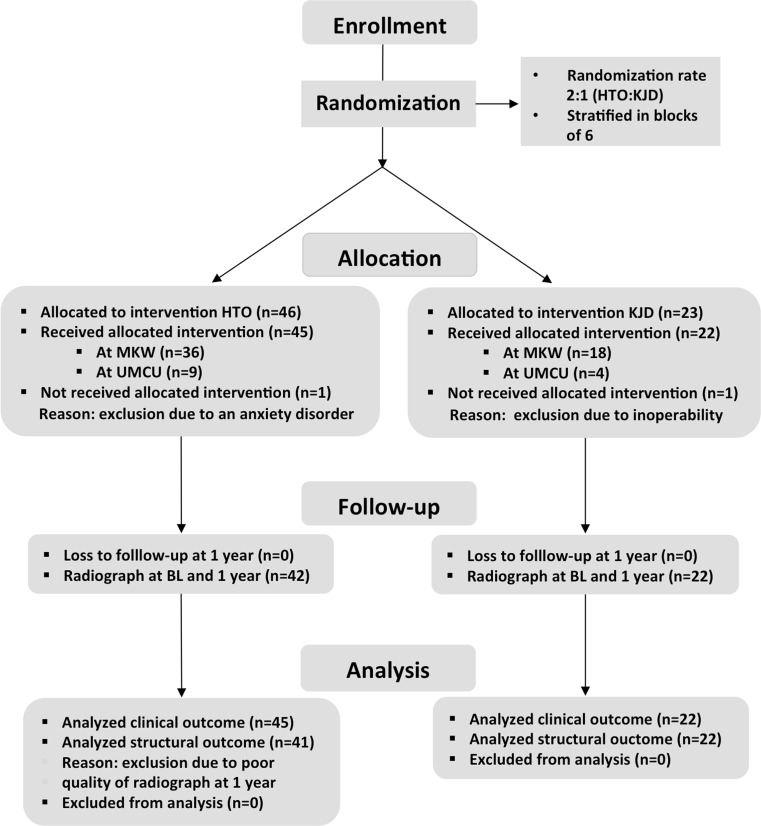
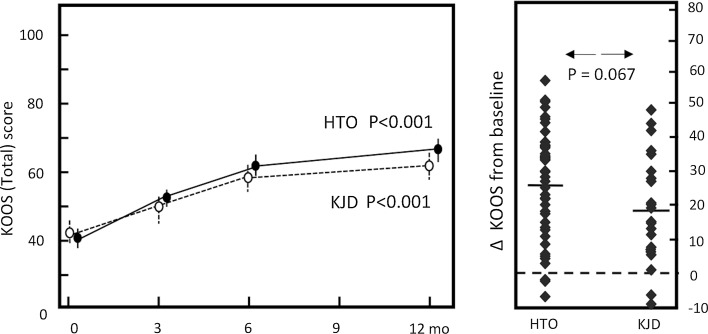
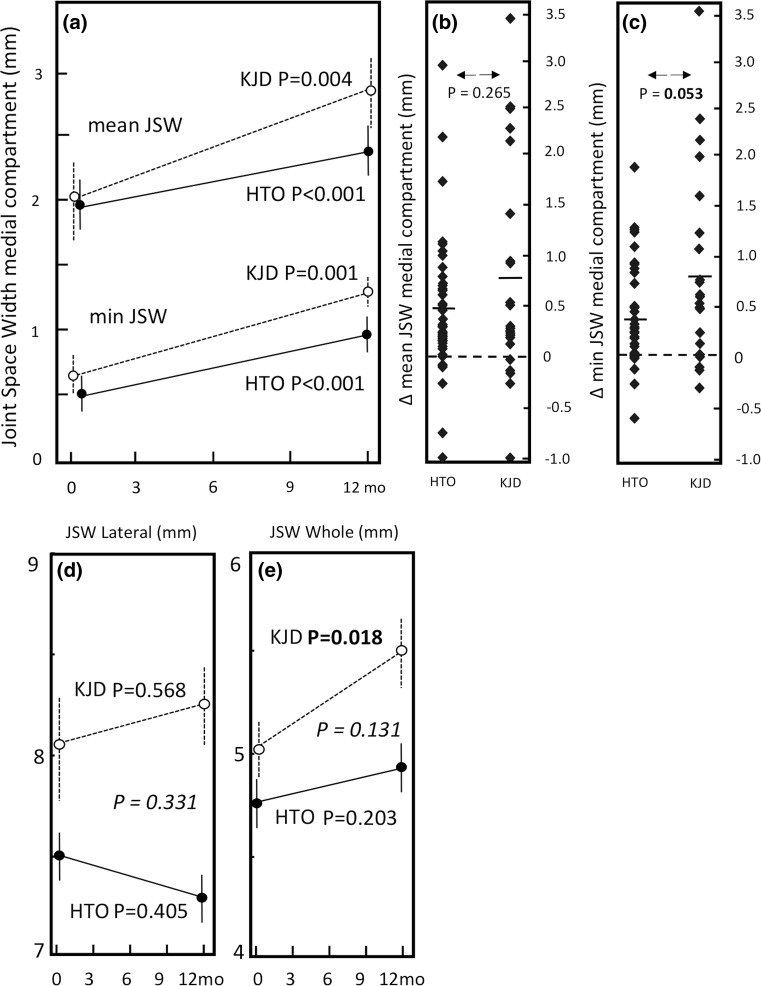
Sixty-nine patients with medial knee joint OA with a varus axis deviation of <10° were randomized to either knee joint distraction (n = 23) or HTO (n = 46). Questionnaires were assessed at baseline and 3, 6, and 12 months. Joint space width (JSW) as a surrogate measure for cartilage thickness was determined on standardized semi-flexed radiographs at baseline and 1-year follow-up.
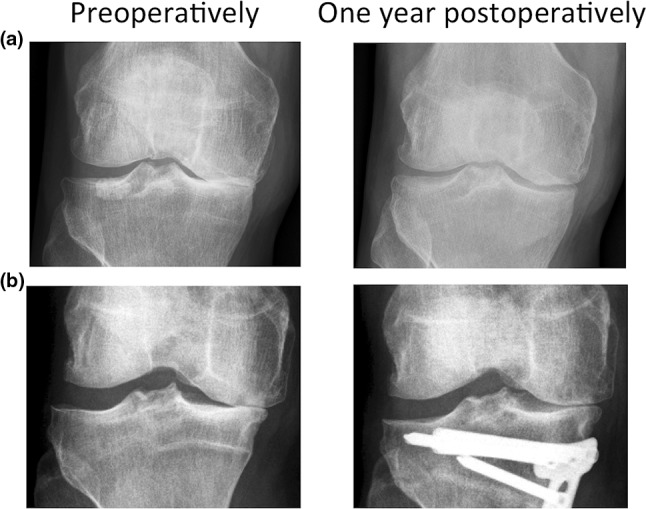
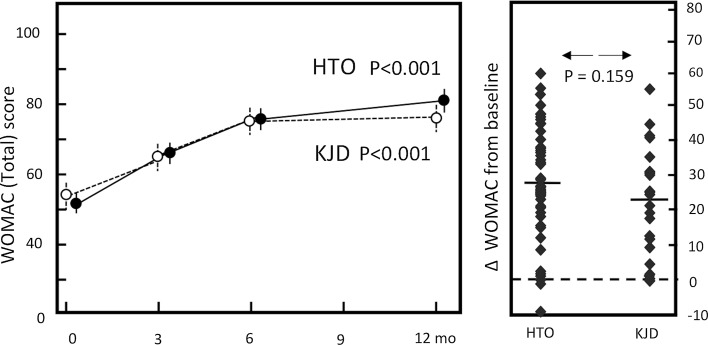
All patient-reported outcome measures (PROMS) improved significantly over 1 year (at 1 year p < 0.02) in both groups. At 1 year, the HTO group showed slightly greater improvement in 4 of the 16 PROMS (p < 0.05). The minimum medial compartment JSW increased 0.8 ± 1.0 mm in the knee joint distraction group (p = 0.001) and 0.4 ± 0.5 mm in the HTO group (p < 0.001), with minimum JSW improvement in favour of knee joint distraction (p = 0.05). The lateral compartment showed a small increase in the knee joint distraction group and a small decrease in the HTO group, leading to a significant increase in mean JSW for knee joint distraction only (p < 0.02).
Cartilaginous repair activity, as indicated by JSW, and clinical outcome improvement occurred with both, knee joint distraction and HTO. These findings suggest that knee joint distraction may be an alternative therapy for medial compartmental OA with a limited mechanical leg malalignment.
Randomized controlled trial, Level I.
膝关节牵张作为一种相对较新的方法和外翻楔形高位胫骨截骨术(HTO),都是用于治疗膝关节骨关节炎(OA)的保膝治疗方法。与HTO相比,膝关节牵张的疗效尚未见报道。
69例膝关节内侧OA且内翻畸形小于10°的患者被随机分为膝关节牵张组(n = 23)或HTO组(n = 46)。在基线、3个月、6个月和12个月时对问卷进行评估。在基线和1年随访时,通过标准化半屈曲位X线片测定关节间隙宽度(JSW)作为软骨厚度的替代指标。
两组患者所有的患者报告结局指标(PROMS)在1年中均有显著改善(1年时p < 0.02)。1年时,HTO组在16项PROMS中的4项改善略大(p < 0.05)。膝关节牵张组最小内侧间室JSW增加0.8±1.0 mm(p = 0.001),HTO组增加0.4±0.5 mm(p < 0.001),最小JSW改善更有利于膝关节牵张(p = 0.05)。外侧间室在膝关节牵张组有小幅增加,在HTO组有小幅减少,仅膝关节牵张组平均JSW有显著增加(p < 0.02)。
JSW所显示的软骨修复活动以及临床结局改善在膝关节牵张和HTO治疗中均有发生。这些发现表明,膝关节牵张可能是治疗机械性下肢对线不良有限的内侧间室OA的一种替代疗法。
随机对照试验,I级。