Sloan Jeff A, Cheville Andrea L, Liu Heshan, Novotny Paul J, Wampfler Jason A, Garces Yolanda I, Clark Matthew M, Yang Ping
Department of Health Sciences Research, 200 First St SW, Rochester, MN, 55905, USA.
Department of Physical Medicine and Rehabilitation, Rochester, USA.
Health Qual Life Outcomes. 2016 Apr 29;14:66. doi: 10.1186/s12955-016-0461-3.
There is some initial evidence that an enhanced physical activity level can improve fquality of life, and possibly survival among patients with lung cancer. The primary aim of this project was to evaluate the impact of physical activity on the quality and quantity of life of lung cancer survivors.
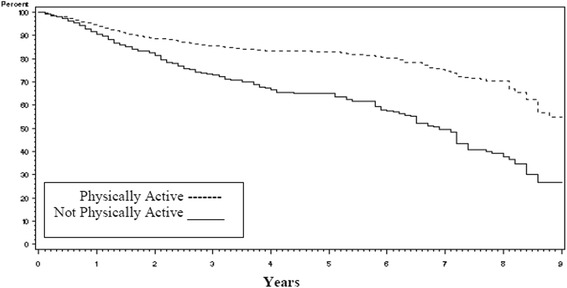
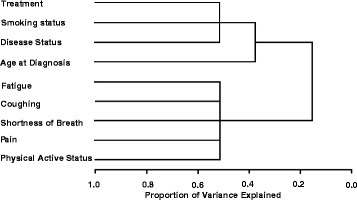
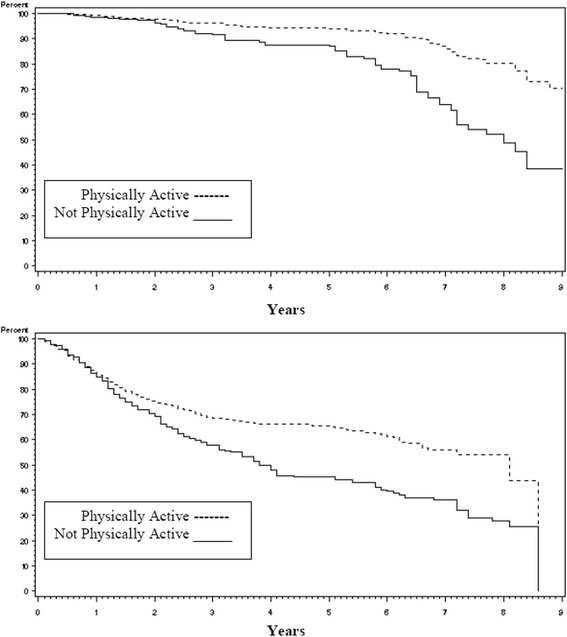
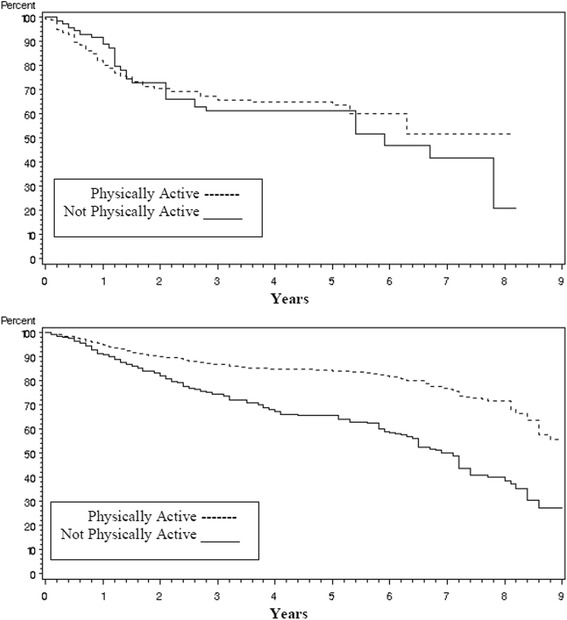
Between January 1, 1997, and December 31, 2009, a total of 1466 lung cancer survivors completed a questionnaire with patient-reported outcomes for quality of life (QOL), demographics, disease and clinical characteristics, and a measure of physical activity (Baecke Questionnaire). Chi-square tests compared lung cancer survivors who reported being physically active versus not on a variety of the other covariates. Kaplan-Meier estimates and Cox models evaluated the prognostic importance of physical activity level on Overall Survival (OS).
Roughly half of the lung cancer survivors had advanced stage disease at the time of survey. Treatment prevalence rates were 61, 54, and 33 % for surgery, chemotherapy and radiotherapy, respectively. The majority (77 %) of survivors reported themselves as physically active. Physically active survivors reported greater activity across all individual Baecke items. Lung cancer survivor-reported QOL indicated the benefits of physical activity in all domains. Survivors receiving chemotherapy or radiation at the time of questionnaire completion were less likely to be physically active (74 and 73 % respectively). In contrast, 84 % of surgical patients were physically active. Disease recurrence rates were the same for physically active and inactive patients (81 % vs 82 %, p = 0.62). Physically active patients survived an average of 4 more years than those who were not physically active (8.4 years versus 4.4 years respectively, log rank p < 0.0001).
Being physically active was related to profound advantages in QOL and survival in a large sample of lung cancer survivors.
有一些初步证据表明,提高身体活动水平可以改善肺癌患者的生活质量,并可能提高其生存率。本项目的主要目的是评估身体活动对肺癌幸存者生活质量和寿命的影响。
在1997年1月1日至2009年12月31日期间,共有1466名肺癌幸存者完成了一份问卷,其中包括患者报告的生活质量(QOL)、人口统计学、疾病和临床特征以及身体活动量度(贝克问卷)。卡方检验比较了报告有身体活动和没有身体活动的肺癌幸存者在各种其他协变量方面的情况。Kaplan-Meier估计和Cox模型评估了身体活动水平对总生存期(OS)的预后重要性。
在调查时,大约一半的肺癌幸存者患有晚期疾病。手术、化疗和放疗的治疗患病率分别为61%、54%和33%。大多数(77%)幸存者报告自己有身体活动。有身体活动的幸存者在贝克问卷的所有单项上报告的活动量更大。肺癌幸存者报告的生活质量表明身体活动在所有领域都有好处。在完成问卷时接受化疗或放疗的幸存者身体活动的可能性较小(分别为74%和73%)。相比之下,84%的手术患者有身体活动。有身体活动和没有身体活动的患者疾病复发率相同(81%对82%,p = 0.62)。有身体活动的患者比没有身体活动的患者平均多活4年(分别为8.四年和4.4年,对数秩检验p < 0.0001)。
在大量肺癌幸存者样本中,身体活动与生活质量和生存率的显著优势相关。