Baranzoni Gian Marco, Fratamico Pina M, Gangiredla Jayanthi, Patel Isha, Bagi Lori K, Delannoy Sabine, Fach Patrick, Boccia Federica, Anastasio Aniello, Pepe Tiziana
Eastern Regional Research Center, United States Department of Agriculture - Agricultural Research Service Wyndmoor, PA, USA.
Center of Food Safety and Applied Nutrition, U.S. Food and Drug Administration Laurel, MD, USA.
Front Microbiol. 2016 Apr 21;7:574. doi: 10.3389/fmicb.2016.00574. eCollection 2016.
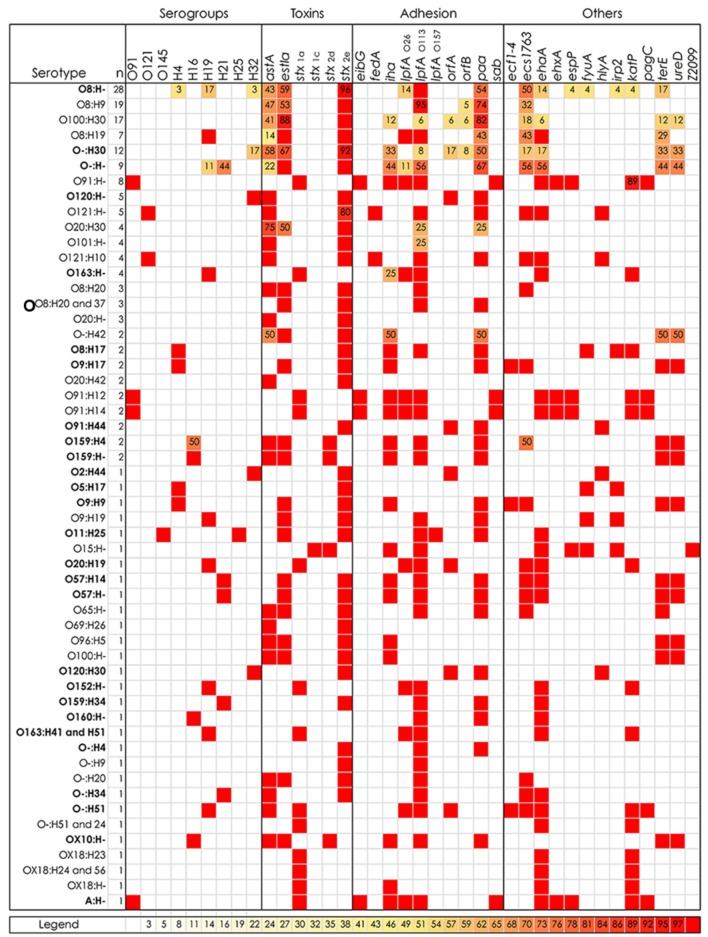
Similar to ruminants, swine have been shown to be a reservoir for Shiga toxin-producing Escherichia coli (STEC), and pork products have been linked with outbreaks associated with STEC O157 and O111:H-. STEC strains, isolated in a previous study from fecal samples of late-finisher pigs, belonged to a total of 56 serotypes, including O15:H27, O91:H14, and other serogroups previously associated with human illness. The isolates were tested by polymerase chain reaction (PCR) and a high-throughput real-time PCR system to determine the Shiga toxin (Stx) subtype and virulence-associated and putative virulence-associated genes they carried. Select STEC strains were further analyzed using a Minimal Signature E. coli Array Strip. As expected, stx 2e (81%) was the most common Stx variant, followed by stx 1a (14%), stx 2d (3%), and stx 1c (1%). The STEC serogroups that carried stx 2d were O15:H27, O159:H16 and O159:H-. Similar to stx 2a and stx 2c, the stx 2d variant is associated with development of hemorrhagic colitis and hemolytic uremic syndrome, and reports on the presence of this variant in STEC strains isolated from swine are lacking. Moreover, the genes encoding heat stable toxin (estIa) and enteroaggregative E. coli heat stable enterotoxin-1 (astA) were commonly found in 50 and 44% of isolates, respectively. The hemolysin genes, hlyA and ehxA, were both detected in 7% of the swine STEC strains. Although the eae gene was not found, other genes involved in host cell adhesion, including lpfAO113 and paa were detected in more than 50% of swine STEC strains, and a number of strains also carried iha, lpfAO26, lpfAO157, fedA, orfA, and orfB. The present work provides new insights on the distribution of virulence factors among swine STEC strains and shows that swine may carry Stx1a-, Stx2e-, or Stx2d-producing E. coli with virulence gene profiles associated with human infections.
与反刍动物类似,猪已被证明是产志贺毒素大肠杆菌(STEC)的宿主,猪肉产品与STEC O157和O111:H-相关的疫情有关。在之前的一项研究中,从育肥后期猪的粪便样本中分离出的STEC菌株共有56种血清型,包括O15:H27、O91:H14以及其他先前与人类疾病相关的血清群。通过聚合酶链反应(PCR)和高通量实时PCR系统对分离株进行检测,以确定它们携带的志贺毒素(Stx)亚型以及与毒力相关和假定的毒力相关基因。使用最小特征大肠杆菌阵列条带对选定的STEC菌株进行进一步分析。正如预期的那样,stx 2e(81%)是最常见的Stx变体,其次是stx 1a(14%)、stx 2d(3%)和stx 1c(1%)。携带stx 2d的STEC血清群为O15:H27、O159:H16和O159:H-。与stx 2a和stx 2c类似,stx 2d变体与出血性结肠炎和溶血尿毒综合征的发生有关,而关于从猪中分离出的STEC菌株中存在该变体的报道较少。此外,编码热稳定毒素(estIa)和肠集聚性大肠杆菌热稳定肠毒素-1(astA)的基因分别在50%和44%的分离株中常见。溶血素基因hlyA和ehxA在7%的猪STEC菌株中均被检测到。虽然未发现eae基因,但在超过50%的猪STEC菌株中检测到了其他参与宿主细胞粘附的基因,包括lpfAO113和paa,并且许多菌株还携带iha、lpfAO26、lpfAO157、fedA、orfA和orfB。本研究为猪源STEC菌株中毒力因子的分布提供了新的见解,并表明猪可能携带产Stx1a、Stx2e或Stx2d的大肠杆菌,其毒力基因谱与人类感染相关。