Becker Svetlana, Florian Anca, Patrascu Alexandru, Rösch Sabine, Waltenberger Johannes, Sechtem Udo, Schwab Matthias, Schaeffeler Elke, Yilmaz Ali
Dr. Margarete Fischer-Bosch Institute of Clinical Pharmacology, Stuttgart, Germany.
Department of Cardiovascular Medicine, University Hospital Münster, Albert-Schweitzer-Campus 1, building A1, 48149, Münster, Germany.
J Cardiovasc Magn Reson. 2016 May 6;18(1):25. doi: 10.1186/s12968-016-0244-3.
Duchenne and Becker muscular dystrophy (DMD and BMD) are X-chromosomal recessive neuromuscular disorders that are caused by mutations in the dystrophin gene and characterized by cardiac involvement. Circulating microRNAs (miRNAs) have been proposed as diagnostic biomarkers for various cardiovascular diseases. However, circulating miRNAs reflecting the presence and/or disease severity of cardiac involvement in DMD/BMD patients have not been described so far.
Sixty-three male patients with known MD and 26 age-matched healthy male controls were prospectively enrolled. All MD patients and controls underwent comprehensive cardiovascular magnetic resonance (CMR) studies as well as venous blood sampling on the same day.
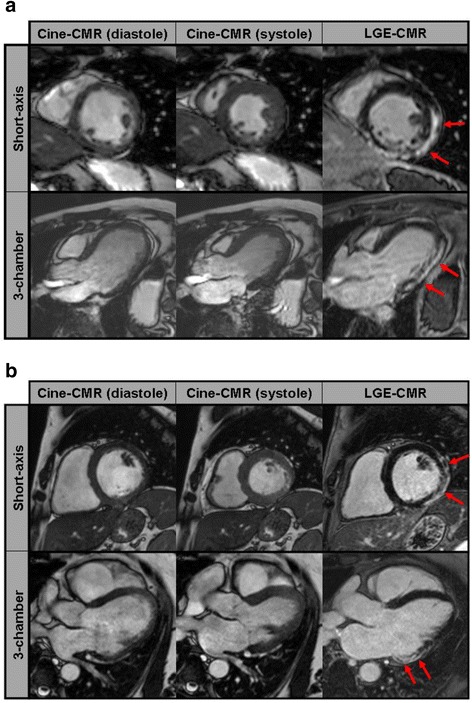
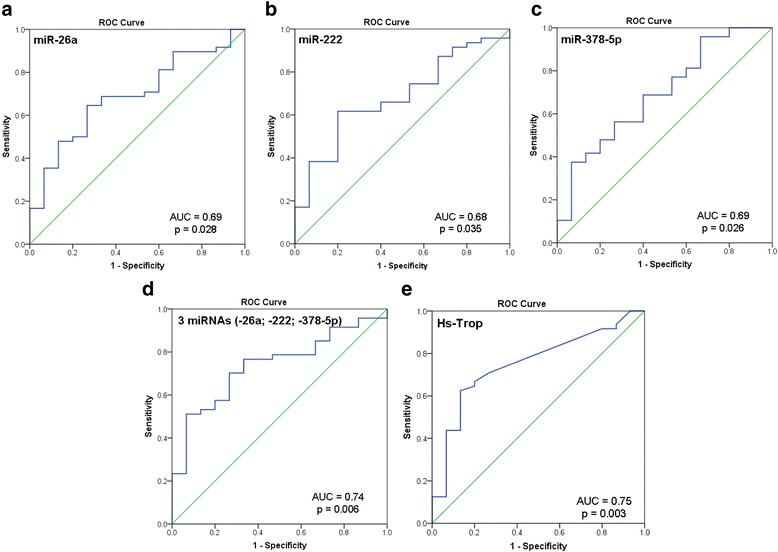
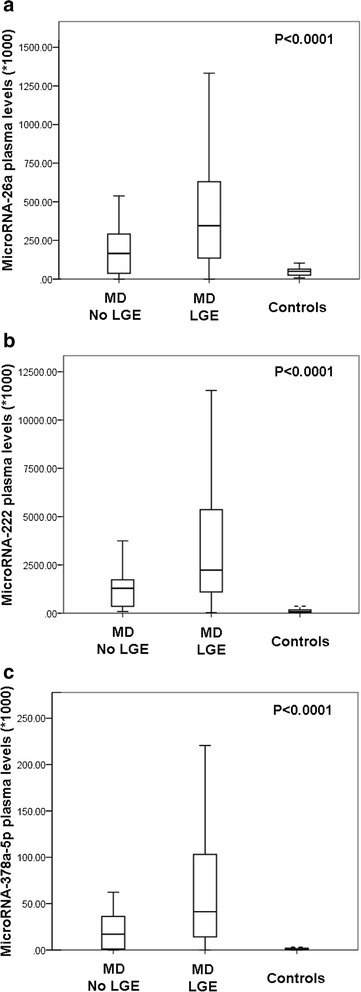
An impaired left ventricular (LV) systolic function (defined as LV-EF <55 %) was detected in 29 (46 %) and presence of late gadolinium enhancement (LGE) indicative of myocardial fibrosis in 48 (76 %) MD patients with an exclusively non-ischemic pattern. Whereas no significant differences were observed for the 27 selected circulating miRNAs in MD patients with abnormal CMR findings (comprising structural and/or functional impairments) compared to those with completely normal CMR studies, a significant up-regulation of three miRNAs was observed in LGE-positive MD patients compared to LGE-negative ones: miR-222 (1.8-fold, p = 0.035), miR-26a (2.1-fold, p = 0.03) and miR-378a-5p (2.4-fold, p = 0.026). A signature of these three miRNAs (miR-26a, miR-222 and miR-378a-5p) resulted in an area under the curve (AUC) value of 0.74 for the diagnosis of LGE-positive MD patients. In a multivariable model, three independent predictors for LGE presence were identified comprising not only clinical and laboratory markers (LV-EF: OR 0.47, 95 % CI 0.24-0.89, p = 0.021 and elevated hs-Trop: OR 2559, 95 % CI 2.97-22.0410(5), p = 0.023) but also the circulating miR-222 (OR 938, 95 % CI 938.46, 3.56-24.7310(4), p = 0.016).
Up-regulation of circulating miRNAs miR-222, miR-26a and miR-378a-5p indicates the presence of myocardial scars in MD patients. Plasma miR-222 appears to be a promising novel biomarker reflecting structural - but not functional - cardiac alterations in MD patients.
杜氏和贝克型肌营养不良症(DMD和BMD)是X染色体隐性神经肌肉疾病,由肌营养不良蛋白基因突变引起,其特征为心脏受累。循环微小RNA(miRNA)已被提议作为各种心血管疾病的诊断生物标志物。然而,迄今为止,尚未描述反映DMD/BMD患者心脏受累情况及/或疾病严重程度的循环miRNA。
前瞻性纳入63例已知患有肌营养不良症的男性患者和26例年龄匹配的健康男性对照。所有肌营养不良症患者和对照在同一天接受了全面的心血管磁共振(CMR)检查以及静脉血采样。
在29例(46%)患者中检测到左心室(LV)收缩功能受损(定义为LV-EF<55%),48例(76%)肌营养不良症患者存在晚期钆增强(LGE),提示心肌纤维化,且均为非缺血性模式。与CMR检查完全正常的肌营养不良症患者相比,CMR检查结果异常(包括结构和/或功能受损)的肌营养不良症患者中,27种选定的循环miRNA未观察到显著差异,但与LGE阴性的患者相比,LGE阳性的肌营养不良症患者中有三种miRNA显著上调:miR-222(1.8倍,p=0.035)、miR-26a(2.1倍,p=0.03)和miR-378a-5p(2.4倍,p=0.026)。这三种miRNA(miR-26a、miR-222和miR-378a-5p)的特征曲线下面积(AUC)值为0.74,用于诊断LGE阳性的肌营养不良症患者。在多变量模型中,确定了LGE存在的三个独立预测因素,不仅包括临床和实验室指标(LV-EF:OR 0.47,95%CI 0.24-0.89,p=0.021和hs-Trop升高:OR 2559,95%CI 2.97-22.04×10⁵,p=0.023),还包括循环miR-222(OR 938,95%CI 938.46,3.56-24.73×10⁴,p=0.016)。
循环miRNA miR-222、miR-26a和miR-378a-5p的上调表明肌营养不良症患者存在心肌瘢痕。血浆miR-222似乎是一种有前景的新型生物标志物,可反映肌营养不良症患者心脏的结构改变而非功能改变。