Cao Song, Xiao Zhi, Sun Mengjie, Li Youyan
Department of Pain Medicine, Affiliated Hospital of Zunyi Medical University, Zunyi, Guizhou, China Guizhou Key Laboratory of Anesthesia and Organ Protection, Zunyi Medical University, Zunyi, Guizhou, China.
Research Center for Medicine and Biology, Zunyi Medical University, Zunyi, Guizhou, China
Mol Pain. 2016 May 12;12. doi: 10.1177/1744806916646786. Print 2016.
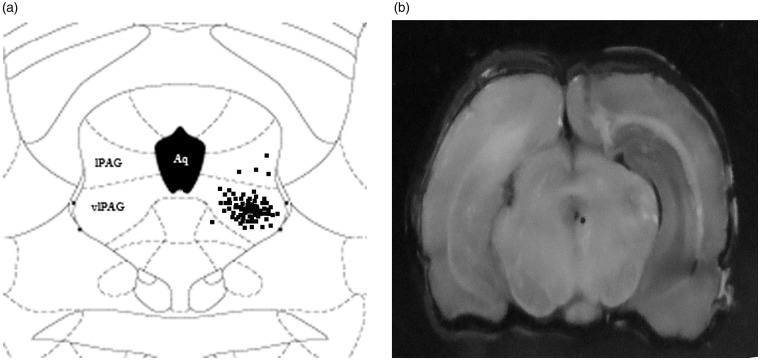
The N-methyl-D-aspartate subtype of glutamate receptor plays a critical role in morphine tolerance. D-serine, a co-agonist of N-methyl-D-aspartate receptor, participates in many physiological and pathophysiological processes via regulating N-methyl-D-aspartate receptor activation. The purinergic P2X7 receptor activation can induce the D-serine release in the central nervous system. This study aimed to investigate the role of the ventrolateral midbrain periaqueductal gray D-serine in the mechanism of morphine tolerance in rats. The development of morphine tolerance was induced in normal adult male Sprague-Dawley rats through subcutaneous injection of morphine (10 mg/kg). The analgesic effect of morphine (5 mg/kg, i.p.) was assessed by measuring mechanical withdrawal thresholds in rats with an electronic von Frey anesthesiometer. The D-serine concentration and serine racemase expression levels in the ventrolateral midbrain periaqueductal gray were evaluated through enzyme-linked immunosorbent assay and Western blot analysis, respectively. The effects of intra-ventrolateral midbrain periaqueductal gray injections of the D-serine degrading enzyme D-amino acid oxidase and antisense oligodeoxynucleotide targeting the P2X7 receptor on chronic morphine-treated rats were also explored.
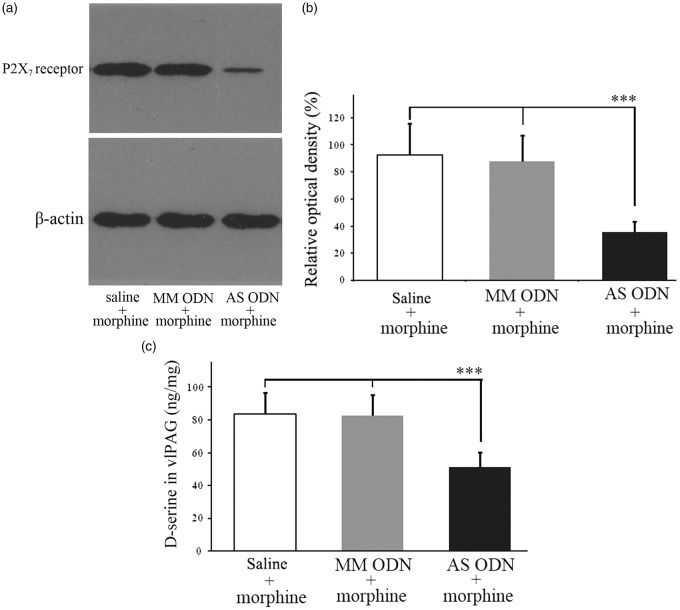
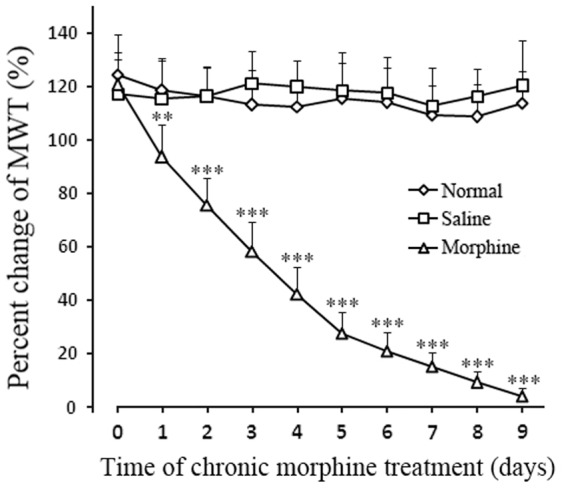
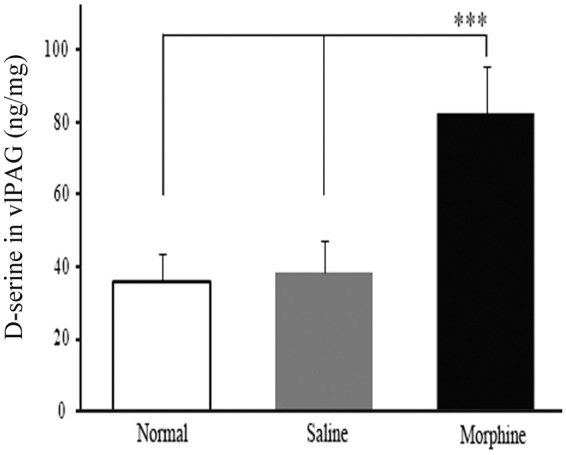
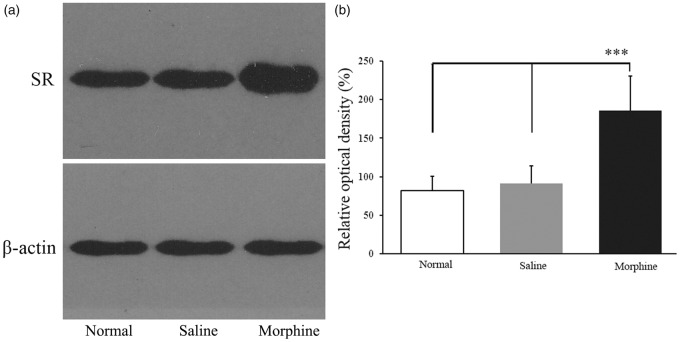
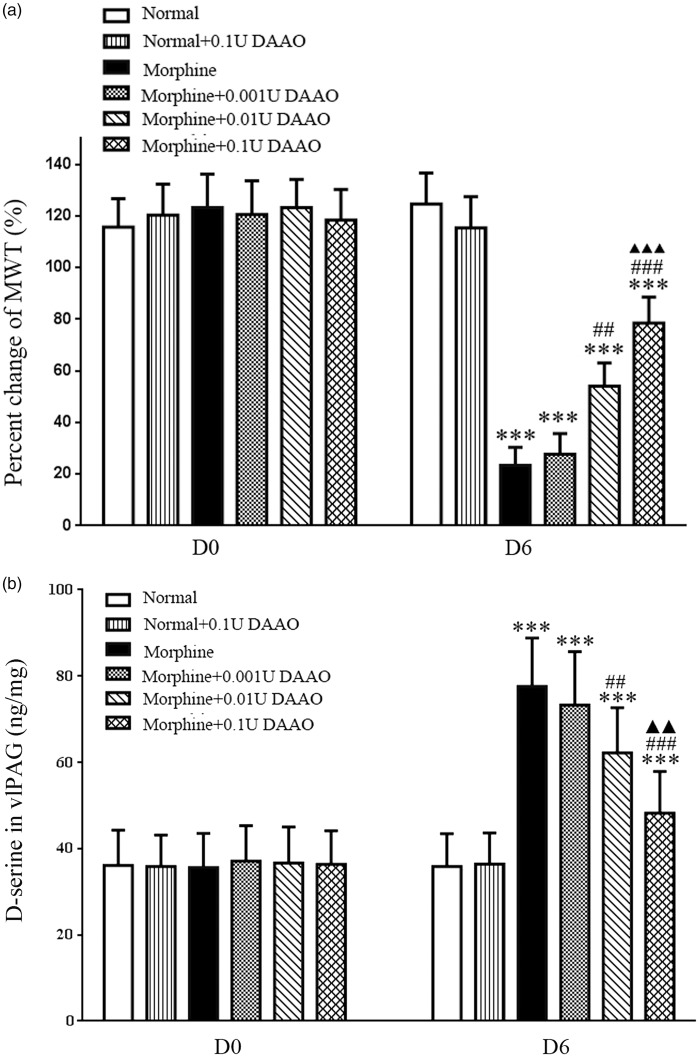
We found that repeated morphine administrations decreased the antinociceptive potency of morphine evidenced by the percent changes in mechanical pain threshold in rats. By contrast, the D-serine contents and the expression levels of the serine racemase protein were upregulated in the ventrolateral midbrain periaqueductal gray in morphine-tolerant rats. The development of morphine tolerance was markedly alleviated by intra-ventrolateral midbrain periaqueductal gray injections of D-amino acid oxidase or antisense oligodeoxynucleotide targeting the P2X7 receptor.
Our data indicate that the development of antinociceptive tolerance to morphine is partially mediated by ventrolateral midbrain periaqueductal gray D-serine content, and the activation of the ventrolateral midbrain periaqueductal gray P2X7 receptor is an essential prelude to D-serine release. These results suggest that a cascade involving P2X7 receptor-D-serine-N-methyl-D-aspartate receptor mediated signaling pathway in the supraspinal mechanism of morphine tolerance.
谷氨酸受体的N-甲基-D-天冬氨酸亚型在吗啡耐受性中起关键作用。D-丝氨酸作为N-甲基-D-天冬氨酸受体的协同激动剂,通过调节N-甲基-D-天冬氨酸受体的激活参与许多生理和病理生理过程。嘌呤能P2X7受体的激活可诱导中枢神经系统中D-丝氨酸的释放。本研究旨在探讨腹外侧中脑导水管周围灰质D-丝氨酸在大鼠吗啡耐受机制中的作用。通过皮下注射吗啡(10mg/kg)诱导正常成年雄性Sprague-Dawley大鼠产生吗啡耐受性。通过用电子von Frey麻醉计测量大鼠的机械撤针阈值来评估吗啡(5mg/kg,腹腔注射)的镇痛效果。分别通过酶联免疫吸附测定和蛋白质印迹分析评估腹外侧中脑导水管周围灰质中D-丝氨酸的浓度和丝氨酸消旋酶的表达水平。还探讨了向腹外侧中脑导水管周围灰质注射D-丝氨酸降解酶D-氨基酸氧化酶和靶向P2X7受体的反义寡脱氧核苷酸对慢性吗啡处理大鼠的影响。
我们发现,重复给予吗啡会降低吗啡的抗伤害感受效能,这可通过大鼠机械性疼痛阈值的百分比变化来证明。相比之下,吗啡耐受大鼠腹外侧中脑导水管周围灰质中的D-丝氨酸含量和丝氨酸消旋酶蛋白的表达水平上调。向腹外侧中脑导水管周围灰质注射D-氨基酸氧化酶或靶向P2X7受体的反义寡脱氧核苷酸可显著减轻吗啡耐受性的发展。
我们的数据表明,对吗啡抗伤害感受耐受性的发展部分是由腹外侧中脑导水管周围灰质D-丝氨酸含量介导的,腹外侧中脑导水管周围灰质P2X7受体的激活是D-丝氨酸释放的必要前奏。这些结果表明,在吗啡耐受的脊髓上机制中存在涉及P2X7受体-D-丝氨酸-N-甲基-D-天冬氨酸受体介导的信号通路的级联反应。