Gorges Tobias M, Stein Alexander, Quidde Julia, Hauch Siegfried, Röck Katharina, Riethdorf Sabine, Joosse Simon A, Pantel Klaus
Department of Tumor Biology, University Medical Center Hamburg-Eppendorf, Hamburg, Germany.
Department of Internal Medicine II and Clinic (Oncology Center), University Medical Center Hamburg-Eppendorf, Hamburg, Germany.
PLoS One. 2016 May 16;11(5):e0155126. doi: 10.1371/journal.pone.0155126. eCollection 2016.
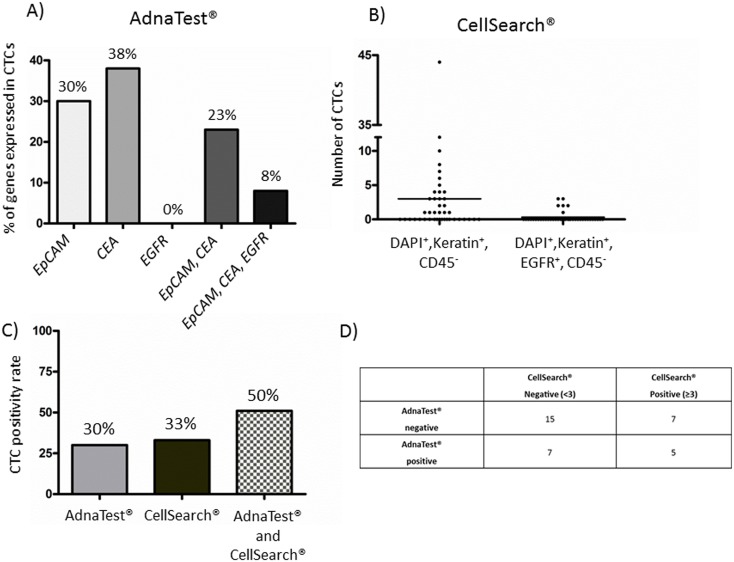
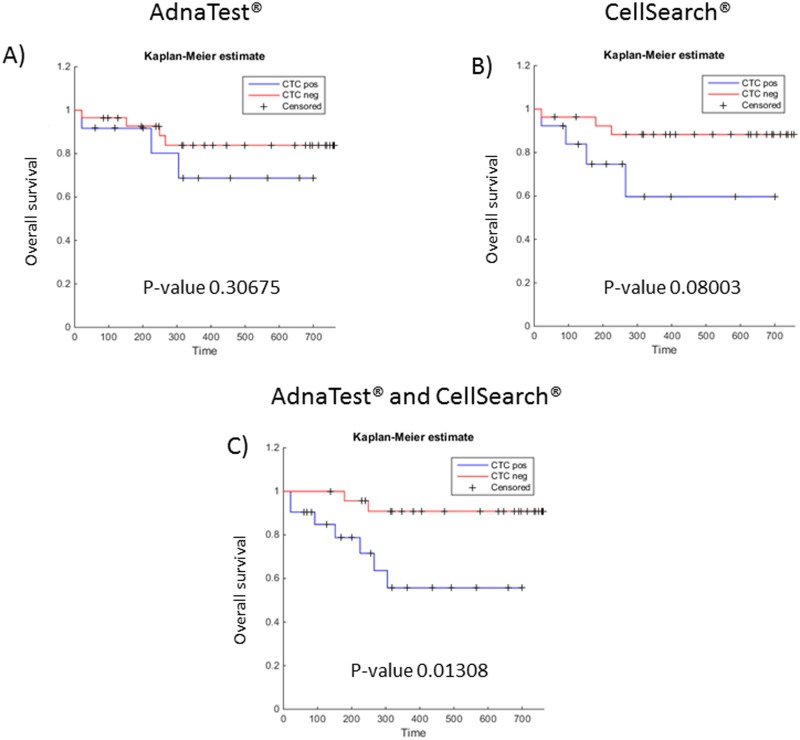
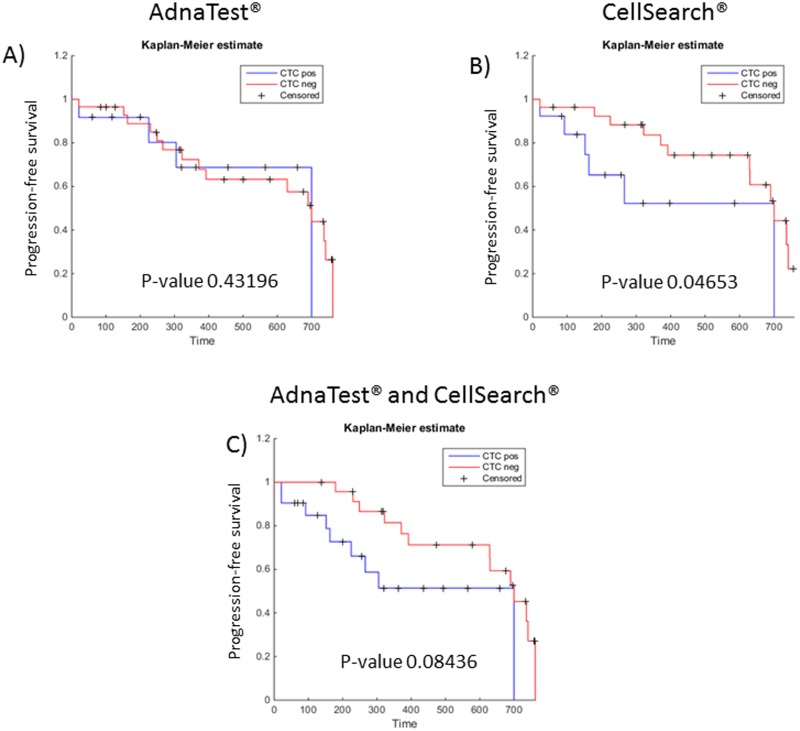
Colorectal cancer (CRC) is one of the major causes of cancer-related death and reliable blood-based prognostic biomarkers are urgently needed. The enumeration and molecular characterization of circulating tumor cells (CTCs) has gained increasing interest in clinical practice. CTC detection by CellSearch® has already been correlated to an unfavorable outcome in metastatic CRC. However, the CTC detection rate in mCRC disease is low compared to other tumor entities. Thus, the use of alternative (or supplementary) assays might help to itemize the prognostic use of CTCs as blood-based biomarkers. In this study, blood samples from 47 mCRC patients were screened for CTCs using the FDA-cleared CellSearch® technology and / or the AdnaTest®. 38 samples could be processed in parallel. We demonstrate that a combined analysis of CellSearch® and the AdnaTest® leads to an improved detection of CTCs in our mCRC patient cohort (positivity rate CellSearch® 33%, AdnaTest® 30%, combined 50%). While CTCs detected with the CellSearch® system were significantly associated with progression-free survival (p = 0.046), a significant correlation regarding overall survival could be only seen when both assays were combined (p = 0.013). These findings could help to establish improved tools to detect CTCs as on-treatment biomarkers for clinical routine in future studies.
结直肠癌(CRC)是癌症相关死亡的主要原因之一,因此迫切需要可靠的基于血液的预后生物标志物。循环肿瘤细胞(CTC)的计数和分子特征在临床实践中越来越受到关注。通过CellSearch®检测CTC已经与转移性CRC的不良预后相关。然而,与其他肿瘤实体相比,mCRC疾病中的CTC检测率较低。因此,使用替代(或补充)检测方法可能有助于将CTC作为基于血液的生物标志物进行预后评估。在本研究中,使用经美国食品药品监督管理局(FDA)批准的CellSearch®技术和/或AdnaTest®对47例mCRC患者的血样进行了CTC筛查。38个样本可以并行处理。我们证明,对CellSearch®和AdnaTest®进行联合分析可提高我们mCRC患者队列中CTC的检测率(CellSearch®阳性率33%,AdnaTest®阳性率30%,联合检测阳性率50%)。虽然通过CellSearch®系统检测到的CTC与无进展生存期显著相关(p = 0.046),但只有在两种检测方法联合使用时,才能观察到与总生存期的显著相关性(p = 0.013)。这些发现有助于建立更好的工具,以便在未来的研究中将检测CTC作为临床常规治疗中的生物标志物。