Evans T C, Nelson D L
Department of Biochemistry, College of Agricultural and Life Sciences, University of Wisconsin-Madison 53706.
Biochem J. 1989 Apr 15;259(2):385-96. doi: 10.1042/bj2590385.
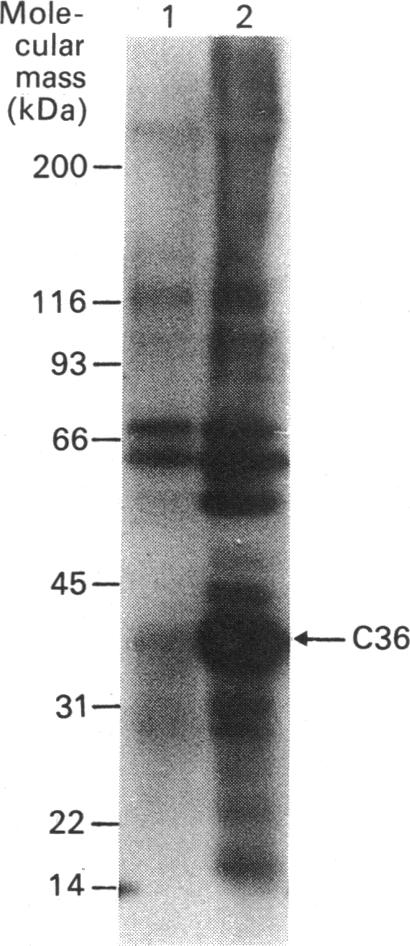
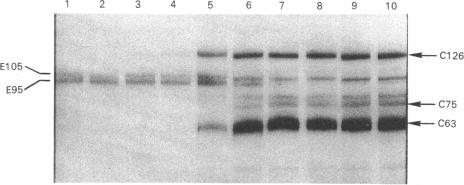
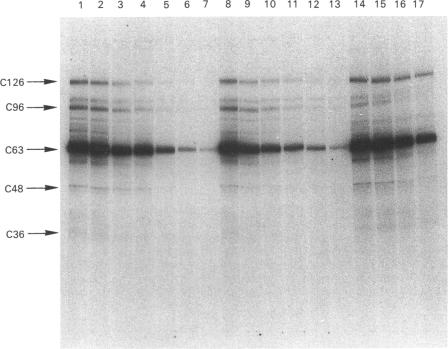
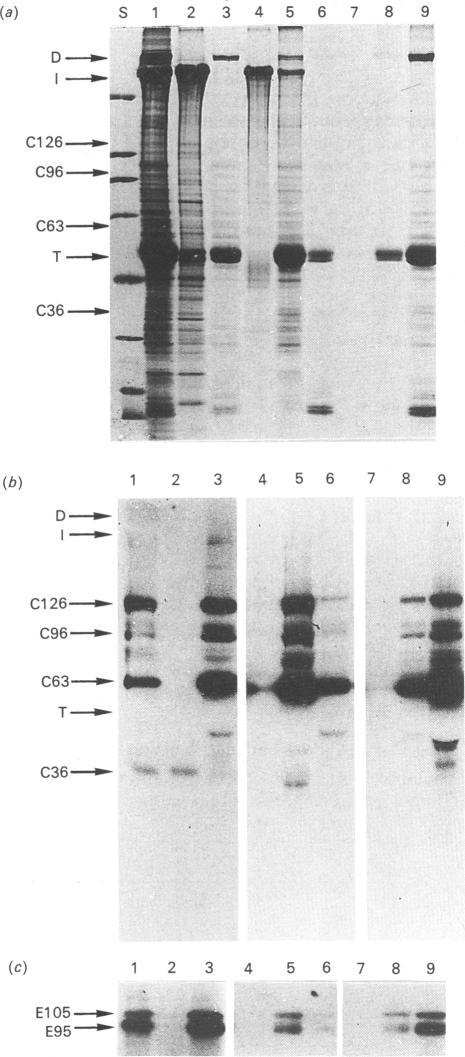
To identify protein targets for calmodulin (CaM) in the cilia of Paramecium tetraurelia, we employed a 125I-CaM blot assay after resolution of ciliary proteins on SDS/polyacrylamide gels. Two distinct types of CaM-binding proteins were detected. One group bound 125I-CaM at free Ca2+ concentrations above 0.5-1 microM and included a major binding activity of 63 kDa (C63) and activities of 126 kDa (C126), 96 kDa (C96), and 36 kDa (C36). CaM bound these proteins with high (nanomolar) affinity and specificity relative to related Ca2+ receptors. The second type of protein bound 125I-CaM only when the free Ca2+ concentration was below 1-2 microM and included polypeptides of 95 kDa (E95) and 105 kDa (E105). E105 may also contain Ca2+-dependent binding sites for CaM. Both E95 and E105 exhibited strong specificity for Paramecium CaM over bovine CaM. Ciliary subfractionation experiments suggested that C63, C126, C96, E95, and E105 are bound to the axoneme, whereas C36 is a soluble and/or membrane-associated protein. Additional Ca2+-dependent CaM-binding proteins of 63, 70, and 120 kDa were found associated with ciliary membrane vesicles. In support of these results, filtration binding assays also indicated high-affinity binding sites for CaM on isolated intact axonemes and suggested the presence of both Ca2+-dependent and Ca2+-inhibitable targets. Like E95 and E105, the Ca2+-inhibitable CaM-binding sites showed strong preference for Paramecium CaM over vertebrate CaM and troponin C. Together, these results suggest that CaM has multiple targets in the cilium and hence may regulate ciliary motility in a complex and pleiotropic fashion.
为了鉴定四膜虫纤毛中钙调蛋白(CaM)的蛋白质靶点,我们在SDS/聚丙烯酰胺凝胶上分离纤毛蛋白后,采用了¹²⁵I-CaM印迹分析。检测到两种不同类型的CaM结合蛋白。一组在游离Ca²⁺浓度高于0.5 - 1微摩尔时结合¹²⁵I-CaM,包括一种主要的63 kDa结合活性(C63)以及126 kDa(C126)、96 kDa(C96)和36 kDa(C36)的活性。相对于相关的Ca²⁺受体,CaM以高(纳摩尔)亲和力和特异性结合这些蛋白。第二类蛋白仅在游离Ca²⁺浓度低于1 - 2微摩尔时结合¹²⁵I-CaM,包括95 kDa(E95)和105 kDa(E105)的多肽。E105可能也含有CaM的Ca²⁺依赖性结合位点。E95和E105对四膜虫CaM的特异性均强于牛CaM。纤毛亚分级实验表明,C63、C126、C96、E95和E105与轴丝结合,而C36是一种可溶性和/或膜相关蛋白。还发现另外63 kDa、70 kDa和120 kDa的Ca²⁺依赖性CaM结合蛋白与纤毛膜囊泡相关。为支持这些结果,过滤结合分析也表明在分离的完整轴丝上存在CaM的高亲和力结合位点,并提示存在Ca²⁺依赖性和Ca²⁺抑制性靶点。与E95和E105一样,Ca²⁺抑制性CaM结合位点对四膜虫CaM的偏好性强于脊椎动物CaM和肌钙蛋白C。总之,这些结果表明CaM在纤毛中有多个靶点,因此可能以复杂且多效的方式调节纤毛运动。